225 posters, 34 videos, 18 topics, 14 sessions, 251 authors, 55 institutions
ePostersLive by SciGen Technologies S.A. All rights reserved.
ISMICS 2024 Annual Meeting
29 May - 1 June, 2024 | Athens, Greece

PC.100
Simultaneous Interventional Aortic And Mitral Valve Replacement In Degenerated Bioprostheses Or Mitral Annular Calcification
Poster Presenter
Authors
Part of Topic
Transcatheter Valve and Bailout Therapies
Video
Combining TAVR and TMVR:
Simultaneous Interventional Aortic And Mitral Valve Replacement
In Degenerated Bioprostheses Or Mitral AnnularCalcification
Nina Feirer1,2, Nora Zahlmann1,2, KetiVitanova1,2,3, Markus Krane1,2,3,4, Hendrik Ruge1,2,3
1 German Heart Center Munich, Department of Cardiovascular Surgery, Technical University Munich, Germany; 2 Institute for Translational Cardiac Surgery (INSURE), German Heart Center Munich, Technical University Munich, Germany; 3 DZHK (German Center for Cardiovascular Research), Partner Site Munich Heart Alliance, Munich, Germany; 4 Yale School of Medicine, Division of Cardiac Surgery, Department of Surgery, New Haven, USA.
Objectives
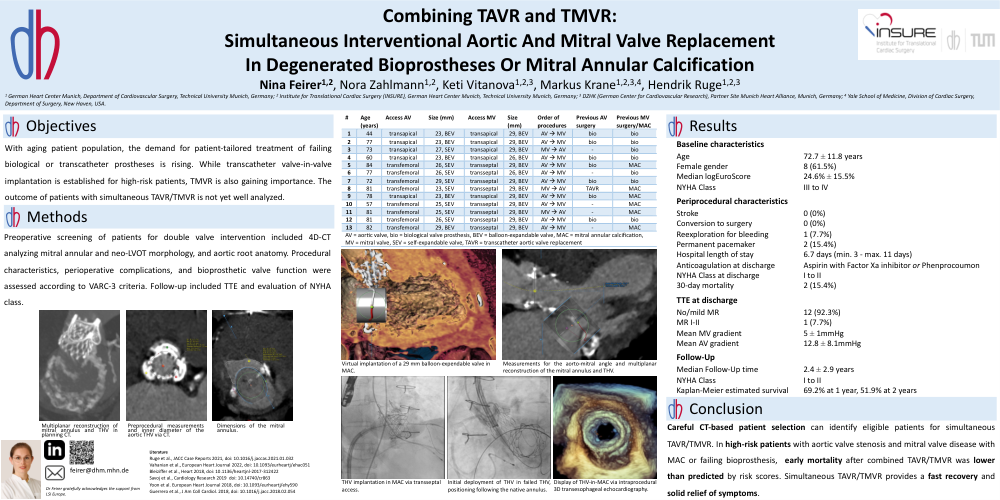
With aging patient population, the demand for patient-tailored treatment of failing biological or transcatheter prostheses is rising. While transcatheter valve-in-valve implantation is established for high-risk patients, TMVR is also gaining importance. The outcome of patients with simultaneous TAVR/TMVR is not yet well analyzed.
Methods
Preoperative screening of patients for double valve intervention included 4D-CT analyzing mitral annular and neo-LVOT morphology, and aortic root anatomy. Procedural characteristics, perioperative complications, and bioprosthetic valve function were assessed according to VARC-3 criteria. Follow-up included TTE and evaluation of NYHA class.
Results
Baseline characteristics
Age 72.7 ± 11.8 years
Female gender 8 (61.5%)
Median logEuroScore 24.6% ± 15.5%
NYHA Class III to IV
Periprocedural characteristics
Stroke 0 (0%)
Conversion to surgery 0 (0%)
Reexploration for bleeding 1 (7.7%)
Permanent pacemaker 2 (15.4%)
Hospital length of stay 6.7 days (min. 3 - max. 11 days)
Anticoagulation at discharge Aspirin with Factor Xa inhibitor or Phenprocoumon
NYHA Class at discharge I to II
30-day mortality 2 (15.4%)
TTE at discharge
No/mild MR 12 (92.3%)
MR I-II 1 (7.7%)
Mean MV gradient 5 ± 1mmHg
Mean AV gradient 12.8 ± 8.1mmHg
Follow-Up
Median Follow-Up time 2.4 ± 2.9 years
NYHA Class I to II
Kaplan-Meier estimated survival 69.2% at 1 year, 51.9% at 2 years
Conclusion
Careful CT-based patient selection can identify eligible patients for simultaneous TAVR/TMVR. In high-risk patients with aortic valve stenosis and mitral valve disease with MAC or failing bioprosthesis, early mortality after combined TAVR/TMVR was lower than predicted by risk scores. Simultaneous TAVR/TMVR provides a fast recovery and solid relief of symptoms.