225 posters, 34 videos, 18 topics, 14 sessions, 251 authors, 55 institutions
ePostersLive by SciGen Technologies S.A. All rights reserved.
ISMICS 2024 Annual Meeting
29 May - 1 June, 2024 | Athens, Greece

PC.82
Comprehensive Perioperative Program Has Potential To Reduce Patient Length Of Stay Following Minimally Invasive Coronary Bypass Grafting
Poster Presenter
Authors
Affiliations
Part of Topic
New Technologies, AI, and Learning Models
TITLE: COMPREHENSIVE PERIOPERATIVE PROGRAM HAS POTENTIAL TO REDUCE PATIENT LENGTH OF STAY FOLLOWING MINIMALLY INVASIVE CORONARY ARTERY BYPASS GRAFTING
C. Ashenhurst¹ ², O. Toubar¹ ³, M. Ponnambalam¹, M. H. Guo¹, H. Issa¹, M. Ruel¹
¹University of Ottawa Heart Institute, ²University of Victoria, ³McGill University
Ethics: Ethics for this analysis were obtained by the Ottawa Health Science Research Ethics Board through the Minimally Invasive coronary surgery compared to Sternotomy coronary artery bypass grafting: the MIST trial
Disclosures: Dr. Ruel is a MICS CABG proctor and PI for the MIST trial (both with support from Medtronic, Inc). All other authors declared that there are no relevant conflicts of interest.
OBJECTIVE:
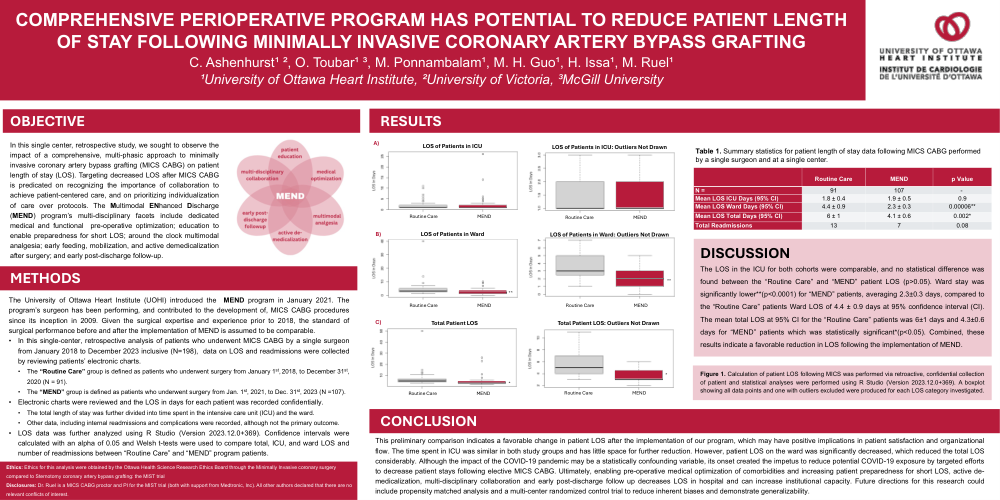
In this single center, retrospective study, we sought to observe the impact of a comprehensive, multi-phasic approach to minimally invasive coronary artery bypass grafting (MICS CABG) on patient length of stay (LOS). Targeting decreased LOS after MICS CABG is predicated on recognizing the importance of collaboration to achieve patient-centered care, and on prioritizing individualization of care over protocols. The Multimodal ENhanced Discharge (MEND) program’s multi-disciplinary facets include dedicated medical and functional pre-operative optimization; education to enable preparedness for short LOS; around the clock multimodal analgesia; early feeding, mobilization, and active demedicalization after surgery; and early post-discharge follow-up.
METHODS:
The University of Ottawa Heart Institute (UOHI) introduced the MEND program in January 2021. The program’s surgeon has been performing, and contributed to the development of, MICS CABG procedures since its inception in 2009. Given the surgical expertise and experience prior to 2018, the standard of surgical performance before and after the implementation of MEND is assumed to be comparable.
The LOS in the ICU for both cohorts were comparable, and no statistical difference was found between the “Routine Care” and “MEND” patient LOS (p>0.05). Ward stay was significantly lower**(p<0.0001) for “MEND” patients, averaging 2.3±0.3 days, compared to the “Routine Care” patients Ward LOS of 4.4 ± 0.9 days at 95% confidence interval (CI). The mean total LOS at 95% CI for the “Routine Care” patients was 6±1 days and 4.3±0.6 days for “MEND” patients which was statistically significant*(p<0.05). Combined, these results indicate a favorable reduction in LOS following the implementation of MEND.