225 posters, 34 videos, 18 topics, 14 sessions, 251 authors, 55 institutions
ePostersLive by SciGen Technologies S.A. All rights reserved.
ISMICS 2024 Annual Meeting
29 May - 1 June, 2024 | Athens, Greece
PC.81
Robotic Simulation Using Fresh Animal Tissue Model Improves Surgical Residents Learning
Poster Presenter
Authors
Part of Topic
New Technologies, AI, and Learning Models
Robotic Simulation Using Fresh Animal Tissue Model Improves Surgical Residents Learning
Background:
•Robot-assisted cardiac surgery has experienced significant evolution over the years with the introduction of the first totally endoscopic coronary bypass in 1998 by Loulmet et al.
•Within recent years, there has been increasing interest in utilization of robot-assisted technologies especially in mitral valve disease and internal mammary artery harvesting.
•However, limited literature exist in incorporating structured robotic cardiac training into residency curriculum and its impact on education.
•Objectives: 1. To establish the efficacy of fresh animal robotic simulation model for harvesting of internal mammary artery (IMA) 2. To investigate the impact of the simulation on resident education in performing robotic procedures.
Methods:
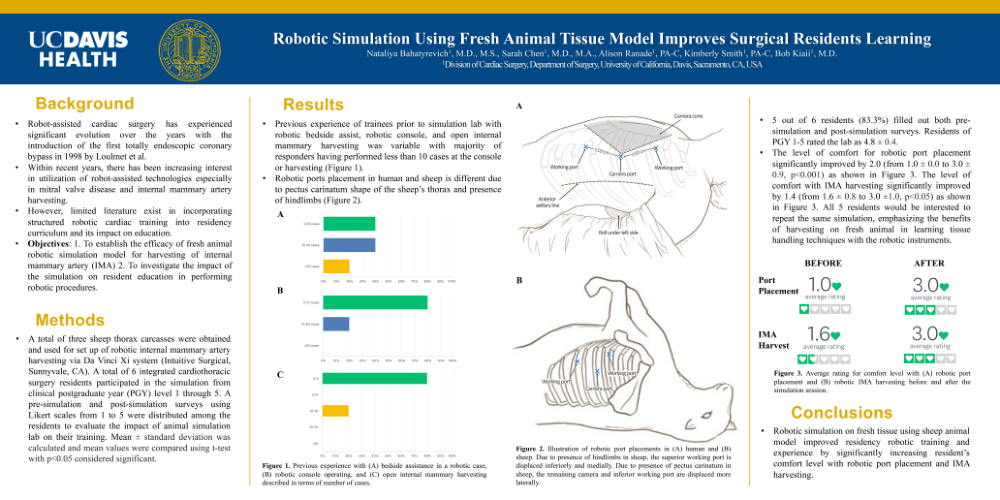
•A total of three sheep thorax carcasses were obtained and used for set up of robotic internal mammary artery harvesting via Da Vinci Xi system (Intuitive Surgical, Sunnyvale, CA). A total of 6 integrated cardiothoracic surgery residents participated in the simulation from clinical postgraduate year (PGY) level 1 through 5. A pre-simulation and post-simulation surveys using Likert scales from 1 to 5 were distributed among the residents to evaluate the impact of animal simulation lab on their training. Mean ± standard deviation was calculated and mean values were compared using t-test with p<0.05 considered significant.
Results:
•Previous experience of trainees prior to simulation lab with robotic bedside assist, robotic console, and open internal mammary harvesting was variable with majority of responders having performed less than 10 cases at the console or harvesting (Figure 1).
•Robotic ports placement in human and sheep is different due to pectus carinatum shape of the sheep’s thorax and presence of hindlimbs (Figure 2).
•5 out of 6 residents (83.3%) filled out both pre-simulation and post-simulation surveys. Residents of PGY 1-5 rated the lab as 4.8 ± 0.4.
•The level of comfort for robotic port placement significantly improved by 2.0 (from 1.0 ± 0.0 to 3.0 ± 0.9, p<0.001) as shown in Figure 3. The level of comfort with IMA harvesting significantly improved by 1.4 (from 1.6 ± 0.8 to 3.0 ±1.0, p<0.05) as shown in Figure 3. All 5 residents would be interested to repeat the same simulation, emphasizing the benefits of harvesting on fresh animal in learning tissue handling techniques with the robotic instruments.
Conclusions:
•Robotic simulation on fresh tissue using sheep animal model improved residency robotic training and experience by significantly increasing resident’s comfort level with robotic port placement and IMA harvesting.