225 posters, 34 videos, 18 topics, 14 sessions, 251 authors, 55 institutions
ePostersLive by SciGen Technologies S.A. All rights reserved.
ISMICS 2024 Annual Meeting
29 May - 1 June, 2024 | Athens, Greece

PC.6
Is Annular Enlargement In Mini Right Thoracotomy Aortic Valve Replacement Safe And Feasible?
Poster Presenter
Authors
Part of Topic
Aortic Valve Surgery
Video
Is Annular Enlargement In Mini Right Thoracotomy Aortic Valve Replacement Safe And Feasible?
Alessandro Vivacqua , MD, Bogdan Kindzelski, MD, Francis Shannon, MD, Jeff Altshuler, MD, Alex Chen, MD, Thomas Schwann, MD
Department of Cardiovascular Surgery, Corewell Health William Beaumont University Hospital, Royal Oak, MI USA
Objective
Aortic annular enlargement during aortic valve replacement (AVR) has gained growing interest to implant larger size prostheses, minimizing trans-prosthetic gradients and preventing patient-prosthesis mismatch. Moreover, a larger prosthesis allows for future more effective valve-in-valve transcatheter procedures in the life long management of these pathology. We report our experience on aortic valve replacement with concomitant root enlargement via a minimally invasive thoracotomy approach.
Methods
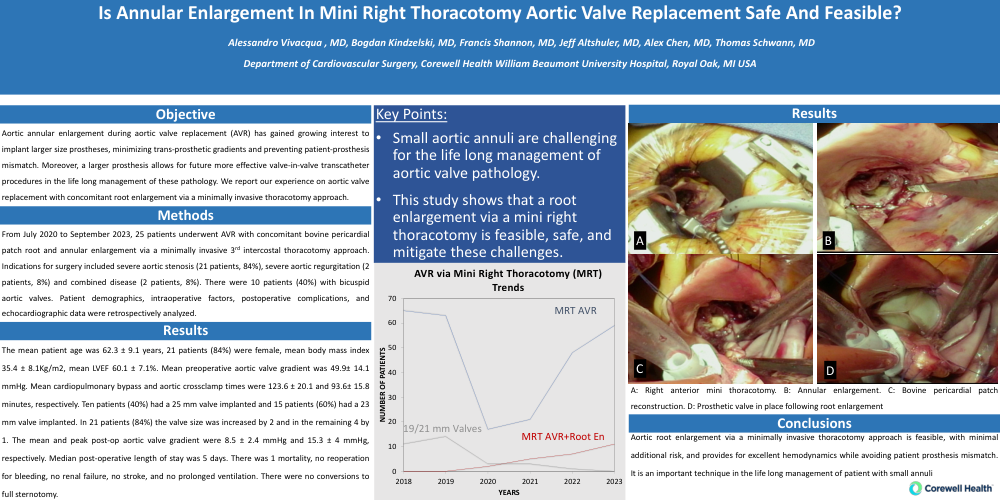
From July 2020 to September 2023, 25 patients underwent AVR with concomitant bovine pericardial patch root and annular enlargement via a minimally invasive 3rd intercostal thoracotomy approach. Indications for surgery included severe aortic stenosis (21 patients, 84%), severe aortic regurgitation (2 patients, 8%) and combined disease (2 patients, 8%). There were 10 patients (40%) with bicuspid aortic valves. Patient demographics, intraoperative factors, postoperative complications, and echocardiographic data were retrospectively analyzed.
Results
The mean patient age was 62.3 ± 9.1 years, 21 patients (84%) were female, mean body mass index 35.4 ± 8.1Kg/m2, mean LVEF 60.1 ± 7.1%. Mean preoperative aortic valve gradient was 49.9± 14.1 mmHg. Mean cardiopulmonary bypass and aortic crossclamp times were 123.6 ± 20.1 and 93.6± 15.8 minutes, respectively. Ten patients (40%) had a 25 mm valve implanted and 15 patients (60%) had a 23 mm valve implanted. In 21 patients (84%) the valve size was increased by 2 and in the remaining 4 by 1. The mean and peak post-op aortic valve gradient were 8.5 ± 2.4 mmHg and 15.3 ± 4 mmHg, respectively. Median post-operative length of stay was 5 days. There was 1 mortality, no reoperation for bleeding, no renal failure, no stroke, and no prolonged ventilation. There were no conversions to full sternotomy.
Conclusion
Aortic root enlargement via a minimally invasive thoracotomy approach is feasible, with minimal additional risk, and provides for excellent hemodynamics while avoiding patient prosthesis mismatch. It is an important technique in the life long management of patient with small annuli