225 posters, 34 videos, 18 topics, 14 sessions, 251 authors, 55 institutions
ePostersLive by SciGen Technologies S.A. All rights reserved.
ISMICS 2024 Annual Meeting
29 May - 1 June, 2024 | Athens, Greece

PC.3
Implantation Of Perceval Valve On Challenging Degenerated Aortic Valves With Three Approaches
Poster Presenter
Authors
Part of Topic
Aortic Valve Surgery
Introduction
Surgical and non-surgical suturelessaortic valve replacement are minimally invasive options with less complications associated with redo valve replacement operation for the treatment of degenerated bioprosthetic valves.1
Non-surgical sutureless Valve-in-vale transcatheter AVR (TAVR) is increasing in use but has significant limitations 2 Moreover, ViV TAVRlong-term outcome (more than five years) are still awaited.
Perceval decrease the cardiopulmonary bypass (CPB) and aortic cross-clamp (ACC) time, compared to other surgical aortic valves.2 Moreover, by eliminating the sewing ring at the valve base with no annular suture required, sutureless valves can increase effective orifice area (EOA) and significantly improve gradients after reoperation of a degenerated aortic valve. 3
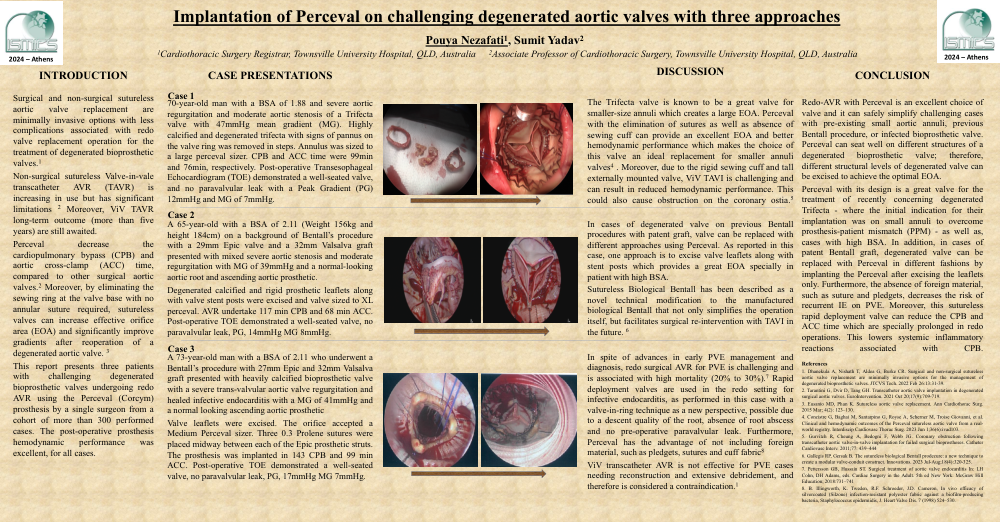
This report presents three patients with challenging degenerated bioprostheticvalves undergoing redo AVR using the Perceval (Corcym) prosthesis by a single surgeon from a cohort of more than 300 performed cases. The post-operative prosthesis hemodynamic performance was excellent, for all cases.
Case 1
70-year-old man with a BSA of 1.88 and severe aortic regurgitation and moderate aortic stenosis of a Trifecta valve with 47mmHg mean gradient (MG). Highlycalcified and degenerated trifecta with signs of pannus on the valve ring was removed in steps. Annulus was sized to a large perceval sizer. CPB and ACC time were 99min and 76min, respectively. Post-operative Transesophageal Echocardiogram (TOE) demonstrated a well-seated valve, and no paravalvular leak with a Peak Gradient (PG) 12mmHg and MG of 7mmHg.
The Trifecta valve is known to be a great valve for smaller-size annuli which creates a large EOA. Perceval with the elimination of sutures as well as absence of sewing cuff can provide an excellent EOA and better hemodynamic performance which makes the choice of this valve an ideal replacement for smaller annuli valves4. Moreover, due to the rigid sewing cuff and tall externally mounted valve, ViVTAVI is challenging and can result in reduced hemodynamic performance. This could also cause obstruction on the coronary ostia.5
Case 2
A 65-year-old with a BSA of 2.11 (Weight 156kg and height 184cm) on a background of Bentall’s procedure with a 29mm Epic valve and a 32mm Valsalva graft presented with mixed severe aortic stenosis and moderate regurgitation with MG of 39mmHg and a normal-looking aortic root and ascending aortic prosthetic.
Degenerated calcified and rigid prosthetic leaflets along with valve stent posts were excised and valve sized to XL perceval. AVR undertake 117 min CPB and 68 min ACC. Post-operative TOE demonstrated a well-seated valve, no paravalvular leak, PG, 14mmHg MG 8mmHg.
In cases of degenerated valve on previous Bentall procedures with patent graft, valve can be replaced with different approaches using Perceval. As reported in this case, one approach is to excise valve leaflets along with stentposts which provides a great EOA specially in patient with high BSA.
Sutureless Biological Bentall has been described as a novel technical modification to the manufactured biological Bentall that not only simplifies the operation itself, but facilitates surgical re-intervention with TAVI in the future. 6
Case 3
A 73-year-old man with a BSA of 2.11 who underwent a Bentall’s procedure with 27mm Epic and 32mm Valsalva graft presented with heavily calcified bioprosthetic valve with a severe trans-valvular aortic valve regurgitation and healed infective endocarditis with a MG of 41mmHg and a normal looking ascending aortic prosthetic
Valve leaflets were excised. The orifice accepted a Medium Perceval sizer. Three 0.3 Prolene sutures were placed midway between each of the Epic prosthetic struts. The prosthesis was implanted in 143 CPB and 99 min ACC. Post-operative TOE demonstrated a well-seated valve, no paravalvular leak, PG, 17mmHg MG 7mmHg.
In spite of advances in early PVE management and diagnosis, redo surgical AVR for PVE is challenging and is associated with high mortality (20% to 30%).7 Rapid deployment valves are used in the redo setting for infective endocarditis, as performed inthis case with a valve-in-ring technique as a new perspective, possible due to a descent quality of the root, absence of root abscess and no pre-operative paravalvular leak. Furthermore, Perceval has the advantage of not including foreign material, such as pledgets, sutures and cuff fabric8
ViV transcatheter AVR is not effective for PVE cases needing reconstruction and extensive debridement, and therefore is considered a contraindication.1
CONCLUSION
Redo-AVR with Perceval is an excellent choice of valve and it can safely simplify challenging cases with pre-existing small aortic annuli, previous Bentall procedure, or infected bioprosthetic valve. Perceval can seat well on different structures of a degenerated bioprosthetic valve; therefore, different structural levels of degenerated valve can be excised to achieve the optimal EOA.
Perceval with its design is a great valve for the treatment of recently concerning degenerated Trifecta - where the initial indication for their implantation was on small annuli to overcome prosthesis-patient mismatch (PPM) - as well as, cases with high BSA. In addition, in cases of patent Bentall graft, degenerated valve can be replaced with Perceval in different fashions by implanting the Perceval after excising the leaflets only. Furthermore, the absence of foreign material, such as suture and pledgets, decreases the risk of recurrent IE on PVE. Moreover, this sutureless rapid deployment valve can reduce the CPB and ACC time which are specially prolonged in redo operations. This lowers systemic inflammatory reactions associated with CPB.
References
1. Dhanekula A, Nishath T, Aldea G, Burke CR. Surgical and non-surgical sutureless aortic valve replacement are minimally invasive options for the management of degenerated bioprosthetic valves. JTCVS Tech. 2022 Feb 26:13:31-39.
2. Tarantini G, Dvir D, Tang GH. Transcatheter aortic valve implantation in degenerated surgical aortic valves. EuroIntervention. 2021 Oct 20;17(9):709-719.
3. Eusanio MD, Phan K. Sutureless aortic valve replacement. Ann Cardiothorac Surg. 2015 Mar; 4(2): 123–130.
4. Concistre G, Baghai M, Santarpino G, Royse A, Scherner M, TroiseGiovanni, et al. Clinical and hemodynamic outcomes of the Perceval sutureless aortic valve from a real-world registry. InterdiscipCardiovasc Thorac Surg. 2023 Jun 1;36(6):ivad103.
5. Gurvitch R, Cheung A, Bedogni F, Webb JG. Coronary obstruction following transcatheter aortic valve-in-valve implantation for failed surgical bioprostheses. Catheter Cardiovasc Interv. 2011;77: 439–444
6. Gallegis RP, Gersak B. The sutureless biological Bentall prodecure: a new technique to create a modular valve-conduit construct. Innovations. 2023 Jul-Aug;18(4):320-325.
7. Pettersson GB, Hussain ST. Surgical treatment of aortic valve endocarditis In: LH Cohn, DH Adams, eds. Cardiac Surgery in the Adult. 5th ed New York: McGraw Hill Education; 2018:731–741
8. B. Illingworth, K. Tweden, R.F. Schroeder, J.D. Cameron, In vivo efficacy of silvercoated (Silzone) infection-resistant polyester fabric against a biofilm-producing bacteria, Staphylococcus epidermidis, J. Heart Valve Dis. 7 (1998) 524–530.