225 posters, 34 videos, 18 topics, 14 sessions, 251 authors, 55 institutions
ePostersLive by SciGen Technologies S.A. All rights reserved.
ISMICS 2024 Annual Meeting
29 May - 1 June, 2024 | Athens, Greece

PC.2
Perceval Aortic Valve Sizing: Diameter Derived From Area Vs Perimeter
Poster Presenter
Part of Topic
Aortic Valve Surgery
Comparing Perceval Aortic Valve Sizing: Diameter Derived From Area Versus Perimeter
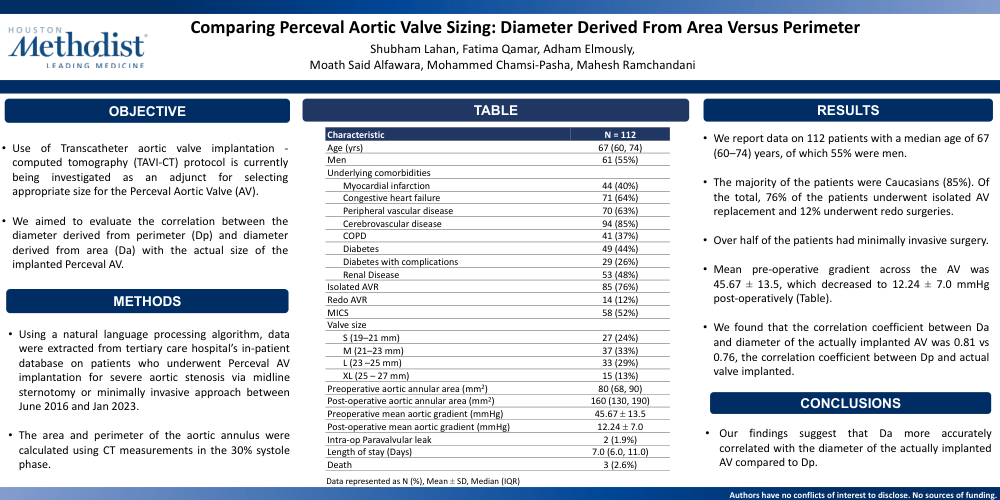
Objective: Use of Transcatheter aortic valve implantation - computed tomography (TAVI-CT) protocol is currently being investigated as an adjunct for selecting appropriate size for the Perceval Aortic Valve (AV). We aimed to evaluate the correlation between the diameter derived from perimeter (Dp) and diameter derived from area (Da) with the actual size of the implanted Perceval AV.
Methods: Using a natural language processing algorithm, data were extracted from tertiary care hospital’s in-patient database on patients who underwent Perceval AV implantation for severe aortic stenosis via midline sternotomy or minimally invasive approach between June 2016 and Jan 2023. The area and perimeter of the aortic annulus were calculated using CT measurements in the 30% systole phase.
Results: We report data on 112 patients with a median age of 67 (60–74) years, of which 55% were men. The majority of the patients were Caucasians (85%). Of the total, 76% of the patients underwent isolated AV replacement and 12% underwent redo surgeries. Over half of the patients had minimally invasive surgery. Mean pre-operative gradient across the AV was 45.67 ± 13.5, which decreased to 12.24 ± 7.0 mmHg post-operatively (Table). We found that the correlation coefficient between Da and diameter of the actually implanted AV was 0.81 vs 0.76, the correlation coefficient between Dp and actual valve implanted.
Conclusions: Our findings suggest that Da more accurately correlated with the diameter of the actually implanted AV compared to Dp.