225 posters, 34 videos, 18 topics, 14 sessions, 251 authors, 55 institutions
ePostersLive by SciGen Technologies S.A. All rights reserved.
ISMICS 2024 Annual Meeting
29 May - 1 June, 2024 | Athens, Greece

PC.22
Study On The Thoracoscopic Assisted Ablation For Atrial Functional Mitral Regurgitation With Atrial Fibrillation
Poster Presenter
Authors
Part of Topic
Arrhythmia and LAA Surgery
Study on the totally thoracoscopic stand-alone surgical ablation for atrial functional mitral regurgitation patients with atrial fibrillation
Yongjun Qian, Zhengjie Wang, Yiren Sun, Qi Tong, Jie Cai, Tao Li, Qiyue Xu, Oumar Abdel Mahamoud, Jun Gu
Department of Cardiovascular Surgery, West China Hospital of Sichuan University, Chengdu, 610065, China.
1.Introduction
Functional mitral regurgitation (FMR) refers to the condition when mitral regurgitation occurs in patients with structurally healthy mitral valve. Atrial fibrillation (AF) can be both a cause and a consequence of FMR due to the process of isolated annular dilation, insufficient compensatory leaflet growth, and atrial or annular dynamics changes,and the FMR caused by AF was defined as atrial functional mitral regurgitation (AFMR)1. About 4-8% of AF patients may suffer from AFMR, and the rises as atrial fibrillation persists over time 2. But currently there is no guidance on whether to perform mitral surgeries in patients with only moderate or mild-to-moderate regurgitation. Some studies proved that the existence of AF has a negative impact on the prognosis of AFMR patients undergoing mitral valve surgery, while the restoration of sinus rhythm was reported to be able to relief AFMR significantly 3-5.The two sides lead to the same conclusion: AF rhythm control is a strong candidate for some edge over mitral surgeries for AFMR patients with AF.
Minimally invasive totally thoracoscopic stand-alone surgical ablation of AF (TTA) derived from the classic MAZE procedure and thoracoscopic techniques has become a potential treatment for AF combined with AFMR due to its advantages of high postoperative sinus restoration and low AF recurrence rate6. However, there is almost no evidence to prove the safety and efficacy of TTA in treating AFMR for AF patients, so we designed this prospective observational cohort study.
2.Methods
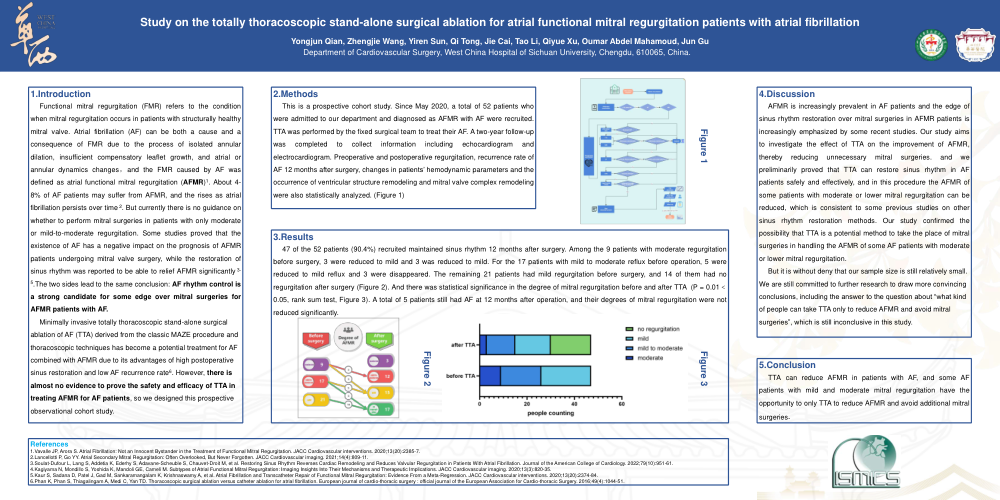
This is a prospective cohort study. Since May 2020, a total of 52 patients who were admitted to our department and diagnosed as AFMR with AF were recruited. TTA was performed by the fixed surgical team to treat their AF. A two-year follow-up was completed to collect information including echocardiogram and electrocardiogram. Preoperative and postoperative regurgitation, recurrence rate of AF 12 months after surgery, changes in patients’ hemodynamic parameters and the occurrence of ventricular structure remodeling and mitral valve complex remodeling were also statistically analyzed. (Figure 1)
3.Results
47 of the 52 patients (90.4%) recruited maintained sinus rhythm 12 months after surgery. Among the 9 patients with moderate regurgitation before surgery, 3 were reduced to mild and 3 was reduced to mild. For the 17 patients with mild to moderate reflux before operation, 5 were reduced to mild reflux and 3 were disappeared. The remaining 21 patients had mild regurgitation before surgery, and 14 of them had no regurgitation after surgery (Figure 2). And there was statistical significance in the degree of mitral regurgitation before and after TTA (P = 0.01<0.05, rank sum test, Figure 3). A total of 5 patients still had AF at 12 months after operation, and their degrees of mitral regurgitation were not reduced significantly.
4.Discussion
AFMR is increasingly prevalent in AF patients and the edge of sinus rhythm restoration over mitral surgeries in AFMR patients is increasingly emphasized by some recent studies. Our study aims to investigate the effect of TTA on the improvement of AFMR, thereby reducing unnecessary mitral surgeries. and we preliminarily proved that TTA can restore sinus rhythm in AF patients safely and effectively, and in this procedure the AFMR of some patients with moderate or lower mitral regurgitation can be reduced, which is consistent to some previous studies on other sinus rhythm restoration methods. Our study confirmed the possibility that TTA is a potential method to take the place of mitral surgeries in handling the AFMR of some AF patients with moderate or lower mitral regurgitation.
But it is without deny that our sample size is still relatively small. We are still committed to further research to draw more convincing conclusions, including the answer to the question about “what kind of people can take TTA only to reduce AFMR and avoid mitral surgeries”, which is still inconclusive in this study.
5.Conclusion
TTA can reduce AFMR in patients with AF, and some AF patients with mild and moderate mitral regurgitation have the opportunity to only TTA to reduce AFMR and avoid additional mitral surgeries.