225 posters, 34 videos, 18 topics, 14 sessions, 251 authors, 55 institutions
ePostersLive by SciGen Technologies S.A. All rights reserved.
ISMICS 2024 Annual Meeting
29 May - 1 June, 2024 | Athens, Greece

PC.18
Radiation Safety In Pulmonary Vein Isolation For Atrial Fibrillation Depending On Single Versus Double Transseptal Punctures
Poster Presenter
Authors
Affiliations
Part of Topic
Arrhythmia and LAA Surgery
Radiation Safety in Pulmonary Vein Isolation for Atrial Fibrillation Depending on Single versus Double Transseptal Punctures
Pulmonary vein isolation (PVI) has emerged as the cornerstone treatment for symptomatic AF, demonstrating substantial efficacy in reducing arrhythmia recurrence and improving quality of life. Transseptal puncture (TSP) is the key step in PVI. While both single and double puncture techniques achieve successful PVI outcomes, the choice between them hinges on a critical balance between procedural efficacy and patient safety. This article delves into the intricacies of radiation exposure in PVI, dissecting the technical nuances of single and double transseptal puncture approaches and their influence on radiation dose.
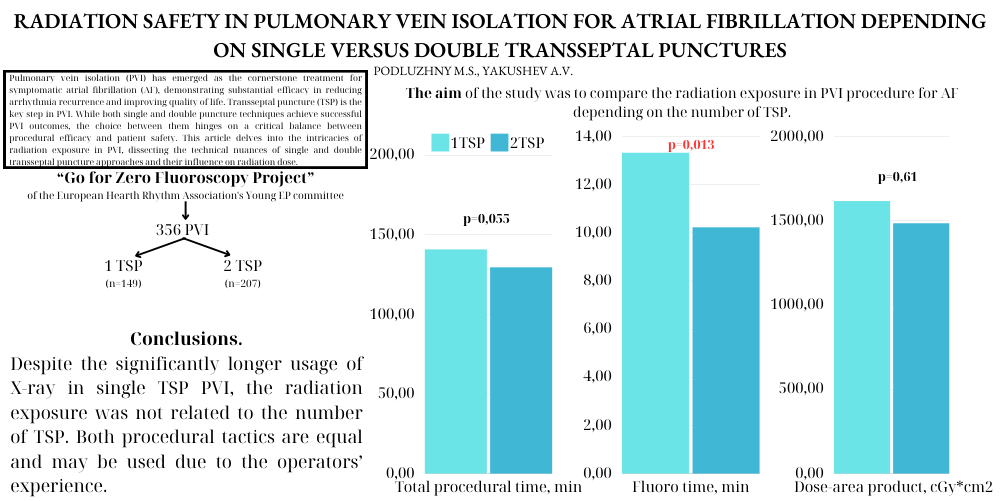
The aim of the study was to compare the radiation exposure in PVI procedure for AF depending on the number of TSP.
Research materials and methods. This paper is the subanalysis of the prospective, international, observational registry of consecutive patients the “Go for Zero Fluoroscopy Project” of the European Hearth Rhythm Association's Young EP committee. All patients had PVI procedure and were divided into two groups, depending on the number of TSP: 1 group (n=149) had 1 TSP, 2 group (n=207) had 2 TSP.
The results. Patients in both groups have not difference in the body mass index, with the average of 28,52±5,52 & 28,96±5,06 kg/m2 (p=0,44), and body surface area, with average of 2,01±0,24 & 2,04±0,24 m2 (p=0,27). Total procedural time for PVI procedure had a strong trend (p=0,055) to be longer in single TSP group: 140,85±47,17 vs 129,57±59,23 min. To receive final success of intervention 1 group used more diagnostic catheters – 2,05±0,79 vs 1,64±0,65 (p<0,0001). The fluoro time spent per procedure was significantly longer in 1 group 13,33±9,39 vs 10,23±12,87 min (p=0,013). However, the dose-area product had no statistical difference: 1617,36±1475,73 vs 1485,56±2931,14 cGy*cm2 (p=0,61).
Conclusions. Despite the significantly longer usage of X-ray in single TSP PVI, the radiation exposure was not related to the number of TSP. Both procedural tactics are equal and may be used due to the operators’ experience.