225 posters, 34 videos, 18 topics, 14 sessions, 251 authors, 55 institutions
ePostersLive by SciGen Technologies S.A. All rights reserved.
ISMICS 2024 Annual Meeting
29 May - 1 June, 2024 | Athens, Greece
D.85
Awake Thoracic Surgery By Uniportal Thoracoscopic Surgery: One Surgeon’s Experience
Poster Presenter
Authors
Part of Topic
Thoracic Surgery
Awake Thoracic Surgery By Uniportal Thoracoscopic Surgery: One Surgeon’S Experience
INTRODUCTION: Lung isolation under general anesthesia with double-lumen tube has become an indispensable part of thoracic surgery. However, intubation-associated complications such as lung infections, lung injury due to ventilation pressure or overexpansion, bronchospasm etc. remain problematic.
Many researchers have reported that awake lung surgery has good feasibility and provides less side effects of general anesthesia, surgery-related trauma, and it also promotes recovery by maintaining a normal physiologic status.
The objective of the current study was to evaluate the feasibility and safety of non-intubated uniportal video-assisted thoracoscopic surgery (VATS) for the management of different pleural diseases, infections, pulmonary nodules and neoplasms.
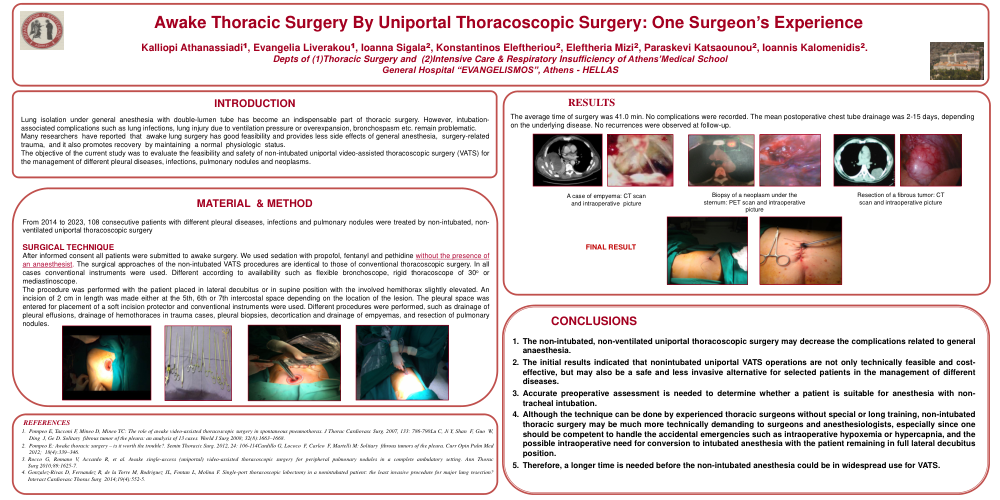
MATERIAL & METHOD: From 2014 to 2023, 108 consecutive patients with different pleural diseases, infections and pulmonary nodules were treated by non-intubated, non-ventilated uniportal thoracoscopic surgery. After informed consent all patients were submitted to awake surgery. We used sedation with propofol, fentanyl and pethidine without the presence of an anaesthesist. The surgical approaches of the non-intubated VATS procedures are identical to those of conventional thoracoscopic surgery. In all cases conventional instruments were used. Different according to availability such as flexible bronchoscope, rigid thoracoscope of 30o or mediastinoscope. The procedure was performed with the patient placed in lateral decubitus or in supine position with the involved hemithorax slightly elevated. An incision of 2 cm in length was made either at the 5th, 6th or 7th intercostal space depending on the location of the lesion. The pleural space was entered for placement of a soft incision protector and conventional instruments were used. Different procedures were performed, such as drainage of pleural effusions, drainage of hemothoraces in trauma cases, pleural biopsies, decortication and drainage of empyemas, and resection of pulmonary nodules.
RESULTS: The average time of surgery was 41.0 min. No complications were recorded. The mean postoperative chest tube drainage was 2-15 days, depending on the underlying disease. No recurrences were observed at follow-up.
CONCLUSIONS: 1. The non-intubated, non-ventilated uniportal thoracoscopic surgery may decrease the complications related to general anaesthesia. 2. The initial results indicated that nonintubated uniportal VATS operations are not only technically feasible and cost-effective, but may also be a safe and less invasive alternative for selected patients in the management of different diseases. 3. Accurate preoperative assessment is needed to determine whether a patient is suitable for anesthesia with non-tracheal intubation. 4. Although the technique can be done by experienced thoracic surgeons without special or long training, non-intubated thoracic surgery may be much more technically demanding to surgeons and anesthesiologists, especially since one should be competent to handle the accidental emergencies such as intraoperative hypoxemia or hypercapnia, and the possible intraoperative need for conversion to intubated anesthesia with the patient remaining in full lateral decubitus position. 5. Therefore, a longer time is needed before the non-intubated anesthesia could be in widespread use for VATS.