225 posters, 34 videos, 18 topics, 14 sessions, 251 authors, 55 institutions
ePostersLive by SciGen Technologies S.A. All rights reserved.
ISMICS 2024 Annual Meeting
29 May - 1 June, 2024 | Athens, Greece

D.83
Impact Of Geographic And Sociodemographic Factors On The Utilization Of Robotic-assisted Lung Resection Versus Video-assisted Lung Resection
Poster Presenter
Authors
Affiliations
Part of Topic
Thoracic Surgery
Impact of Geographic and Sociodemographic Factors on the Utilization of Robotic Lung Resection versus Videoscopic Lung Resection
Aaron R. Dezube MD 1,2, Natasha K Valas DO 1,2, Michael Dezube M.Eng 3, Virginia R. Litle MD 1,2
1. St. Elizabeth’s Medical Center, Brighton, MA; 2. Boston University Chobanian and Avedisian School of Medicine, Boston, MA; 3. Department of Radiology, Massachusetts General Hospital, Boston MA
Background
• Robotic-assisted thoracoscopic surgery
(RATS) is now a widely accepted
approach for lung resection.
• Less is know about patterns of usage
within the United States.
Investigate whether geographic and
sociodemographic factors impact trends
in utilization of RATS versus video-assisted
thoracoscopic surgery (VATS) for lung
resection in the United States.
A data use agreement was signed.
• All patients with complete demographic
variables undergoing RATS and VATS
within the National Inpatient Sample
between 2016-2020 for benign or
malignant neoplasms and nodules were
included.
• Degree of resection and technique were
compared with respect to pretreatment
variables: sociodemographic, hospital
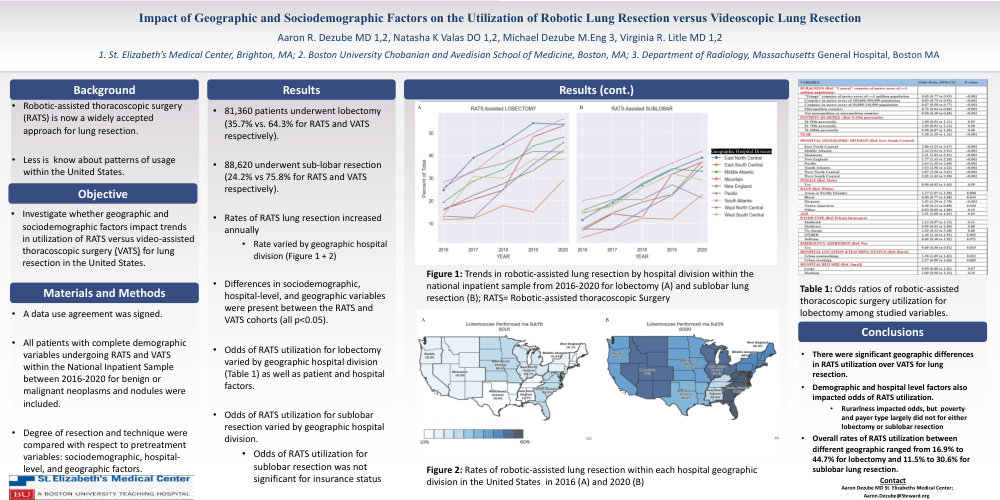
81,360 patients underwent lobectomy
(35.7% vs. 64.3% for RATS and VATS
respectively).
• 88,620 underwent sub-lobar resection
(24.2% vs 75.8% for RATS and VATS
respectively).
• Rates of RATS lung resection increased
annually
• Rate varied by geographic hospital
division (Figure 1 + 2)
• Differences in sociodemographic,
hospital-level, and geographic variables
were present between the RATS and
VATS cohorts (all p<0.05).
• Odds of RATS utilization for lobectomy
varied by geographic hospital division
(Table 1) as well as patient and hospital
factors.
• Odds of RATS utilization for sublobar
resection varied by geographic hospital
division.
• Odds of RATS utilization for
sublobar resection was not
significant for insurance status
There were significant geographic differences
in RATS utilization over VATS for lung
resection.
• Demographic and hospital level factors also
impacted odds of RATS utilization.
• Rurarlness impacted odds, but poverty
and payer type largely did not for either
lobectomy or sublobar resection
• Overall rates of RATS utilization between
different geographic ranged from 16.9% to
44.7% for lobectomy and 11.5% to 30.6% for
sublobar lung resection