225 posters, 34 videos, 18 topics, 14 sessions, 251 authors, 55 institutions
ePostersLive by SciGen Technologies S.A. All rights reserved.
ISMICS 2024 Annual Meeting
29 May - 1 June, 2024 | Athens, Greece

D.21
Convergent Ablation And Minimally Invasive Left Atrial Appendage Closure In Persistent Atrial Fibrillation, Two Year Outcomes
Poster Presenter
Authors
Part of Topic
Arrhythmia Surgery & Interventions
Convergent Ablation And Minimally Invasive Left Atrial Appendage Closure In Persistent Atrial Fibrillation, Two Year Outcomes
Michal Szlapka, Rodolfo Siordia-Dawson, Inka Klonz, Vladimir Vulevic, Stanislav Tsvelodub, Konstantin Krieger, Boris A. Hoffmann, Thorsten Hanke; Asklepios Harburg, Hamburg, Germany
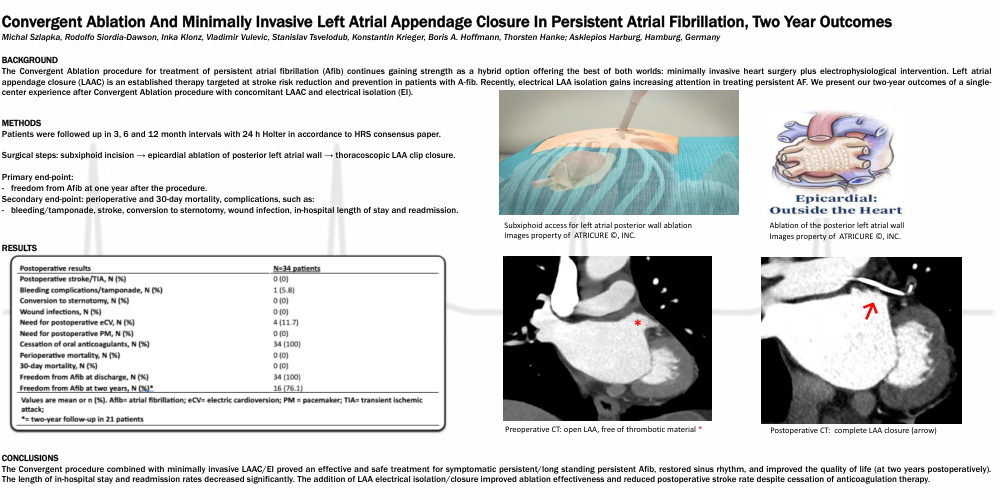
BACKGROUND. The Convergent Ablation procedure for treatment of persistent atrial fibrillation (Afib) continues gaining strength as a hybrid option offering the best of both worlds: minimally invasive heart surgery plus electrophysiological intervention. Left atrial appendage closure (LAAC) is an established therapy targeted at stroke risk reduction and prevention in patients with A-fib. Recently, electrical LAA isolation gains increasing attention in treating persistent AF. We present our two-year outcomes of a single-center experience after Convergent Ablation procedure with concomitant LAAC and electrical isolation (EI).
METHODS. Patients were followed up in 3, 6 and 12 month intervals with 24 h Holter in accordance to HRS consensus paper.
Surgical steps: subxiphoid incision → epicardial ablation of posterior left atrial wall → thoracoscopic LAA clip closure.
Primary end-point:
Secondary end-point: perioperative and 30-day mortality, complications, such as:
RESULTS (Table 1).
CONCLUSIONS. The Convergent procedure combined with minimally invasive LAAC/EI proved an effective and safe treatment for symptomatic persistent/long standing persistent Afib, restored sinus rhythm, and improved the quality of life (at two years postoperatively). The length of in-hospital stay and readmission rates decreased significantly. The addition of LAA electrical isolation/closure improved ablation effectiveness and reduced postoperative stroke rate despite cessation of anticoagulation therapy.