225 posters, 34 videos, 18 topics, 14 sessions, 251 authors, 55 institutions
ePostersLive by SciGen Technologies S.A. All rights reserved.
ISMICS 2024 Annual Meeting
29 May - 1 June, 2024 | Athens, Greece
PC.126
Minimally Invasive Extraction Of Ectopic Parathyroid Glands
Poster Presenter
Authors
Part of Topic
Thoracic Surgery
MINIMALLY INVASIVE EXTRACTION OF ECTOPIC PARATHYROID GLANDS
INTRODUCTION: Mediastinal ectopic parathyroid adenomas (MEPAs) are rare tumors, constituting 1-2% of all parathyroid adenomas. Thorough understanding of the anatomy and embryology of the parathyroid glands is required by endocrine and thoracic surgeons to maximise chances of cure from hyperparathyroidism. It is also of paramount importance that clinicians should be aware of the advancements in preoperative parathyroid localization, intraoperative parathyroid hormone (PTH) monitoring and the different surgical accesses for MEPAs, including ‘focused’ parathyroidectomy, bilateral surgical neck exploration, video-assisted neck exploration, radioguided parathyroidectomy, feeding vessel embolization, bronchoscopic ablation, open thoracotomy, median sternotomy and video-assisted thoracoscopic surgery (VATS). We present our experience of extraction of intrathoracic parathyroid adenomas by using minimally invasive techniques avoiding sternotomy or thoracotomy.
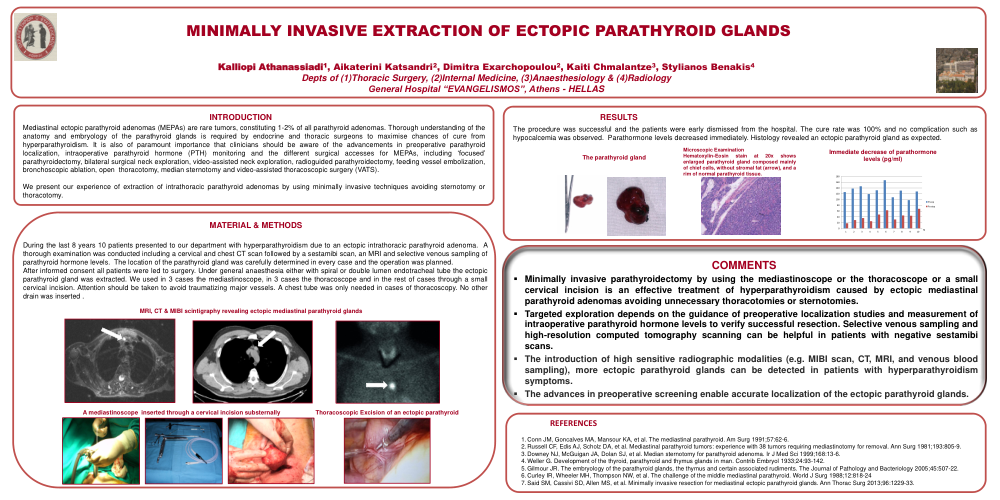
MATERIAL & METHOD: During the last 8 years 10 patients presented to our department with hyperparathyroidism due to an ectopic intrathoracic parathyroid adenoma. A thorough examination was conducted including a cervical and chest CT scan followed by a sestamibi scan, an MRI and selective venous sampling of parathyroid hormone levels. The location of the parathyroid gland was carefully determined in every case and the operation was planned. After informed consent all patients were led to surgery. Under general anaesthesia either with spiral or double lumen endotracheal tube the ectopic parathyroid gland was extracted. We used in 3 cases the mediastinoscope, in 3 cases the thoracoscope and in the rest of cases through a small cervical incision. Attention should be taken to avoid traumatizing major vessels. A chest tube was only needed in cases of thoracoscopy. No other drain was inserted .
RESULTS: The procedure was successful and the patients were early dismissed from the hospital. The cure rate was 100% and no complication such as hypocalcemia was observed. Parathormone levels decreased immediately. Histology revealed an ectopic parathyroid gland as expected.
CONCLUSIONS: 1. Minimally invasive parathyroidectomy by using the mediastinoscope or the thoracoscope or a small cervical incision is an effective treatment of hyperparathyroidism caused by ectopic mediastinal parathyroid adenomas avoiding unnecessary thoracotomies or sternotomies. 2. Targeted exploration depends on the guidance of preoperative localization studies and measurement of intraoperative parathyroid hormone levels to verify successful resection. Selective venous sampling and high-resolution computed tomography scanning can be helpful in patients with negative sestamibi scans. 3.The introduction of high sensitive radiographic modalities (e.g. MIBI scan, CT, MRI, and venous blood sampling), more ectopic parathyroid glands can be detected in patients with hyperparathyroidism symptoms. 4.The advances in preoperative screening enable accurate localization of the ectopic parathyroid glands.