225 posters, 34 videos, 18 topics, 14 sessions, 251 authors, 55 institutions
ePostersLive by SciGen Technologies S.A. All rights reserved.
ISMICS 2024 Annual Meeting
29 May - 1 June, 2024 | Athens, Greece
PC.124
Robotic-assisted Thoracoscopic Repair of Liver Herniation After HELLP Syndrome.
Poster Presenter
Authors
Part of Topic
Thoracic Surgery
Robotic-Assisted Thoracoscopic Repair of Liver Herniation after HELLP Syndrome
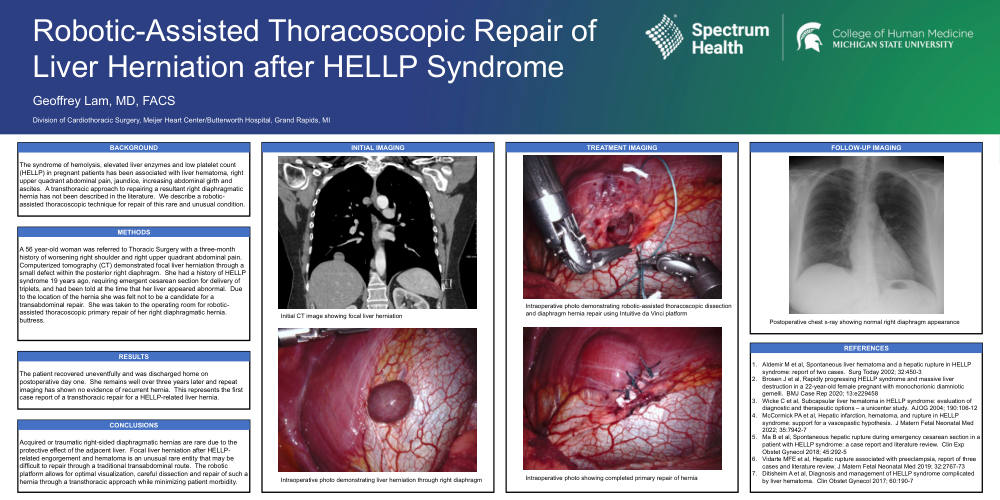
Background: The syndrome of hemolysis, elevated liver enzymes and low platelet count (HELLP) in pregnant patients has been associated with liver hematoma, right upper quadrant abdominal pain, jaundice, increasing abdominal girth and ascites. A transthoracic approach to repairing a resultant right diaphragmatic hernia has not been described in the literature. We describe a robotic-assisted thoracoscopic technique for repair of this rare and unusual condition.
Methods: A 56 year-old woman was referred to Thoracic Surgery with a three-month history of worsening right shoulder and right upper quadrant abdominal pain. Computerized tomography (CT) demonstrated focal liver herniation through a small defect within the posterior right diaphragm. She had a history of HELLP syndrome 19 years ago, requiring emergent cesarean section for delivery of triplets, and had been told at the time that her liver appeared abnormal. Due to the location of the hernia she was felt not to be a candidate for a transabdominal repair. She was taken to the operating room for robotic-assisted thoracoscopic primary repair of her right diaphragmatic hernia. buttress.
Results: The patient recovered uneventfully and was discharged home on postoperative day one. She remains well over three years later and repeat imaging has shown no evidence of recurrent hernia. This represents the first case report of a transthoracic repair for a HELLP-related liver hernia.
Conclusions: Acquired or traumatic right-sided diaphragmatic hernias are rare due to the protective effect of the adjacent liver. Focal liver herniation after HELLP-related engorgement and hematoma is an unusual rare entity that may be difficult to repair through a traditional transabdominal route. The robotic platform allows for optimal visualization, careful dissection and repair of such a hernia through a transthoracic approach while minimizing patient morbidity.