167 posters, 28 videos, 9 topics, 12 sessions, 337 authors, 160 institutions
ePostersLive by SciGen Technologies S.A. All rights reserved.
ISMICS 2023 Annual Meeting
31 May - 3 June, 2023 | Boston, MA

PC75
Outcomes Of 100 Consecutive Robotic And Minimally Invasive Ivor-lewis Esophagectomy Without Pyloric Drainage
Part of Topic
Thoracic Surgery
Outcomes of 100 Consecutive Robotic and Minimally Invasive Ivor-Lewis Esophagectomy Without Pyloric Drainage
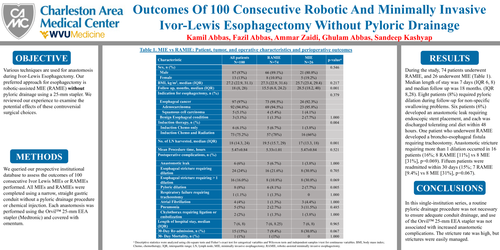
Objective: Various techniques are used for anastomosis during Ivor-Lewis Esophagectomy. Our preferred approach for esophagectomy is robotic-assisted MIE (RAMIE) without pyloric drainage using a 25-mm stapler. We reviewed our experience to examine the potential effects of these controversial surgical choices.
Methods: We queried our prospective institutional database to assess the outcomes of 100 consecutive Ivor Lewis MIEs or RAMIEs performed. All MIEs and RAMIEs were completed using a narrow, straight gastric conduit without a pyloric drainage procedure or chemical injection. Each anastomosis was performed using the Orvil™ 25-mm EEA stapler (Medtronic) and covered with omentum.
Results: During the study, 74 patients underwent RAMIE, and 26 underwent MIE (Table 1). Median length of stay was 7 days (IQR 6, 8) and median follow up was 18 months. (IQR 8,28). Eight patients (8%) required pyloric dilation during follow-up for non-specific swallowing problems. Six patients (6%) developed an anastomotic leak requiring endoscopic stent placement, and each was discharged tolerating oral diet within 48 hours. One patient who underwent RAMIE developed a broncho-esophageal fistula requiring tracheostomy. Anastomotic stricture requiring more than 1 dilation occurred in 16 patients (16%; 8 RAMIE [11%] vs 8 MIE [31%], p=0.069). Fifteen patients were readmitted within 30 days (15%; 7 RAMIE [9.4%] vs 8 MIE [31%], p=0.067).
Conclusions: In this single-institution series, a routine pyloric drainage procedure was not necessary to ensure adequate conduit drainage, and use of the Orvil™ 25-mm EEA stapler was not associated with increased anastomotic complications. The stricture rate was high, but strictures were easily managed.