167 posters, 28 videos, 9 topics, 12 sessions, 337 authors, 160 institutions
ePostersLive by SciGen Technologies S.A. All rights reserved.
ISMICS 2023 Annual Meeting
31 May - 3 June, 2023 | Boston, MA

PC62
Long-term Outcomes Of Robotic Hybrid Coronary Artery Revascularization. A Single Center Experience.
Poster Presenter
Authors
Affiliations
Part of Topic
Coronary Revascularization
BACKGROUND
The impact of long-term complications after CABG, including repeat revascularization, myocardial infarction (MI), and persistent angina in patients undergoing robotic hybrid coronary revascularization (HCR) remain limited.
AIM
We sought to analyze risk factors for coronary events after robotic-assisted HCR and their time-varying effects on outcomes.
METHODS
We identified all consecutive patients who underwent robotic HCR between February 2006 and June 2021 at our institution. Baseline characteristics were explored as possible risk factors for angina, MI and repeat revascularization with stents at any time during the follow-up after the index procedures.
RESULTS
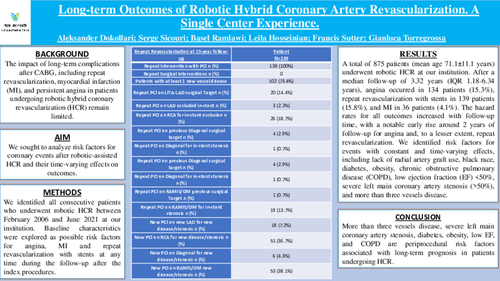
A total of 875 patients (mean age 71.1±11.1 years) underwent robotic HCR at our institution. After a median follow-up of 3.32 years (IQR 1.18-6.34 years), angina occurred in 134 patients (15.3%), repeat revascularization with stents in 139 patients (15.8%), and MI in 36 patients (4.1%). The hazard rates for all outcomes increased with follow-up time, with a notable early rise around 2 years of follow-up for angina and, to a lesser extent, repeat revascularization. We identified risk factors for events with constant and time-varying effects, including lack of radial artery graft use, black race, diabetes, obesity, chronic obstructive pulmonary disease (COPD), low ejection fraction (EF) <50%, severe left main coronary artery stenosis (>50%), and more than three vessels disease.
CONCLUSION
More than three vessels disease, severe left main coronary artery stenosis, diabetes, obesity, low EF, and COPD are periprocedural risk factors associated with long-term prognosis in patients undergoing HCR.