167 posters, 28 videos, 9 topics, 12 sessions, 337 authors, 160 institutions
ePostersLive by SciGen Technologies S.A. All rights reserved.
ISMICS 2023 Annual Meeting
31 May - 3 June, 2023 | Boston, MA

PC42
Totally Thoracoscopic Cardiac Valve Surgery Of Pregnancy
Poster Presenter
Part of Topic
Thoracic Surgery
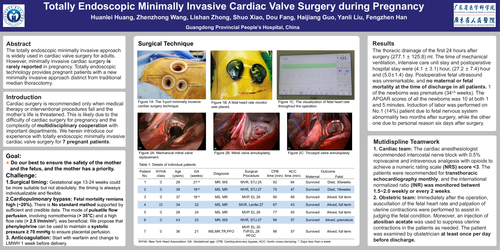
Abstract: The totally endoscopic minimally invasive approach is widely used in cardiac valve surgery for adults. However, minimally invasive cardiac surgery is rarely reported in pregnancy. Totally endoscopic technology provides pregnant patients with a new minimally invasive approach distinct from traditional median thoracotomy.
Introduction: Cardiac surgery is recommended only when medical therapy or interventional procedures fail and the mother’s life is threatened. This is likely due to the difficulty of cardiac surgery for pregnancy and the complexity of multidisciplinary cooperation with important departments. We herein introduce our experience with totally endoscopic minimally invasive cardiac valve surgery for 7 pregnant patients.
Goal: Do our best to ensure the safety of the mother and the fetus, and the mother has a priority.
Challenge: 1.Surgical timing: Gestational age 13-24 weeks could be more suitable but not absolutely; the timing is alwasys individualizable and flexible. 2.Cardiopulmonary bypass: Fetal mortality remians high (~20%). There is No standard method supported by sufficient and credible data. The mode of pulsatile flow perfusion, involving normothermia (> 35°C) and a high flow rate (> 2.5 l/min/m2), was beneficial. We propose that phenylephrine can be used to maintain a systolic pressure ≥ 70 mmHg to ensure placental perfusion. 3. Anticoagulation: Start with warfarin and change to LMWH 1 week before delivery.
Results The thoracic drainage of the first 24 hours after surgery (277.1 ± 125.8) ml. The time of mechanical ventilation, intensive care unit stay and postoperative hospital stay were (4.1 ± 3.1) hour, (27.2 ± 7.4) hour and (5.0±1.4) day. Postoperative fetal ultrasound was unremarkable, and no maternal or fetal mortality at the time of discharge in all patients. 1 of the newborns was premature (34+5 weeks). The APGAR scores of all the newborns was 10 at both 1 and 5 minutes. Induction of labor was performed on No.1 (14%) patient due to fetal nervous system abnormality two months after surgery, while the other one due to personal reason six days after surgery.
Mutidispline Teamwork: 1. Cardiac team: The cardiac anesthesiologist recommended intercostal nerve block with 0.5% ropivacaine and intravenous analgesia with opioids to achieve a numeric rating scale (NRS) score <3. The patients were recommended for transthoracic echocardiography monthly, and the international normalized ratio (INR) was monitored betwent 1.5~2.0 weekly or every 2 weeks. 2. Obstetric team: Immediately after the operation, auscultation of the fetal heart rate and palpation of uterine contractions were performed to assist in judging the fetal condition. Moreover, an injection of atosiban acetate was used to suppress uterine contractions in the patients as needed. The patient was examined by obstetrician at least once per day before discharge.