167 posters, 28 videos, 9 topics, 12 sessions, 337 authors, 160 institutions
ePostersLive by SciGen Technologies S.A. All rights reserved.
ISMICS 2023 Annual Meeting
31 May - 3 June, 2023 | Boston, MA

D62
Effects Of Religious Faith On Outcomes After Robotic-assisted Pulmonary Lobectomy For Non-small Cell Lung Cancer
Poster Presenter
Part of Topic
Thoracic Surgery
INTRODUCTION:
Numerous prospective studies have reported a robust relationship between religiosity and increased survival in patients with a range of illnesses. Non-small cell lung cancer (NSCLC) is the number one cause of cancer mortality in the United States. Religious faith has been associated with a decreased hazard ratio for mortality in cancer patients.
OBJECTIVE:
We evaluated the unexamined relationship between religious faith and outcomes after robotic-assisted pulmonary lobectomy for NSCLC.
METHODS:
We retrospectively analyzed consecutive patients who underwent RAPL September 2010 - March 2022 by one surgeon. Of 697 evaluable patients, 637 patients were religious and 60 were non-religious. Demographics, medical history, tumor characteristics, perioperative complications, and outcomes were compared in univariate analysis. Cox regression was used for survival analysis.
RESULTS:
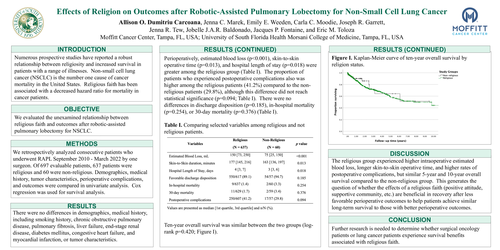
There were no differences in demographics, medical history, including smoking history, chronic obstructive pulmonary disease, pulmonary fibrosis, liver failure, end-stage renal disease, diabetes mellitus, congestive heart failure, and myocardial infarction, or tumor characteristics. Perioperatively, estimated blood loss (p<0.001), skin-to-skin operative time (p=0.013), and hospital length of stay (p=0.018) were greater among the religious group (Table I). The proportion of patients who experienced postoperative complications also was higher among the religious patients (41.2%) compared to the non-religious patients (29.8%), although this difference did not reach statistical significance (p=0.094; Table I). There were no differences in discharge disposition (p=0.185), in-hospital mortality (p=0.254), or 30-day mortality (p=0.376; Table I). Ten-year overall survival was similar between the two groups (log-rank p=0.420; Figure I).
DISCUSSION:
The religious group experienced higher intraoperative estimated blood loss, longer skin-to-skin operative time, and higher rates of postoperative complications, but similar 5-year and 10-year overall survival compared to the non-religious group. This generates the question of whether the effects of a religious faith (positive attitude, supportive community, etc.) are beneficial in recovery after less favorable perioperative outcomes to help patients achieve similar long-term survival to those with better perioperative outcomes.
CONCLUSION:
Further research is needed to determine whether surgical oncology patients or lung cancer patients experience survival benefits associated with religious faith.