167 posters, 28 videos, 9 topics, 12 sessions, 337 authors, 160 institutions
ePostersLive by SciGen Technologies S.A. All rights reserved.
ISMICS 2023 Annual Meeting
31 May - 3 June, 2023 | Boston, MA

D61
Minimally-invasive, Multidisciplinary Approach To Gastropericardial Fistula
Poster Presenter
Authors
Affiliations
Part of Topic
Thoracic Surgery
BACKGROUND:
Gastropericardial fistula is a rare communication between the stomach and pericardial space with high associated morbidity and mortality. Less than one hundred cases have been described in the literature, with the majority of surviving patients undergoing surgical repair. All transthoracic repairs have been performed via open thoracotomy. We describe a minimally-invasive, multidisciplinary approach to this potentially devastating condition.
METHODS:
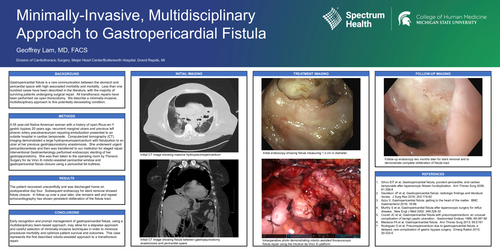
A 55 year-old Native American woman with a history of open Roux-en-Y gastric bypass 20 years ago, recurrent marginal ulcers and previous left phrenic artery pseudoaneurysm requiring embolization presented to an outside hospital in cardiac tamponade. Computerized tomography (CT) imaging demonstrated a large hydropneumopericardium with fistulization to an ulcer at her previous gastrojejunostomy anastomosis. She underwent urgent pericardiocentesis and then was transferred to our institution for staged repair. Interventional Gastroenterology performed endoscopic stenting of her gastrojejunostomy. She was then taken to the operating room by Thoracic Surgery for da Vinci Xi robotic-assisted pericardial window and gastropericardial fistula closure using a pericardial fat buttress.
RESULTS:
The patient recovered uneventfully and was discharged home on postoperative day four. Subsequent endoscopy for stent removal showed fistula closure. In follow up over a year later, she remains well and repeat echocardiography has shown persistent obliteration of the fistula tract.
CONCLUSIONS:
Early recognition and prompt management of gastropericardial fistula, using a multidisciplinary team-based approach, may allow for a stepwise approach and careful selection of minimally-invasive techniques in order to minimize procedural morbidity and optimize patient survival and outcomes. This case represents the first described robotic-assisted approach to a transthoracic repair.