167 posters, 28 videos, 9 topics, 12 sessions, 337 authors, 160 institutions
ePostersLive by SciGen Technologies S.A. All rights reserved.
ISMICS 2023 Annual Meeting
31 May - 3 June, 2023 | Boston, MA

D56
Urgent Robotic Coronary Revascularization In Morbid Obese Patient
Poster Presenter
Authors
Affiliations
Part of Topic
Coronary Revascularization
Video
BACKGROUND
We aim to investigate the role of robotic-assisted coronary surgery by reporting the successful case of a morbidly obese male (BMI=58 kg/m2) who presented at our center with severe coronary disease.
Patient Presentation
A 54-year-old male with a BMI of 58 kg/m2 (194 kg) presented with dyspnea acute chest pain. hypertension, hyperlipidemia, diabetes mellitus type 2, four episodes of pulmonary embolism from deep vein thrombosis of the lower extremities (in treatment with rivaroxaban), statin intolerance, inflammatory bowel disease, neuropathy, chronic opioid use, obstructive sleep apnea, hypothyroidism, asthma, hepatic steatosis, former smoker, and positive family history of cardiac disease.
INVESTIGATIONS
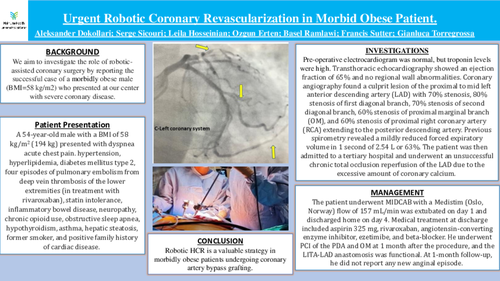
Pre-operative electrocardiogram was normal, but troponin levels were high. Transthoracic echocardiography showed an ejection fraction of 65% and no regional wall abnormalities. Coronary angiography found a culprit lesion of the proximal to mid left anterior descending artery (LAD) with 70% stenosis, 80% stenosis of first diagonal branch, 70% stenosis of second diagonal branch, 60% stenosis of proximal marginal branch (OM), and 60% stenosis of proximal right coronary artery (RCA) extending to the posterior descending artery. Previous spirometry revealed a mildly reduced forced expiratory volume in 1 second of 2.54 L or 63%. The patient was then admitted to a tertiary hospital and underwent an unsuccessful chronic total occlusion reperfusion of the LAD due to the excessive amount of coronary calcium.
MANAGEMENT
The patient underwent MIDCAB with a Medistim (Oslo, Norway) flow of 157 mL/min was extubated on day 1 and discharged home on day 4. Medical treatment at discharge included aspirin 325 mg, rivaroxaban, angiotensin-converting enzyme inhibitor, ezetimibe, and beta-blocker. He underwent PCI of the PDA and OM at 1 month after the procedure, and the LITA-LAD anastomosis was functional. At 1-month follow-up, he did not report any new anginal episode.
CONCLUSION
Robotic HCR is a valuable strategy in morbidly obese patients undergoing coronary artery bypass grafting.