167 posters, 28 videos, 9 topics, 12 sessions, 337 authors, 160 institutions
ePostersLive by SciGen Technologies S.A. All rights reserved.
ISMICS 2023 Annual Meeting
31 May - 3 June, 2023 | Boston, MA

D55
Clinical And Angiographic Outcomes Of Patients Undergoing Reverse Hybrid Revascularization
Poster Presenter
Authors
Affiliations
Part of Topic
Coronary Revascularization
BACKGROUND
We aim to analyze long-term clinical outcomes of robotic-assisted reverse hybrid coronary revascularization (HCR).
METHODS
All consecutive 285 patients that underwent reverse robotic-assisted HCR between 09/2005-07/2021 are included. Reverse HCR consists of percutaneous coronary intervention (PCI) with stent implantation in non-left anterior descending (LAD) coronary artery vessels performed within 30-days prior to robotic-assisted left internal thoracic artery (LITA) harvesting and LITA to LAD anastomosis through a 4-cm left minithoracotomy. Dual antiplatelet therapy was not interrupted on any patient.
RESULTS
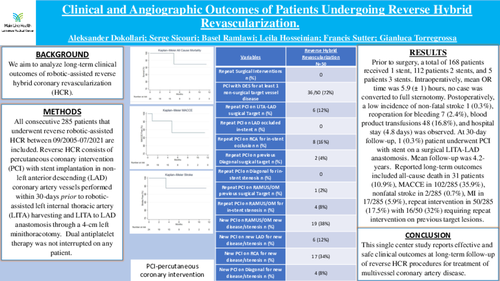
Prior to surgery, a total of 168 patients received 1 stent, 112 patients 2 stents, and 5 patients 3 stents. Intraoperatively, mean OR time was 5.9 (± 1) hours, no case was converted to full sternotomy. Postoperatively, a low incidence of non-fatal stroke 1 (0.3%), reoperation for bleeding 7 (2.4%), blood product transfusions 48 (16.8%), and hospital stay (4.8 days) was observed. At 30-day follow-up, 1 (0.3%) patient underwent PCI with stent on a surgical LITA-LAD anastomosis. Mean follow-up was 4.2-years. Reported long-term outcomes included all-cause death in 31 patients (10.9%), MACCE in 102/285 (35.9%), nonfatal stroke in 2/285 (0.7%), MI in 17/285 (5.9%), repeat intervention in 50/285 (17.5%) with 16/50 (32%) requiring repeat intervention on previous target lesions.
CONCLUSION
This single center study reports effective and safe clinical outcomes at long-term follow-up of reverse HCR procedures for treatment of multivessel coronary artery disease.