167 posters, 28 videos, 9 topics, 12 sessions, 337 authors, 160 institutions
ePostersLive by SciGen Technologies S.A. All rights reserved.
ISMICS 2023 Annual Meeting
31 May - 3 June, 2023 | Boston, MA

D52
Retrospective Single-surgeon Study Of Outcomes After Minimally Invasive Coronary Surgery For Elderly Patients
Poster Presenter
Authors
Affiliations
Part of Topic
Coronary Revascularization
Retrospective Single-surgeon Study Of Outcomes
After Minimally Invasive Coronary Surgery For Elderly Patients
Ryota Nakamura, Keita Kikuchi, Joji Ito, Yuichi Nakamura, Ryota Hara, Kunihiko Yoshino, Kyoko Shigetomi and Koji Fukita
Tokyo Bay Urayasu Ichikawa Medical Center, Chiba, Japan
Introduction
MICS-CABG (Minimally Invasive Cardiac Surgery-Coronary Artery Bypass Grafting), performed via a small intercostal incision, offers potential benefits over conventional sternotomy including reduced postoperative pain and bleeding risk1. Additionally, its minimally invasive nature may facilitate faster recovery process and early return to daily activities1. These advantages are particularly significant for patients with increased complication risk, such as the elderly or those with comorbidities. However, data regarding MICS-CABG outcomes in ultra-elderly patients (80 years and older) remain scarce.
This study analyzes the surgical outcomes of MICS-CABG in ultra-elderly patients and investigates its feasibility in this patient population.
Methods
This observational case-control study was designed to analyze patients who underwent MICS-CABG performed by a single surgeon across multiple facilities (including Yamato Seiwa Hospital, Wuhan Asia Heart Disease Hospital, Ichinomiya Nishi Hospital, Yuai Medical Center (formerly Tomigusuku Chuo Hospital), and Tokyo Bay Urayasu Ichikawa Medical Center) between January 2012 and April 2022. Patients were stratified into two groups based on age: those 80 years or older (ultra-elderly group) and those under 80 were (non-elderly group). Evaluated outcomes included:
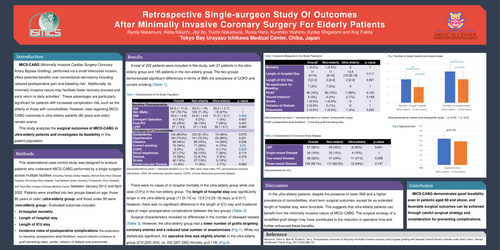
A total of 222 patients were included in this study, with 27 patients in the ultra-elderly group and 195 patients in the non-elderly group. The two groups demonstrated significant differences in terms of BMI, the prevalence of COPD and current smoking (Table 1).
Table.1 Characteristics of the Study Population
There were no cases of in-hospital mortality in the ultra-elderly group while one case (0.5%) in the non-elderly group. The length of hospital stay was significantly longer in the ultra-elderly group (11 [9-14] vs. 13.5 [10.25-18] days, p=0.017). However, there was no significant difference in the length of ICU stay and incidence rates of major postoperative complications between the two groups (Table 2).
Surgical characteristics revealed no differences in the number of diseased vessels (Table 3). However, the ultra-elderly group had a lower number of grafts targeting coronary arteries and a reduced total number of anastomoses (Fig.1). While not statistically significant, the operative time was slightly shorter in the ultra-elderly group (270 [202-324] vs. 242 [207-282] minutes, p=0.118) (Fig.2).
Table.2 Outcome Measures in the Study Population
Table.3 Characteristics of Coronary Artery Disease
Discussion
In the ultra-elderly patients, despite the presence of lower BMI and a higher prevalence of comorbidities, short-term surgical outcomes, except for an extended length of hospital stay, were favorable. This suggests that ultra-elderly patients can benefit from the minimally invasive nature of MICS-CABG. The surgical strategy of a simplified graft design may have contributed to the reduction in operative time and further enhanced these benefits.
Conclusion
MICS-CABG demonstrates good feasibility even in patients aged 80 and above, and favorable surgical outcomes can be achieved through careful surgical strategy and consideration for preventing complications.
Reference
Kikuchi K, Chen X, Mori M, Kurata A, Tao L. Perioperative outcomes of off-pump minimally invasive coronary artery bypass grafting with bilateral internal thoracic arteries under direct vision. Interact Cardiovasc Thorac Surg. 2017;24(5):696-701.