167 posters, 28 videos, 9 topics, 12 sessions, 337 authors, 160 institutions
ePostersLive by SciGen Technologies S.A. All rights reserved.
ISMICS 2023 Annual Meeting
31 May - 3 June, 2023 | Boston, MA

D51
Robot-assisted Coronary Artery Bypass Grafting In A Single Academic Center: Preliminary Results
Poster Presenter
Authors
Ivan Murrieta-Alvarez, Susana Lopez-Alamillo, Zachary D. Gray, Kenneth K. Liao
Affiliations
Part of Topic
Coronary Revascularization
Background
The Robot-assisted (RA) techniques for surgical coronary revascularization have been developed to achieve a less invasive alternative to conventional coronary artery bypass grafting (CABG) to improve postoperative recovery, patient satisfaction, and early discharge. This is particularly useful in selected patients with higher morbidity and mortality risk that could benefit from hybrid revascularization. This study aimed to compare the feasibility of RA-CABG for one-stage versus hybrid two-stage revascularization.
Methods
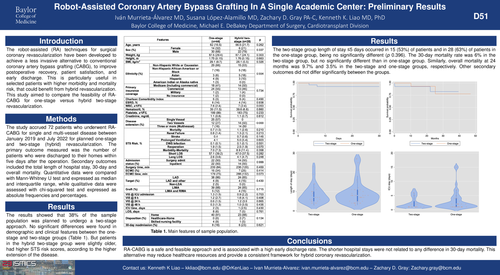
The study accrued 72 patients who underwent RA CABG for single and multi-vessel disease between January 2019 and July 2022 for planned one-stage and two-stage (hybrid) revascularization. The primary outcome measured was the number of patients who were discharged to their homes within five days after the operation. Secondary outcomes included the total length of hospital stay, 30-day, and overall mortality. Quantitative data were compared with the Mann-Whitney U test and expressed as a median and interquartile range. In contrast, qualitative data were assessed with a chi-squared test and expressed as absolute frequencies and percentages.
Results
The results showed that 38 of the sample population was planned to undergo a two-stage approach. No significant differences between the one-stage and two-stage groups were found in demographic and clinical features (Table 1). But patients in the hybrid two-stage group were slightly older and had higher STS risk scores, according to the higher extension of the disease. The two-stage group length of stay of five days occurred in 15 53 of the patients and in 28 63 of the patients in the one-stage group, being no significantly different p 0 396 The 30-day mortality rate was 6 in the two-stage group, but not significantly different than in one stage group Similarly, overall mortality at 24 months was 9 7 and 3 5 in the two-stage. One-stage groups, respectively. Other secondary outcomes did not differ significantly between the groups.
Conclusions
RA-CABG is a safe and feasible approach associated with a high early discharge rate. The shorter hospital stays were not related to any difference in 30-day mortality. This alternative may reduce healthcare resources and provide a consistent framework for hybrid coronary revascularization.