167 posters, 28 videos, 9 topics, 12 sessions, 337 authors, 160 institutions
ePostersLive by SciGen Technologies S.A. All rights reserved.
ISMICS 2023 Annual Meeting
31 May - 3 June, 2023 | Boston, MA

D45
Clinical Outcomes Of A Surgeon In The First Year Of Robotic Coronary Revascularization Independent Clinical Practice.
Poster Presenter
Authors
Affiliations
Part of Topic
Coronary Revascularization
AIM
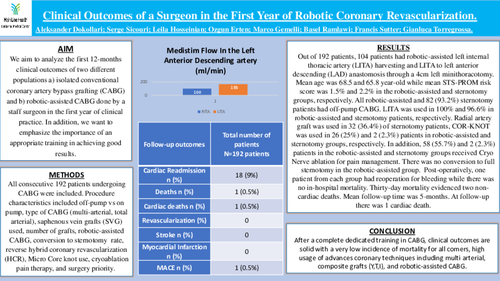
We aim to analyze the first 12-months clinical outcomes of two different populations a) isolated conventional coronary artery bypass grafting (CABG) and b) robotic-assisted CABG done by a staff surgeon in the first year of clinical practice. In addition, we want to emphasize the importance of an appropriate training in achieving good results.
METHODS
All consecutive 192 patients undergoing CABG were included. Procedure characteristics included off-pump vs on pump, type of CABG (multi-arterial, total arterial), saphenous vein grafts (SVG) used, number of grafts, robotic-assisted CABG, conversion to sternotomy rate, reverse hybrid coronary revascularization (HCR), Micro Core knot use, cryoablation pain therapy, and surgery priority.
RESULTS
Out of 192 patients, 104 patients had robotic-assisted left internal thoracic artery (LITA) harvesting and LITA to left anterior descending (LAD) anastomosis through a 4cm left minithoracotomy. Mean age was 68.5 and 65.8 year-old while mean STS-PROM risk score was 1.5% and 2.2% in the robotic-assisted and sternotomy groups, respectively. All robotic-assisted and 82 (93.2%) sternotomy patients had off-pump CABG. LITA was used in 100% and 96.6% in robotic-assisted and sternotomy patients, respectively. Radial artery graft was used in 32 (36.4%) of sternotomy patients, COR-KNOT was used in 26 (25%) and 2 (2.3%) patients in robotic-assisted and sternotomy groups, respectively. In addition, 58 (55.7%) and 2 (2.3%) patients in the robotic-assisted and sternotomy groups received Cryo Nerve ablation for pain management. There was no conversion to full sternotomy in the robotic-assisted group. Post-operatively, one patient from each group had reoperation for bleeding while there was no in-hospital mortality. Thirty-day mortality evidenced two non-cardiac deaths. Mean follow-up time was 5-months. At follow-up there was 1 cardiac death.
CONCLUSION
After a complete dedicated training in CABG, clinical outcomes are solid with a very low incidence of mortality for all comers, high usage of advances coronary techniques including multi arterial, composite grafts (Y,T,I), and robotic-assisted CABG.