477 posters, 14 topics, 2,065 authors, 1,055 institutions
ePostersLive by SciGen Technologies S.A. All rights reserved.
The Joint EBJIS-MSIS 2026 Conference
17 - 19 September, 2026 | Porto, Portugal

PP69
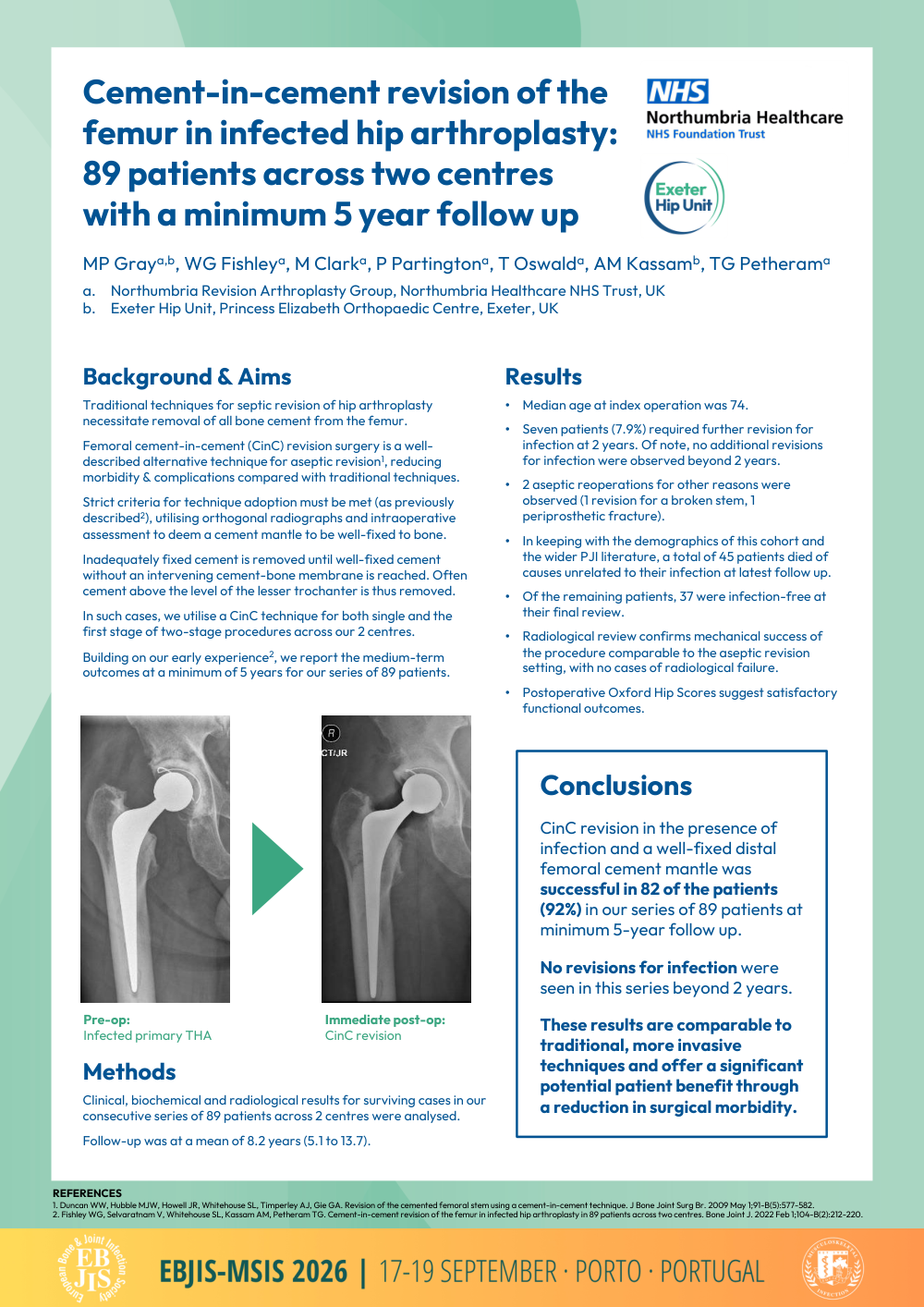
Cement-in-cement revision of the femur in infected hip arthroplasty in 89 patients across two centres with medium term follow up
Part of Topic
Prosthetic Joint Infections
Cement-in-cement revision of the
femur in infected hip arthroplasty:
89 patients across two centres
with a minimum 5 year follow up
MP Graya,b, WG Fishleya, M Clarka, P Partingtona, T Oswalda, AM Kassamb, TG Petherama
a. Northumbria Revision Arthroplasty Group, Northumbria Healthcare NHS Trust, UK
b. Exeter Hip Unit, Princess Elizabeth Orthopaedic Centre, Exeter, UK
Background & Aims
Traditional techniques for septic revision of hip arthroplasty
necessitate removal of all bone cement from the femur.
Femoral cement-in-cement (CinC) revision surgery is a welldescribed
alternative technique for aseptic revision1, reducing
morbidity & complications compared with traditional techniques.
Strict criteria for technique adoption must be met (as previously
described2), utilising orthogonal radiographs and intraoperative
assessment to deem a cement mantle to be well-fixed to bone.
Inadequately fixed cement is removed until well-fixed cement
without an intervening cement-bone membrane is reached. Often
cement above the level of the lesser trochanter is thus removed.
In such cases, we utilise a CinC technique for both single and the
first stage of two-stage procedures across our 2 centres.
Building on our early experience2, we report the medium-term
outcomes at a minimum of 5 years for our series of 89 patients.
Results
• Median age at index operation was 74.
• Seven patients (7.9%) required further revision for
infection at 2 years. Of note, no additional revisions
for infection were observed beyond 2 years.
• 2 aseptic reoperations for other reasons were
observed (1 revision for a broken stem, 1
periprosthetic fracture).
• In keeping with the demographics of this cohort and
the wider PJI literature, a total of 45 patients died of
causes unrelated to their infection at latest follow up.
• Of the remaining patients, 37 were infection-free at
their final review.
• Radiological review confirms mechanical success of
the procedure comparable to the aseptic revision
setting, with no cases of radiological failure.
• Postoperative Oxford Hip Scores suggest satisfactory
functional outcomes.
Methods
Clinical, biochemical and radiological results for surviving cases in our
consecutive series of 89 patients across 2 centres were analysed.
Follow-up was at a mean of 8.2 years (5.1 to 13.7).
Conclusions
CinC revision in the presence of
infection and a well-fixed distal
femoral cement mantle was
successful in 82 of the patients
(92%) in our series of 89 patients at
minimum 5-year follow up.
No revisions for infection were
seen in this series beyond 2 years.
These results are comparable to
traditional, more invasive
techniques and offer a significant
potential patient benefit through
a reduction in surgical morbidity.