477 posters, 14 topics, 2,065 authors, 1,055 institutions
ePostersLive by SciGen Technologies S.A. All rights reserved.
The Joint EBJIS-MSIS 2026 Conference
17 - 19 September, 2026 | Porto, Portugal

PP68
Cutibacteria in periprosthetic hip joint infections a 10-year retrospective study from a regional Swedish hospital
Poster Presenter
Authors
Affiliations
Department of Infectious Diseases, NU Hospital Group, Trollh?ttan/Uddevalla, Sweden; Department of Infectious Diseases, Institute of Biomedicine, Sahlgrenska Academy, University of Gothenburg, Gothenburg, Sweden, NU Hospital Group, Trollh?ttan/Uddevalla, Sweden, Department of Orthopaedic Surgery, NU Hospital Group, Trollh?ttan/Uddevalla, Sweden, NU Hospital Group, Trollh?ttan
Part of Topic
Prosthetic Joint Infections
Introduction and aim Cutibacterium acnes is the leading cause of periprosthetic shoulder joint infections (PJIs). Its role in hip PJIs is less described and the relation between infection and colonization debated. This study aimed to describe all Cutibacterium hip PJIs during a 10-year period in a Swedish regional hospital regarding patient characteristics, Cutibacterium subspecies, clinical picture, surgical and antibiotical treatment strategies, and long-term outcome.
Methods All patients with Cutibacterium species (spp.) hip PJIs between January 2015 and December 2024 were identified and their medical journals retrospectively reviewed. Patients with growth of Cutibacterium spp. in ≥ two tissue cultures or joint fluid were included.
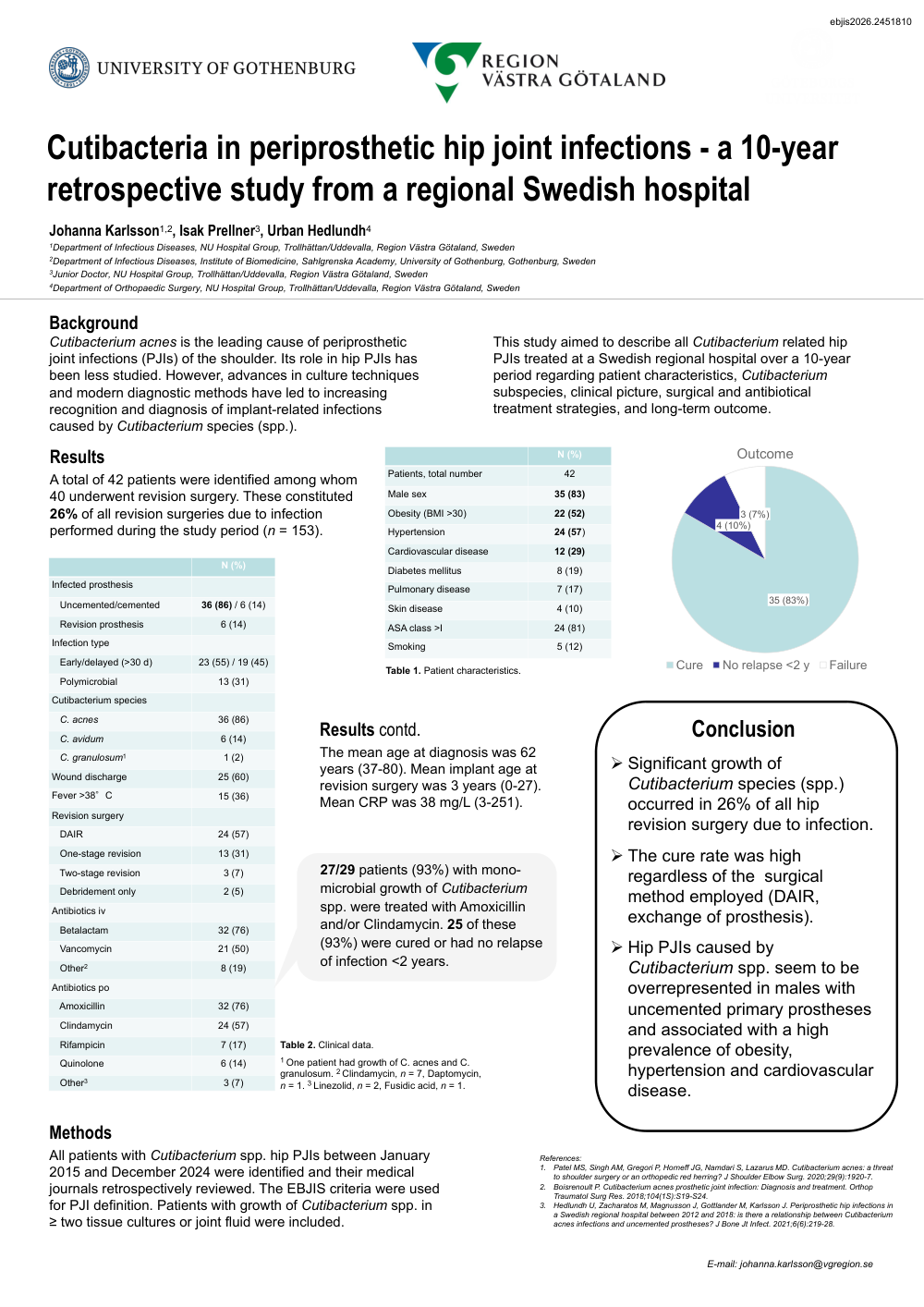
Results A total of 42 patients were identified with a mean age of 62 years. Thirty-five (83%) were male. Obesity (BMI ≥30) was found in 22/42 patients (52%), hypertonia in 24/42 (57%), cardiovascular disease in 12/42 (29%), and diabetes in 8/42 (19%). An uncemented primary prosthesis was present in 36/42 patients (86%). In 23/42 cases (55%) the patient had an early infection (debut <30 days after reconstructive surgery), in 19/42 cases (45%) the infection was delayed (≥30 days). Thirteen patients (31%) had a polymicrobial infection, most commonly with CoNS (8/13, 62%). In 36 cases (86%) tissue cultures were positive for C. acnes, in six cases for C. avidum (14%), and in one case for C. granulosum combined with C. acnes. Mean CRP was 38 (2.8-251). Debridement, antibiotics and implant retention (DAIR) was the most common surgical intervention (24/42, 57%), one-stage revision was performed in 13 cases (31%), and two-stage revision in 3 cases (7%), all procedures performed by a lateral approach. Two patients were surgically debrided without exchange of prostheses and further put on life-long suppressive antibiotics. Beta-lactam antibiotics were used in 76% (32/42) of the patients. Cure, defined as no clinical or laboratory sign of infection at two years follow-up, was seen in 35 patients (83%) while 3 patients (7%) had a treatment failure with pertaining or relapsing Cutibacterium infection. Four further patients were followed less than two years at study inclusion but showed no sign of relapse at study follow-up.
Conclusions Hip PJIs caused by Cutibacterium spp. seem to be overrepresented in males with uncemented primary prostheses and with a high prevalence of obesity, hypertonia and cardiovascular disease.