477 posters, 14 topics, 2,065 authors, 1,055 institutions
ePostersLive by SciGen Technologies S.A. All rights reserved.
The Joint EBJIS-MSIS 2026 Conference
17 - 19 September, 2026 | Porto, Portugal

PP65
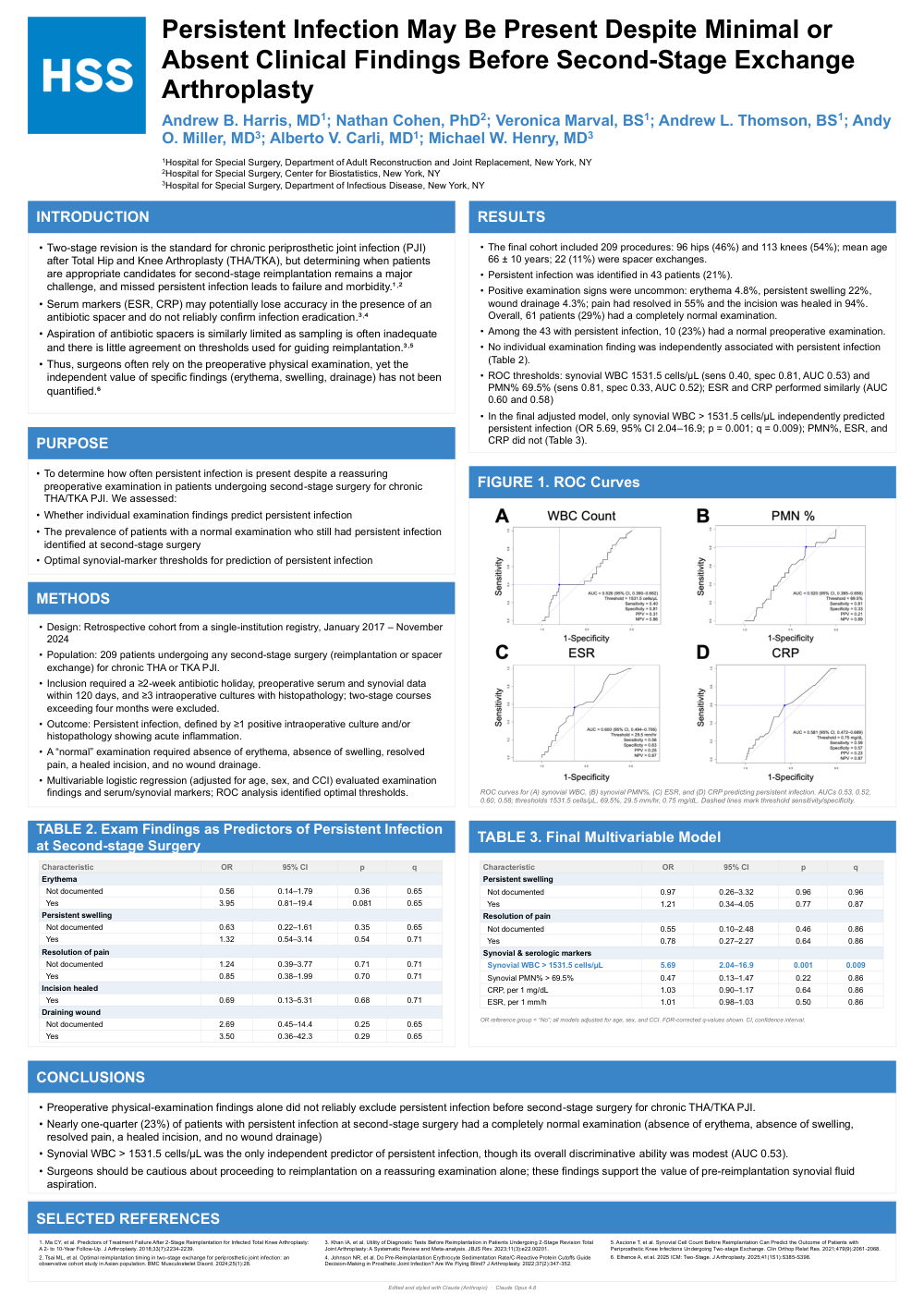
Persistent Infection May Be Present Despite Minimal or Absent Clinical Findings Before Second-Stage Exchange Arthroplasty
Poster Presenter
Part of Topic
Prosthetic Joint Infections
Persistent Infection May Be Present Despite Minimal or Absent Clinical Findings Before Second-Stage Exchange Arthroplasty
Andrew B. Harris, MD1; Nathan Cohen, PhD2; Veronica Marval, BS1; Andrew L. Thomson, BS1; Andy O. Miller, MD3; Alberto V. Carli, MD1; Michael W. Henry, MD3
1Hospital for Special Surgery, Department of Adult Reconstruction and Joint Replacement, New York, NY
2Hospital for Special Surgery, Center for Biostatistics, New York, NY
3Hospital for Special Surgery, Department of Infectious Disease, New York, NY
INTRODUCTION
Two-stage revision is the standard for chronic periprosthetic joint infection (PJI) after Total Hip and Knee Arthroplasty (THA/TKA), but determining when patients are appropriate candidates for second-stage reimplantation remains a major challenge, and missed persistent infection leads to failure and morbidity.¹,²
Serum markers (ESR, CRP) may potentially lose accuracy in the presence of an antibiotic spacer and do not reliably confirm infection eradication.³,⁴
Aspiration of antibiotic spacers is similarly limited as sampling is often inadequate and there is little agreement on thresholds used for guiding reimplantation.³,⁵
Thus, surgeons often rely on the preoperative physical examination, yet the independent value of specific findings (erythema, swelling, drainage) has not been quantified.⁶
PURPOSE
To determine how often persistent infection is present despite a reassuring preoperative examination in patients undergoing second-stage surgery for chronic THA/TKA PJI. We assessed:
Whether individual examination findings predict persistent infection
The prevalence of patients with a normal examination who still had persistent infection identified at second-stage surgery
Optimal synovial-marker thresholds for prediction of persistent infection
METHODS
Design: Retrospective cohort from a single-institution registry, January 2017 – November 2024
Population: 209 patients undergoing any second-stage surgery (reimplantation or spacer exchange) for chronic THA or TKA PJI.
Inclusion required a ≥2-week antibiotic holiday, preoperative serum and synovial data within 120 days, and ≥3 intraoperative cultures with histopathology; two-stage courses exceeding four months were excluded.
Outcome: Persistent infection, defined by ≥1 positive intraoperative culture and/or histopathology showing acute inflammation.
A “normal” examination required absence of erythema, absence of swelling, resolved pain, a healed incision, and no wound drainage.
Multivariable logistic regression (adjusted for age, sex, and CCI) evaluated examination findings and serum/synovial markers; ROC analysis identified optimal thresholds.
RESULTS
The final cohort included 209 procedures: 96 hips (46%) and 113 knees (54%); mean age 66 ± 10 years; 22 (11%) were spacer exchanges.
Persistent infection was identified in 43 patients (21%).
Positive examination signs were uncommon: erythema 4.8%, persistent swelling 22%, wound drainage 4.3%; pain had resolved in 55% and the incision was healed in 94%. Overall, 61 patients (29%) had a completely normal examination.
Among the 43 with persistent infection, 10 (23%) had a normal preoperative examination.
No individual examination finding was independently associated with persistent infection (Table 2).
ROC thresholds: synovial WBC 1531.5 cells/µL (sens 0.40, spec 0.81, AUC 0.53) and PMN% 69.5% (sens 0.81, spec 0.33, AUC 0.52); ESR and CRP performed similarly (AUC 0.60 and 0.58)
In the final adjusted model, only synovial WBC > 1531.5 cells/µL independently predicted persistent infection (OR 5.69, 95% CI 2.04–16.9; p = 0.001; q = 0.009); PMN%, ESR, and CRP did not (Table 3).
FIGURE 1. ROC Curves
ROC curves for (A) synovial WBC, (B) synovial PMN%, (C) ESR, and (D) CRP predicting persistent infection. AUCs 0.53, 0.52, 0.60, 0.58; thresholds 1531.5 cells/µL, 69.5%, 29.5 mm/hr, 0.75 mg/dL. Dashed lines mark threshold sensitivity/specificity.
TABLE 2. Exam Findings as Predictors of Persistent Infection at Second-stage Surgery
Characteristic | OR | 95% CI | p | q
Erythema
Not documented | 0.56 | 0.14–1.79 | 0.36 | 0.65
Yes | 3.95 | 0.81–19.4 | 0.081 | 0.65
Persistent swelling
Not documented | 0.63 | 0.22–1.61 | 0.35 | 0.65
Yes | 1.32 | 0.54–3.14 | 0.54 | 0.71
Resolution of pain
Not documented | 1.24 | 0.39–3.77 | 0.71 | 0.71
Yes | 0.85 | 0.38–1.99 | 0.70 | 0.71
Incision healed
Yes | 0.69 | 0.13–5.31 | 0.68 | 0.71
Draining wound
Not documented | 2.69 | 0.45–14.4 | 0.25 | 0.65
Yes | 3.50 | 0.36–42.3 | 0.29 | 0.65
TABLE 3. Final Multivariable Model
Characteristic | OR | 95% CI | p | q
Persistent swelling
Not documented | 0.97 | 0.26–3.32 | 0.96 | 0.96
Yes | 1.21 | 0.34–4.05 | 0.77 | 0.87
Resolution of pain
Not documented | 0.55 | 0.10–2.48 | 0.46 | 0.86
Yes | 0.78 | 0.27–2.27 | 0.64 | 0.86
Synovial & serologic markers
Synovial WBC > 1531.5 cells/µL | 5.69 | 2.04–16.9 | 0.001 | 0.009
Synovial PMN% > 69.5% | 0.47 | 0.13–1.47 | 0.22 | 0.86
CRP, per 1 mg/dL | 1.03 | 0.90–1.17 | 0.64 | 0.86
ESR, per 1 mm/h | 1.01 | 0.98–1.03 | 0.50 | 0.86
OR reference group = “No”; all models adjusted for age, sex, and CCI. FDR-corrected q-values shown. CI, confidence interval.
CONCLUSIONS
Preoperative physical-examination findings alone did not reliably exclude persistent infection before second-stage surgery for chronic THA/TKA PJI.
Nearly one-quarter (23%) of patients with persistent infection at second-stage surgery had a completely normal examination (absence of erythema, absence of swelling, resolved pain, a healed incision, and no wound drainage)
Synovial WBC > 1531.5 cells/µL was the only independent predictor of persistent infection, though its overall discriminative ability was modest (AUC 0.53).
Surgeons should be cautious about proceeding to reimplantation on a reassuring examination alone; these findings support the value of pre-reimplantation synovial fluid aspiration.
SELECTED REFERENCES
1. Ma CY, et al. Predictors of Treatment Failure After 2-Stage Reimplantation for Infected Total Knee Arthroplasty: A 2- to 10-Year Follow-Up. J Arthroplasty. 2018;33(7):2234-2239.
2. Tsai ML, et al. Optimal reimplantation timing in two-stage exchange for periprosthetic joint infection: an observative cohort study in Asian population. BMC Musculoskelet Disord. 2024;25(1):28.
3. Khan IA, et al. Utility of Diagnostic Tests Before Reimplantation in Patients Undergoing 2-Stage Revision Total Joint Arthroplasty: A Systematic Review and Meta-analysis. JBJS Rev. 2023;11(3):e22.00201.
4. Johnson NR, et al. Do Pre-Reimplantation Erythrocyte Sedimentation Rate/C-Reactive Protein Cutoffs Guide Decision-Making in Prosthetic Joint Infection? Are We Flying Blind? J Arthroplasty. 2022;37(2):347-352.
5. Ascione T, et al. Synovial Cell Count Before Reimplantation Can Predict the Outcome of Patients with Periprosthetic Knee Infections Undergoing Two-stage Exchange. Clin Orthop Relat Res. 2021;479(9):2061-2068.
6. Elhence A, et al. 2025 ICM: Two-Stage. J Arthroplasty. 2025;41(1S1):S385-S398.