477 posters, 14 topics, 2,065 authors, 1,055 institutions
ePostersLive by SciGen Technologies S.A. All rights reserved.
The Joint EBJIS-MSIS 2026 Conference
17 - 19 September, 2026 | Porto, Portugal

PP48
In Vitro Assessment of Taurolidine Antimicrobial Properties: Implications for Prevention of Periprosthetic Joint Infection (PJI)
Poster Presenter
Authors
Yu Ning, Kun Shi, Stephanie Maria Kirschbaum, Andrej Trampuz, Arne Kienzle, Svetlana Karbysheva
Affiliations
Centrum F?r Muskuloskeletale Chirurgie (cmsc),Charit?-Universit?tsmedizin Berlin, Berlin, Germany, School of Medicine, Faculty of Health, Queensland University of Technology, Brisbane, Australia; Royal Brisbane and Women's Hospital, Herston, Australia, Centrum F?r Muskuloskeletale Chirurgie (cmsc),Charit?-Universit?tsmedizin Berlin
Part of Topic
Prosthetic Joint Infections
Periprosthetic joint infection (PJI) is a serious complication of joint arthroplasty, largely attributable to biofilms that shield bacteria from host immune responses and reduce the efficacy of conventional antibiotics.
Taurolidine (TLD), a broad-spectrum antimicrobial agent, is active against a wide range of bacterial and fungal pathogens, including antibiotic-resistant strains. Owing to its favorable safety profile, low toxicity, and lack of resistance induction, it has been used clinically as a catheter lock solution and to prevent contamination of active cardiac implants. The present study evaluated the antibiofilm efficacy of TLD in comparison with standard Ringer's solution (RS) lavage using a validated in vitro biofilm model.
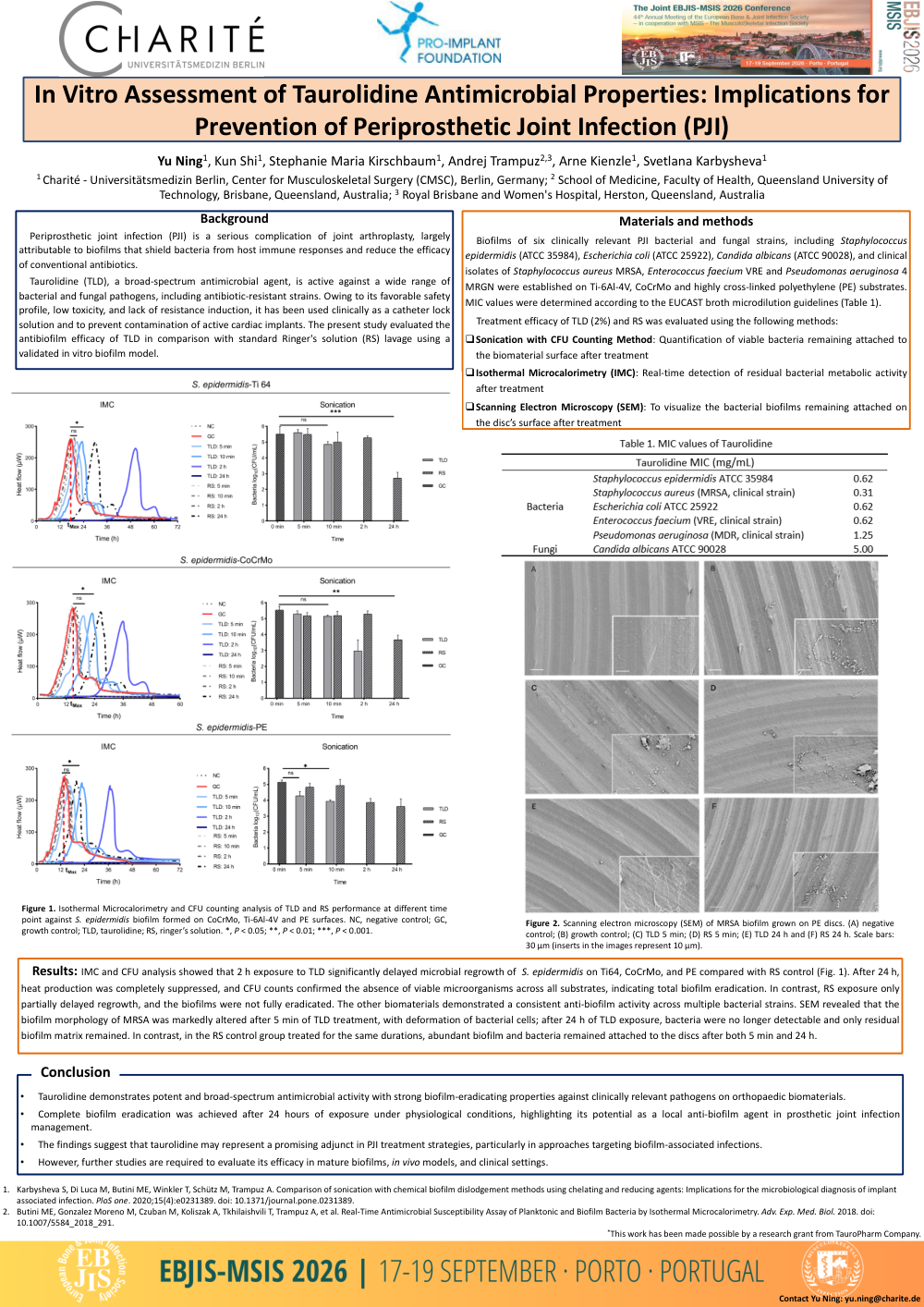
Materials and methods: Biofilms of six clinically relevant PJI bacterial and fungal strains, including Staphylococcus epidermidis (ATCC 35984), Escherichia coli (ATCC 25922), Candida albicans (ATCC 90028), and clinical isolates of Staphylococcus aureus MRSA, Enterococcus faecium VRE and Pseudomonas aeruginosa 4 MRGN were established on Ti-6Al-4V, CoCrMo and highly cross-linked polyethylene (PE) substrates. MIC values were determined according to the EUCAST broth microdilution guidelines.
Treatment efficacy of TLD (2%) and RS was evaluated using the following methods:
Sonication with CFU Counting Method: Quantification of viable bacteria remaining attached to the biomaterial surface after treatment;
Isothermal Microcalorimetry (IMC): Real-time detection of residual bacterial metabolic activity after treatment;
Scanning Electron Microscopy (SEM): To visualize the bacterial biofilms remaining attached on the disc’s surface after treatment.
Results: IMC and CFU analysis showed that 2 h exposure to TLD significantly delayed microbial regrowth of S. epidermidis on Ti64, CoCrMo, and PE compared with RS control (Fig. 1). After 24 h, heat production was completely suppressed, and CFU counts confirmed the absence of viable microorganisms across all substrates, indicating total biofilm eradication. In contrast, RS exposure only partially delayed regrowth, and the biofilms were not fully eradicated. The other biomaterials demonstrated a consistent anti-biofilm activity across multiple bacterial strains. SEM revealed that the biofilm morphology of MRSA was markedly altered after 5 min of TLD treatment, with deformation of bacterial cells; after 24 h of TLD exposure, bacteria were no longer detectable and only residual biofilm matrix remained. In contrast, in the RS control group treated for the same durations, abundant biofilm and bacteria remained attached to the discs after both 5 min and 24 h.
Conclusion: Taurolidine demonstrates potent and broad-spectrum antimicrobial activity with strong biofilm-eradicating properties against clinically relevant pathogens on orthopaedic biomaterials.
Complete biofilm eradication was achieved after 24 hours of exposure under physiological conditions, highlighting its potential as a local anti-biofilm agent in prosthetic joint infection management.
The findings suggest that taurolidine may represent a promising adjunct in PJI treatment strategies, particularly in approaches targeting biofilm-associated infections.
However, further studies are required to evaluate its efficacy in mature biofilms, in vivo models, and clinical settings.