477 posters, 14 topics, 2,065 authors, 1,055 institutions
ePostersLive by SciGen Technologies S.A. All rights reserved.
The Joint EBJIS-MSIS 2026 Conference
17 - 19 September, 2026 | Porto, Portugal

PP45
Knee Arthrodesis With Modular Cemented Intramedullary Nail Following Infected Total Knee Arthroplasty: Patient-Reported Satisfaction And Functional Outcomes
Poster Presenter
Authors
Luigi Zanna, Jacopo Corti, Marco Distefano, Francesco Raspanti, Niccolò Giabbani, Marco Mugnaini
Affiliations
Santa Maria Annunziata Hospital, Department Of Orthopaedic, Asl Toscana Centro, Bagno A Ripoli, Florence, Italy, Santa Maria Annunziata Hospital, Department Of Orthopaedic, Asl Toscana Centro, Bagno A Ripoli, Florence
Part of Topic
Prosthetic Joint Infections
MODULAR INTRAMEDULLARY KNEE ARTHRODESIS FOR CHRONIC PERIPROSTHETIC JOINT INFECTION AFTER TOTAL KNEE ARTHROPLASTY: PATIENT-REPORTED SATISFACTION AND FUNCTIONAL OUTCOMES
Luigi Zanna, Jacopo Corti, Francesco Raspanti, Marco Distefano, Niccolò Giabbani, Matteo Piccica, Marco Mugnaini
Department of Orthopaedic Surgery, Santa Maria Annunziata Hospital, Azienda USL Toscana Centro, Bagno a Ripoli, Florence, Italy,
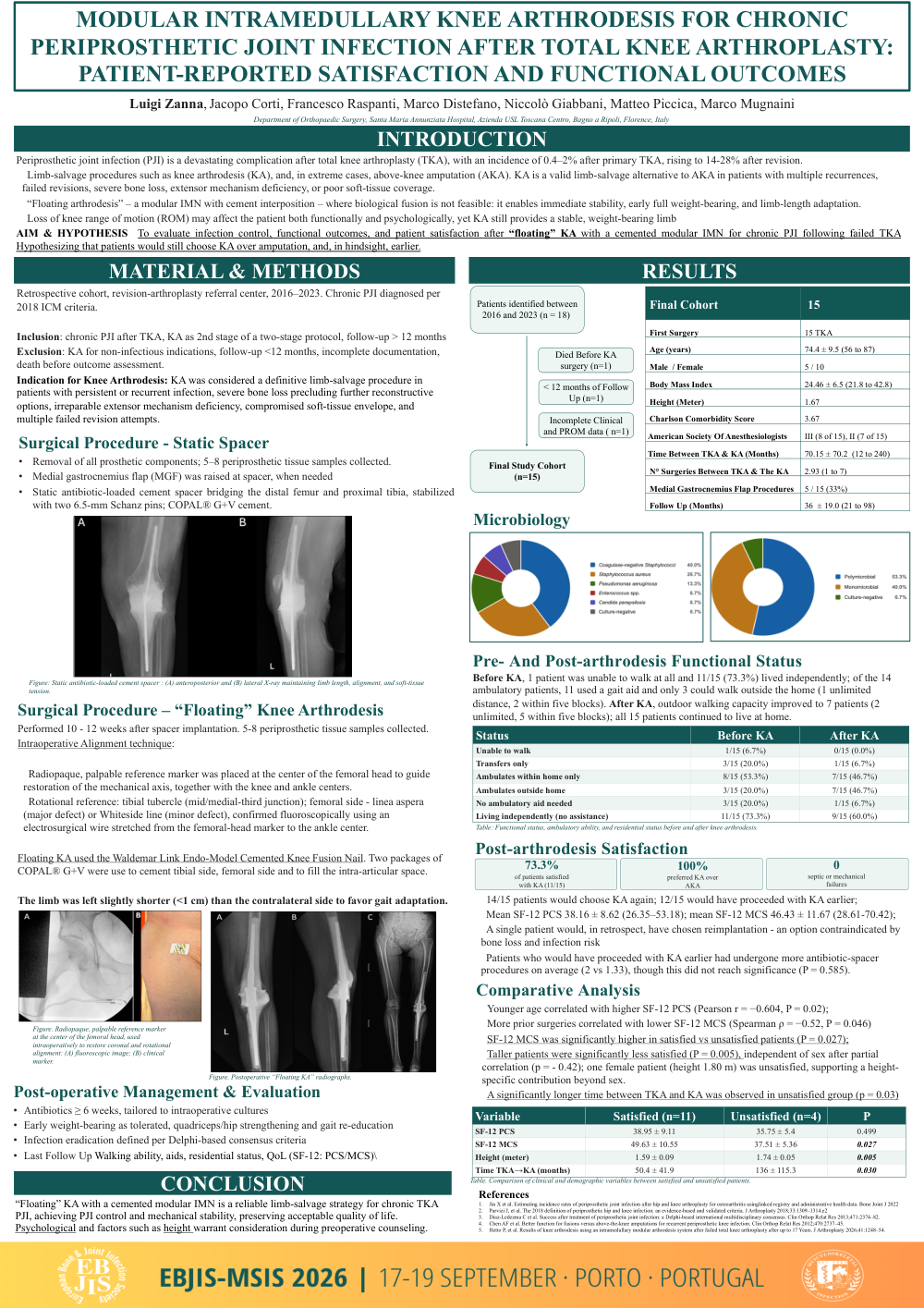
Introduction: Periprosthetic joint infection (PJI) is a devastating complication after total knee arthroplasty (TKA), with an incidence of 0.4–2% after primary TKA, rising to 14–28% after revision. Knee arthrodesis (KA) is a valid limb-salvage alternative to above-knee amputation in patients with multiple recurrences, failed revisions, severe bone loss, extensor mechanism deficiency, or poor soft-tissue coverage. "Floating arthrodesis" — a modular intramedullary nail with cement interposition — enables immediate stability, early full weight-bearing, and limb-length adaptation when biological fusion is not feasible.
Aim: To evaluate infection control, functional outcomes, and patient satisfaction after "floating" KA with a cemented modular intramedullary nail for chronic PJI following failed TKA, hypothesizing that patients would still choose KA over amputation, and, in hindsight, earlier.
Materials & Methods: Retrospective cohort study at a revision-arthroplasty referral center (2016–2023). Chronic PJI was diagnosed per 2018 ICM criteria. Inclusion criteria: chronic PJI after TKA, KA as the second stage of a two-stage protocol, follow-up >12 months. A static antibiotic-loaded cement spacer was placed first, followed by floating KA using the Waldemar Link Endo-Model Cemented Knee Fusion Nail 10–12 weeks later. Outcomes assessed included infection eradication, ambulatory status, residential status, quality of life (SF-12 PCS/MCS), and patient satisfaction.
Results: The final cohort included 15 patients (mean age 74.4 ± 9.5 years, 5 male/10 female), with a mean follow-up of 36 ± 19.0 months. No septic or mechanical failures were recorded. Outdoor walking capacity improved from 3/15 (20.0%) before KA to 7/15 (46.7%) after KA, and 11/15 (73.3%) patients lived independently before surgery versus 9/15 (60.0%) after. Overall, 73.3% of patients (11/15) were satisfied with KA, 100% preferred KA over amputation, and 14/15 patients would choose KA again. Satisfaction was significantly associated with higher SF-12 MCS scores (P=0.027), shorter height (P=0.005), and shorter time between TKA and KA (P=0.030).
Conclusion: "Floating" KA with a cemented modular intramedullary nail is a reliable limb-salvage strategy for chronic TKA PJI, achieving infection control and mechanical stability while preserving acceptable quality of life. Psychological factors and patient height warrant consideration during preoperative counseling.