477 posters, 14 topics, 2,052 authors, 1,056 institutions
ePostersLive by SciGen Technologies S.A. All rights reserved.
The Joint EBJIS-MSIS 2026 Conference
17 - 19 September, 2026 | Porto, Portugal

PP44
Reinfection and Complication Rates in Two-Stage Revision for Chronic Hip Periprosthetic Joint Infections Using the Direct Anterior Approach
Poster Presenter
Authors
Sebastian Simon, Jennyfer A Mitterer, Bernhard JH Frank, Stephanie Huber, Sujeesh Sebastian, Susana Gardete-Hartmann, Jochen G Hofstaetter
Affiliations
Orthopaedic Hospital Vienna Speising, Vienna, Austria; University hospital basel, Basel, Switzerland, Orthopaedic Hospital Vienna Speising, Vienna, Austria
Part of Topic
Prosthetic Joint Infections
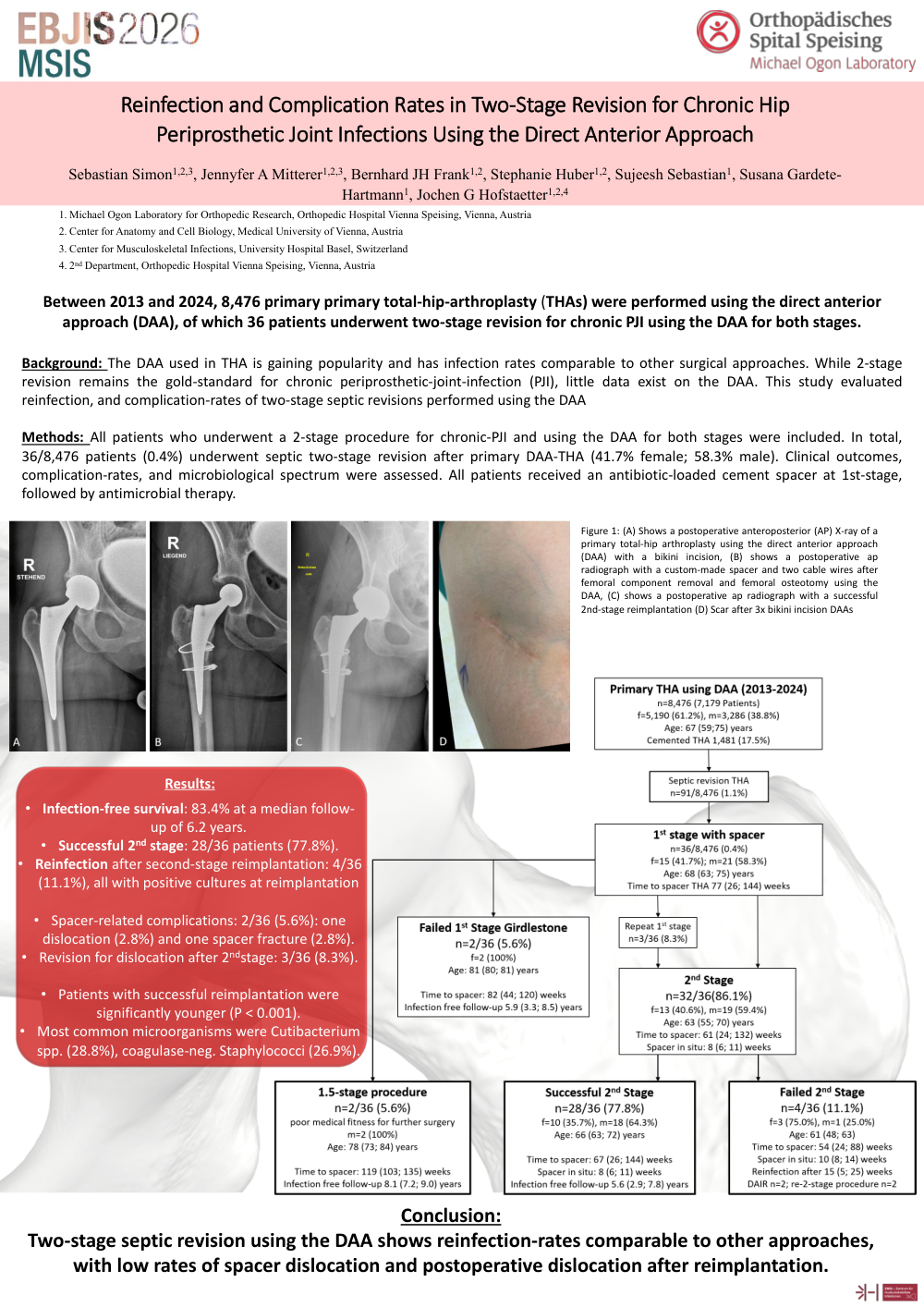
Introduction: The direct-anterior-approach (DAA) used in primary total-hip-arthroplasty (THA) is gaining popularity and has infection rates comparable to other surgical approaches. While 2-stage revision remains the gold-standard for chronic periprosthetic-joint-infection (PJI), little data exist on the DAA. This study evaluated reinfection, and complication-rates of two-stage septic revisions performed using the DAA.
Methods: This retrospective single-center study included data from 8,476 patients who underwent primary THA using the DAA between 2013-2024. All patients who underwent a 2-stage procedure for chronic-PJI were included. Clinical outcomes, complication-rates, and microbiological spectrum were assessed. All patients received an antibiotic-loaded cement spacer at 1st-stage, followed by antimicrobial therapy.
Results: We identified 36/8,476 (0.4%) patients (Female:41.7%, Male:58.3%) who underwent septic 2-stage revision after primary DAA-THA. Infection-free survival was 83.4% at a median 6.2-year follow-up. Successful 2nd-stage reimplantation occurred in 28/36 patients (77.8%), while 2/36 (5.6%) remained infection-free after a 1.5-stage procedure due to being clinically unfit for reimplantation. Four patients (11.1%) underwent a 2nd-stage but developed reinfection requiring septic revision. Two patients (5.6%) had failed 1st-stage and underwent Girdlestone procedure. Reinfection rate was 11.1%, all culture-positive at the 2nd-stage. Spacer-related complications occurred in 2/36 (5.6%), including one dislocation (2.8%) and one spacer fracture (2.8%). Revision for dislocation after the 2nd-stage was required in 3/36 (8.3%). Patients with successful reimplantation were younger (P <0.001). Most common microorganisms were Cutibacterium spp. (28.8%) and coagulase-negative Staphylococci (26.9%).
Conclusions: Two-stage septic revision using the DAA shows reinfection-rates comparable to other approaches, with low rates of spacer dislocation and postoperative dislocation after reimplantation.