477 posters, 14 topics, 2,052 authors, 1,056 institutions
ePostersLive by SciGen Technologies S.A. All rights reserved.
The Joint EBJIS-MSIS 2026 Conference
17 - 19 September, 2026 | Porto, Portugal

EP449
Spinal vs General Anesthesia on the Risk of Surgical Site and Periprosthetic Joint Infections: A Systematic Review and Meta Analysis
Poster Presenter
Part of Topic
Prosthetic Joint Infections
General Versus Neuraxial Anesthesia and Infection Risk in Total Knee and Hip Arthroplasty: A Systematic Review and Meta-Analysis
Kyle Cantave, BA1; Reginald Chinweze M.D., LLM2; Andrew Cole Ringo Foster, BS1; David Dallas-Orr, MD, MBA, MTM2; Zachary Lum, DO2
1. University of California Davis, School of Medicine, Sacramento, CA, USA
2. Department of Orthopaedic Surgery, University of California Davis, Sacramento, CA, USA
Introduction
▪Surgical site infection (SSI) and periprosthetic joint infection (PJI) are debilitating complications of TKA and THA.
▪General anesthesia (GA) has been implicated as a risk factor for SSI/PJI.
▪Objective: to examine the association between anesthesia type and the risk of SSI and PJI on patients undergoing TKA and THA.
Methods
▪PRISMA-guided systematic review and meta-analysis.
▪Comparative studies of adult THA/TKA patients receiving GA vs. neuraxial anesthesia, reporting SSI and/or PJI.
Results
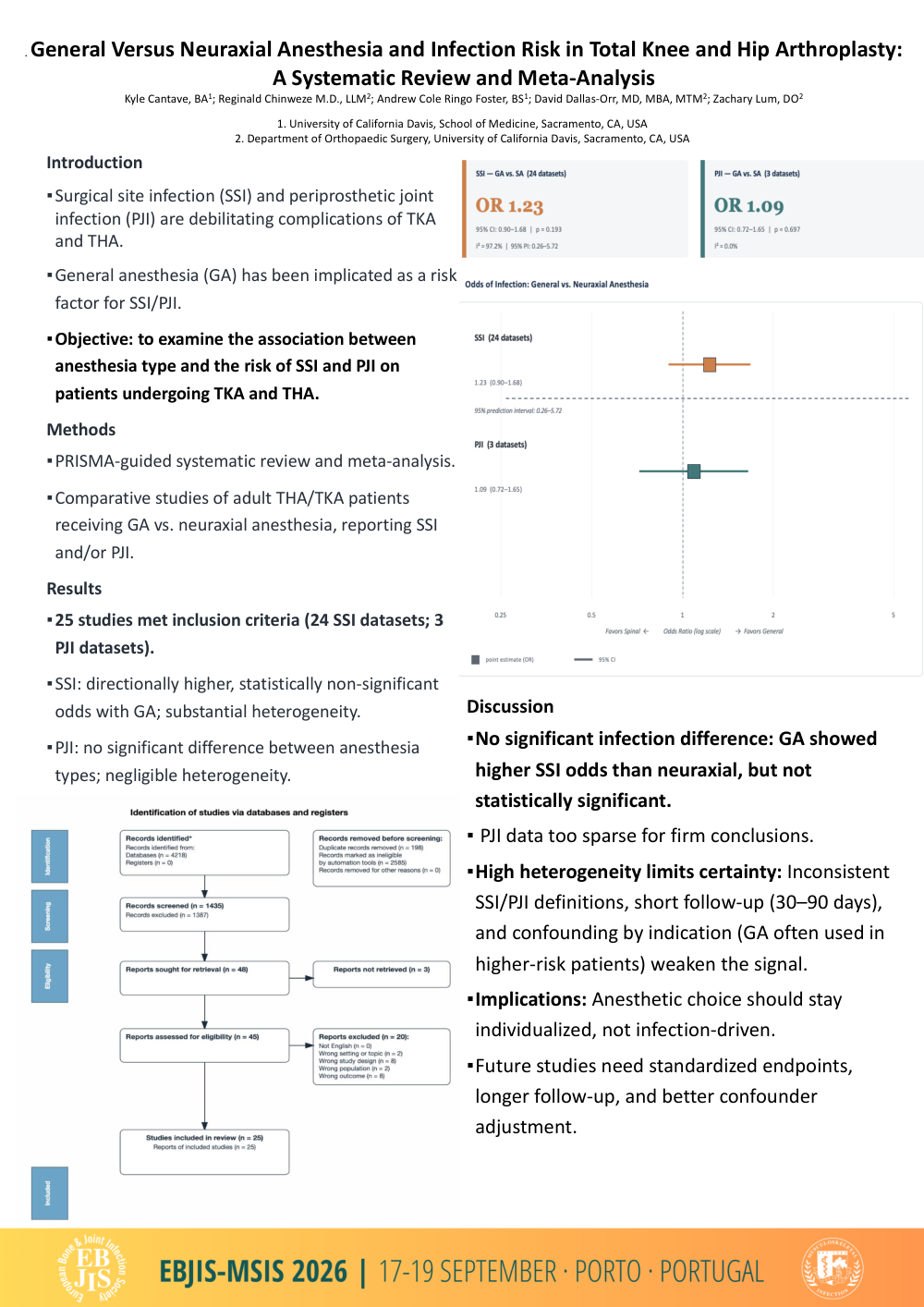
▪25 studies met inclusion criteria (24 SSI datasets; 3 PJI datasets).
▪SSI: directionally higher, statistically non-significant odds with GA; substantial heterogeneity.
▪PJI: no significant difference between anesthesia types; negligible heterogeneity.
Discussion
▪No significant infection difference: GA showed higher SSI odds than neuraxial, but not statistically significant.
▪ PJI data too sparse for firm conclusions.
▪High heterogeneity limits certainty: Inconsistent SSI/PJI definitions, short follow-up (30–90 days), and confounding by indication (GA often used in higher-risk patients) weaken the signal.
▪Implications: Anesthetic choice should stay individualized, not infection-driven.
▪Future studies need standardized endpoints, longer follow-up, and better confounder adjustment.
•