477 posters, 14 topics, 2,065 authors, 1,055 institutions
ePostersLive by SciGen Technologies S.A. All rights reserved.
The Joint EBJIS-MSIS 2026 Conference
17 - 19 September, 2026 | Porto, Portugal

EP447
IMPACT OF RIFAMPICIN UNAVAILABILITY ON THE OUTCOME OF PROSTHETIC JOINT INFECTION CAUSED BY STAPHYLOCOCCUS SPP.
Poster Presenter
Authors
Juliana Arruda De Matos, Leonardo Antunes Vilaça de Souza, Julia Herkenhoff Carijó, Alan de Paula Mozella, Lourenço Pinto Peixoto, Pedro David Campos de Souza e Silva, Juliana Agostinho da Costa, Cassianne Cristina da Silva Souza, Julie Romão Posse, Kelly Biancardini Gomes Barbato
Affiliations
Instituto nacional de traumatologia e ortopedia, INTO, Department of Infectious Diseases, Rio de Janeiro, Brazil; Fiocruz, National Institute of Infectology Evandro Chagas, Rio de Janeiro, Brazil, INTO, Department of Infectious Diseases, Rio de Janeiro, Brazil; Universidade Federal do Rio de Janeiro, Rio de Janeiro, Brazil, INTO, Department of Infectious Diseases, Rio de Janeiro, Brazil, INTO, Specialized Care Center for Knee Surgeries, Rio de Janeiro, Brazil, INTO, Specialized Care Center for Hip Surgeries, Rio de Janeiro, Brazil, INTO, Teaching and Research Division, Rio de Janeiro, Brazil
Part of Topic
Prosthetic Joint Infections
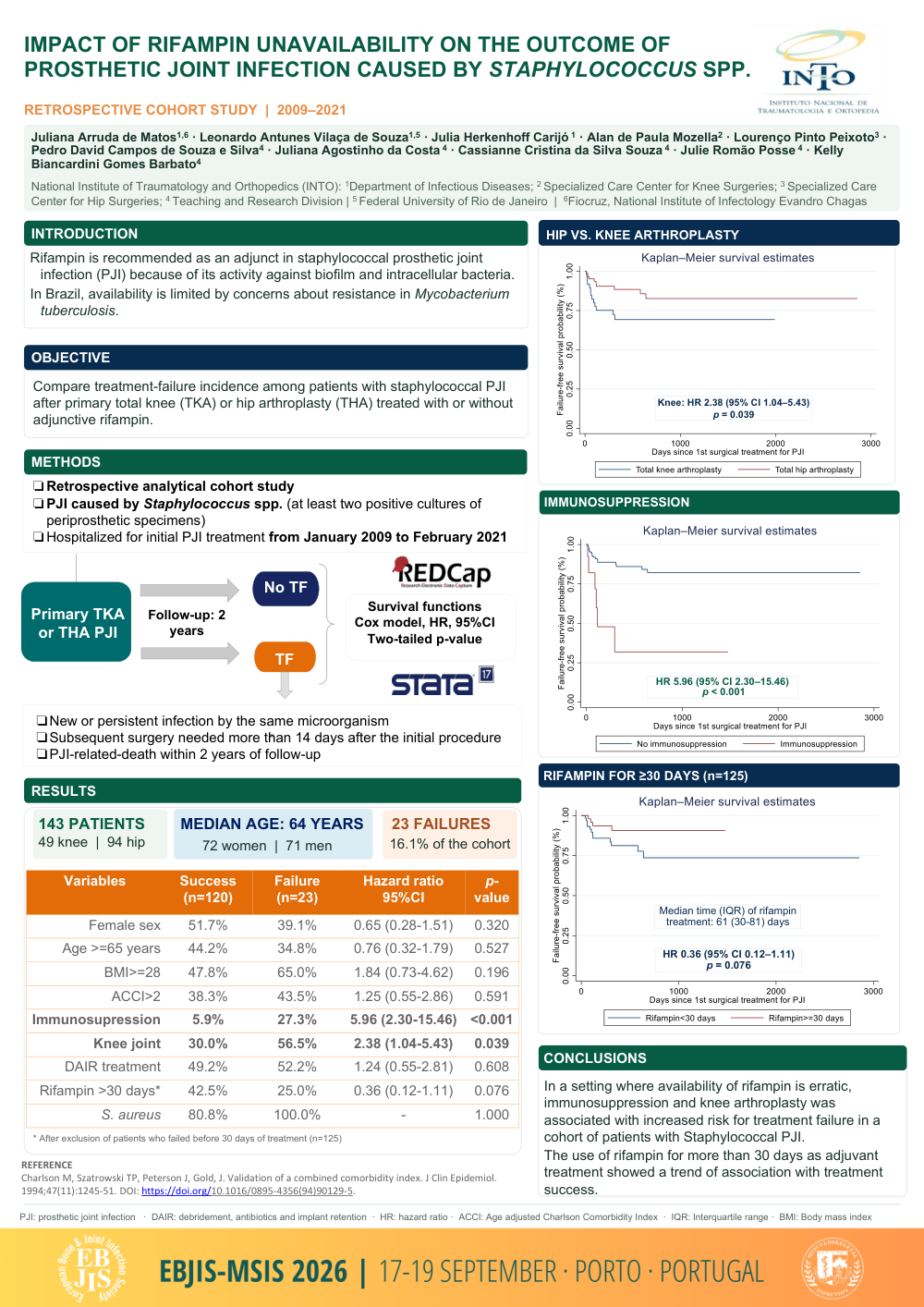
Aim: The use of rifampin as an adjuvant in antibiotic treatment of Staphylococcal prosthetic joint infection (PJI) is recommended due to its action both in the biofilm and intracellular compartment. However, in Brazil, the availability of rifampin is limited due to concerns regarding resistance induction in Mycobacterium tuberculosis. This study aimed to analyze treatment failure (TF) incidence in patients with Staphylococcal PJI treated with or without rifampicin.
Method: In this retrospective analytical cohort study, we collected data from medical records of patients with PJI caused by Staphylococcus spp. (at least two positive cultures of periprosthetic specimens) after primary knee and hip arthroplasty, who were hospitalized for initial PJI treatment from January 2009 to February 2021. TF was defined by new or persistent infection by the same microorganism; subsequent surgery needed more than 14 days after the initial procedure; and death related to PJI during 2 years of follow-up after initial treatment. Survival functions (time to outcome) were computed using the Cox model; hazard ratio (HR), 95% confidence intervals (95% CI), and two-tailed p-values were calculated. The data was recorded in the REDCap program and analyzed using Stata 17.0.
Results: 143 patients were included, 49 after primary knee and 94 after primary hip arthroplasty. The median age was 64 years; 49% of patients were male. Most patients had early PJI (less than 3 months between surgery and the beginning of symptoms). Initial surgical treatment was debridement with implant retention, in 49%. Local antibiotics were used in 39%. Methicillin susceptible Staphylococcus aureus was isolated in 71% of patients. Sixty-seven patients were treated with rifampin for at least one day; median time of rifampin treatment was 61 days (interquartile range (IQR) 30-81 days). TF was diagnosed in 23 patients. The factors that were statistically associated with time until failure were immunosuppression (HR(95%CI)= 5.96 (2.30-15.46);p<0.001) and knee arthroplasty (HR(95%CI)=2.38 (1.04-5.43); p=0.039). After exclusion of patients who failed before 30 days of treatment (n=125), adjuvant treatment with rifampin for 30 or more days showed a trend of association with treatment failure (HR(95%CI)=0.36(0.12-1.11);p=0.076 - protective factor).
Conclusion: In a setting where availability of rifampin is erratic, immunosuppression and knee arthroplasty was associated with increased risk for treatment failure in a cohort of patients with Staphylococcal PJI. The use of rifampin for more than 30 days as adjuvant treatment showed a trend of association with treatment success.