477 posters, 14 topics, 2,065 authors, 1,055 institutions
ePostersLive by SciGen Technologies S.A. All rights reserved.
The Joint EBJIS-MSIS 2026 Conference
17 - 19 September, 2026 | Porto, Portugal

EP438
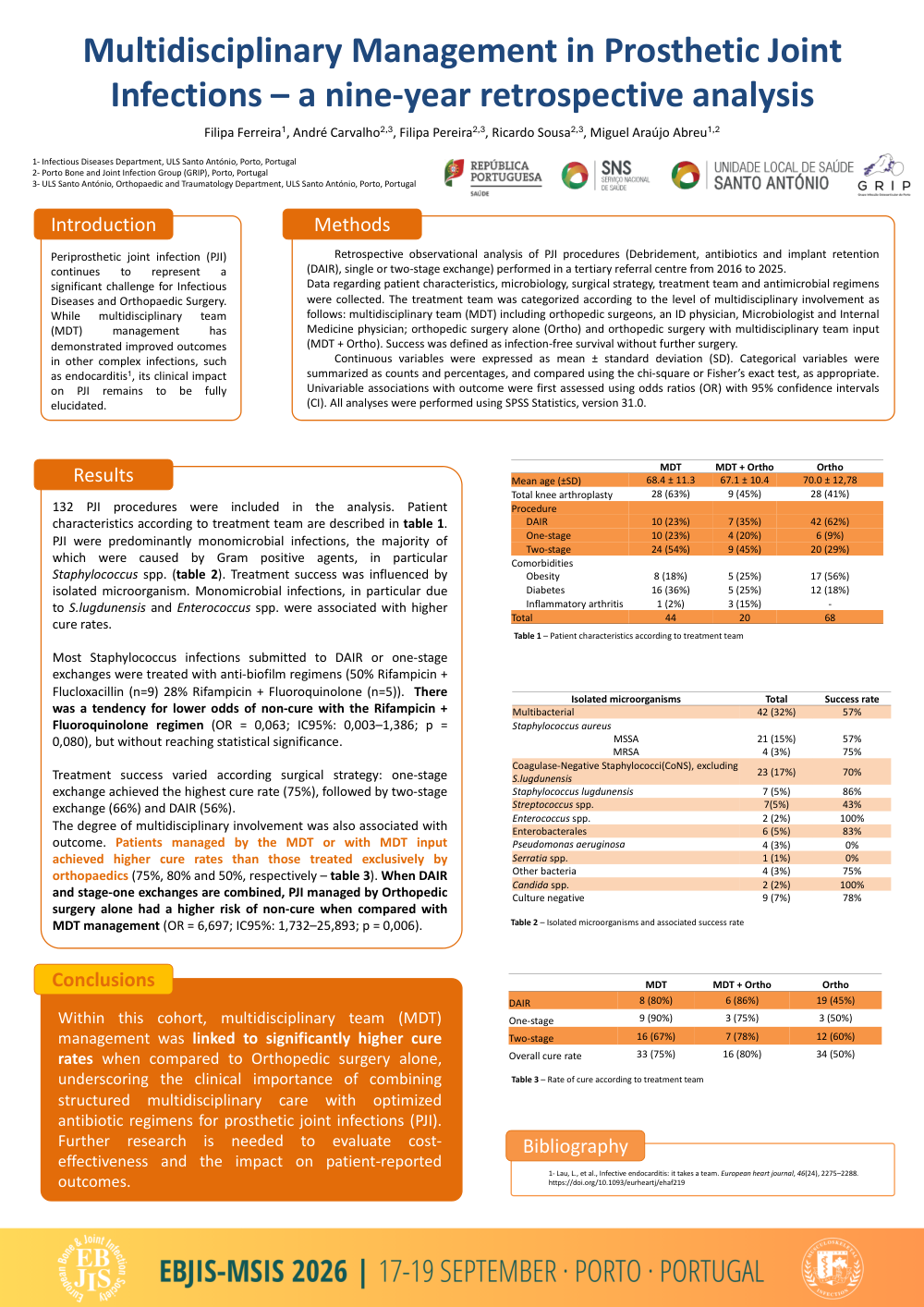
Multidisciplinary Management in Prosthetic Joint Infections a nine-year retrospective analysis
Poster Presenter
Authors
Filipa Ferreira, Andre Dias Carvalho, Filipa Pereira, Ricardo Sousa, Miguel Araujo Abreu
Affiliations
Infectious Diseases Department, ULS Santo Ant?nio, Infectious Diseases Department, ULS Santo Antonio, Porto, Portugal, Porto Bone and Joint Infection Group (GRIP), ULS Santo Antonio, Porto, Portugal; Orthopaedic and Traumatology Department, ULS Santo Antonio, Porto, Portugal, Infectious Diseases Department, ULS Santo Antonio, Porto, Portugal; Porto Bone and Joint Infection Group (GRIP), ULS Santo Antonio, Porto, Portugal
Part of Topic
Prosthetic Joint Infections
Introduction
Periprosthetic joint infection (PJI) continues to represent a significant challenge for Infectious Diseases and Orthopaedic Surgery. While multidisciplinary team (MDT) management has demonstrated improved outcomes in other complex infections, such as endocarditis1, its clinical impact on PJI remains to be fully elucidated.
Methods
Retrospective observational analysis of PJI procedures (Debridement, antibiotics and implant retention (DAIR), single or two-stage exchange) performed in a tertiary referral centre from 2016 to 2025. Data regarding patient characteristics, microbiology, surgical strategy, treatment team and antimicrobial regimens were collected. The treatment team was categorized according to the level of multidisciplinary involvement as follows: multidisciplinary team (MDT) including orthopedic surgeons, an ID physician, Microbiologist and Internal Medicine physician; orthopedic surgery alone (Ortho) and orthopedic surgery with multidisciplinary team input (MDT + Ortho). Success was defined as infection-free survival without further surgery. Continuous variables were expressed as mean ± standard deviation (SD). Categorical variables were summarized as counts and percentages, and compared using the chi-square or Fisher’s exact test, as appropriate. Univariable associations with outcome were first assessed using odds ratios (OR) with 95% confidence intervals (CI). All analyses were performed using SPSS Statistics, version 31.0.
Results
132 PJI procedures were included in the analysis. Patient characteristics according to treatment team are described in table 1. PJI were predominantly monomicrobial infections, the majority of which were caused by Gram positive agents, in particular Staphylococcus spp. (table 2). Treatment success was influenced by isolated microorganism. Monomicrobial infections, in particular due to S.lugdunensis and Enterococcus spp. were associated with higher cure rates. Most Staphylococcus infections submitted to DAIR or one-stage exchanges were treated with anti-biofilm regimens (50% Rifampicin + Flucloxacillin (n=9) 28% Rifampicin + Fluoroquinolone (n=5)). There was a tendency for lower odds of non-cure with the Rifampicin + Fluoroquinolone regimen (OR = 0,063; IC95%: 0,003–1,386; p = 0,080), but without reaching statistical significance. Treatment success varied according surgical strategy: one-stage exchange achieved the highest cure rate (75%), followed by two-stage exchange (66%) and DAIR (56%). The degree of multidisciplinary involvement was also associated with outcome. Patients managed by the MDT or with MDT input achieved higher cure rates than those treated exclusively by orthopaedics (75%, 80% and 50%, respectively – table 3). When DAIR and stage-one exchanges are combined, PJI managed by Orthopedic surgery alone had a higher risk of non-cure when compared with MDT management (OR = 6,697; IC95%: 1,732–25,893; p = 0,006).
Conclusions
Within this cohort, multidisciplinary team (MDT) management was linked to significantly higher cure rates when compared to Orthopedic surgery alone, underscoring the clinical importance of combining structured multidisciplinary care with optimized antibiotic regimens for prosthetic joint infections (PJI). Further research is needed to evaluate cost-effectiveness and the impact on patient-reported outcomes.