477 posters, 14 topics, 2,065 authors, 1,055 institutions
ePostersLive by SciGen Technologies S.A. All rights reserved.
The Joint EBJIS-MSIS 2026 Conference
17 - 19 September, 2026 | Porto, Portugal

EP436
Racial and Ethnic Variation in Inflammatory Markers and Microbiologic Profiles in Periprosthetic Joint Infection
Poster Presenter
Authors
Elias Nasser, Joshua Davis, Rohith Ryali, Samhita Bandaru, Adriana Liimakka MD, Ayesha Abdeen MD, Antonia F Chen MD MBA
Affiliations
UT Southwestern Medical Center, Department of Orthopaedic Surgery, Dallas, United States, Boston Medical Center, Department of Orthopaedic Surgery, Boston, United States, Brigham and Women's Hospital, Department of Orthopaedic Surgery, Boston, United States, UT Southwestern Medical Center
Part of Topic
Prosthetic Joint Infections
Racial and Ethnic Variation in Inflammatory Markers and Microbiologic Profiles in
Periprosthetic Joint Infection: A Multicenter Retrospective Cohort Study
Elias Nasser BS 1 , Joshua Davis BS 2 , Rohith Ryali BS 3 , Samhita Bandaru BS 1 , Adriana Liimakka MD2,
Ayesha Abdeen MD3, Antonia F. Chen MD MBA1
1UT Southwestern Medical Center, Department of Orthopaedic Surgery, Dallas, TX, USA
2Brigham and Women’s Hospital, Department of Orthopaedic Surgery, Boston, MA, USA
3Boston Medical Center, Department of Orthopaedic Surgery, Boston, MA, USA
Introduction
Periprosthetic joint infection (PJI) is a devastating complication after total joint arthroplasty (TJA). Diagnosis relies on serum inflammatory markers and synovial fluid analysis. One prior study demonstrated elevated serum ESR in Black patients undergoing aseptic revision, but no studies have examined racial variation in diagnostic markers for PJI or whether such differences impact diagnostic accuracy [1].
Methodology
A retrospective, multi-center cohort study was conducted on patients from 3 large academic centers who underwent revision TJA for PJI from 2000 to 2025. Exclusion criteria included primary TJA for fracture or tumor indication and patients with significant immunocompromise (e.g., solid organ transplant or chronic DMARD use. Demographic data, serum inflammatory markers (ESR, CRP, WBC), synovial fluid analysis (nucleated cell count, PMN percentage), and microbiologic culture results were collected. Patients were assigned an Area Deprivation Index (ADI) score using the Wisconsin Neighborhood Atlas [2]. Statistical analysis was performed in Python (pandas, SciPy).
Objective
The purpose of this study was to determine whether significant racial differences exist in serum and synovial fluid diagnostic markers for PJI across diverse patient populations.
Results
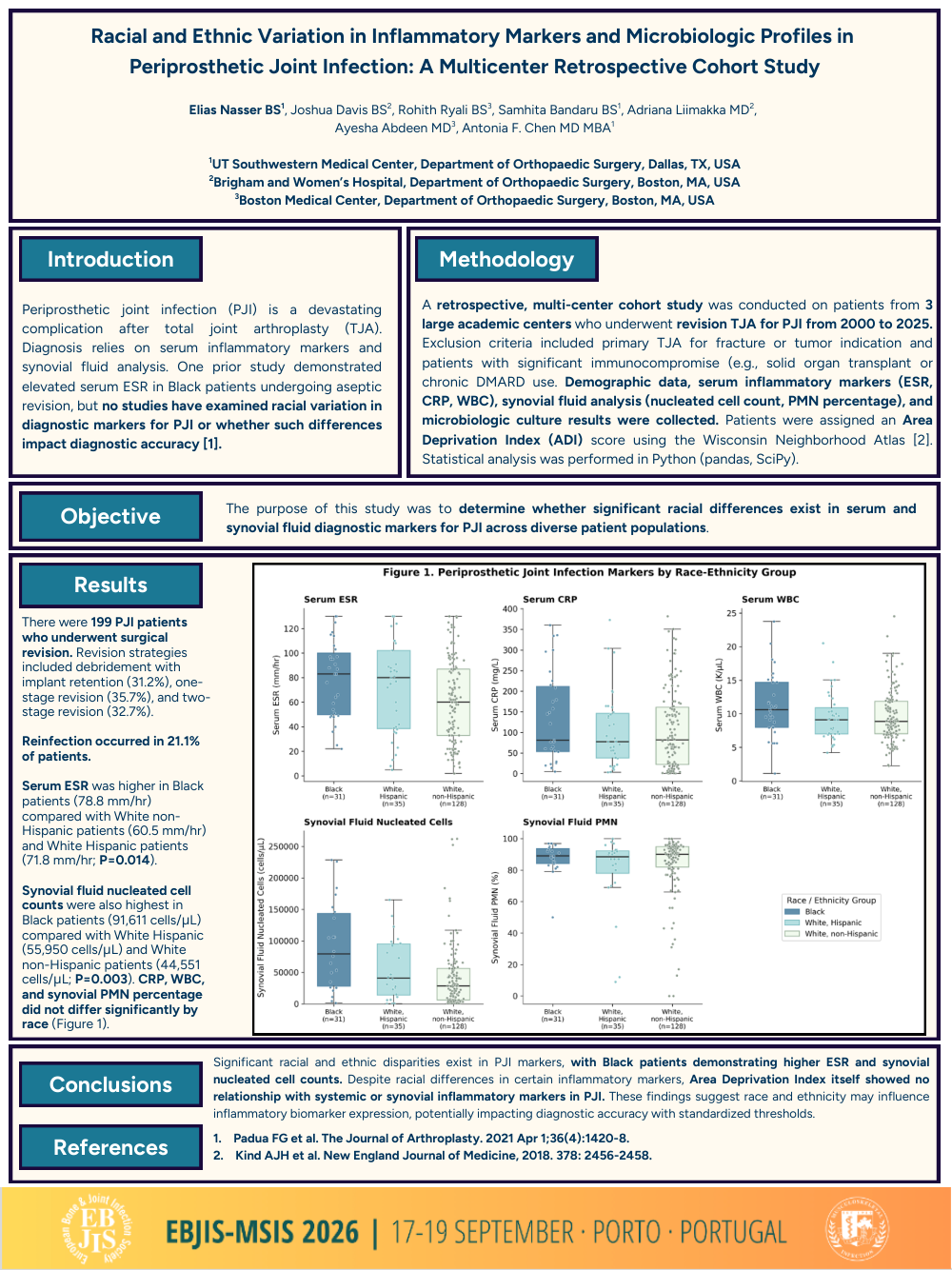
There were 199 PJI patients who underwent surgical revision. Revision strategies included debridement with implant retention (31.2%), one-stage revision (35.7%), and two-stage revision (32.7%). Reinfection occurred in 21.1% of patients. Serum ESR was higher in Black patients (78.8 mm/hr) compared with White non- Hispanic patients (60.5 mm/hr) and White Hispanic patients (71.8 mm/hr; P=0.014). Synovial fluid nucleated cell counts were also highest in Black patients (91,611 cells/μL) compared with White Hispanic (55,950 cells/μL) and White non-Hispanic patients (44,551 cells/μL; P=0.003). CRP, WBC, and synovial PMN percentage did not differ significantly by race (Figure 1).
Conclusions
Significant racial and ethnic disparities exist in PJI markers, with Black patients demonstrating higher ESR and synovial nucleated cell counts. Despite racial differences in certain inflammatory markers, Area Deprivation Index itself showed no relationship with systemic or synovial inflammatory markers in PJI. These findings suggest race and ethnicity may influence inflammatory biomarker expression, potentially impacting diagnostic accuracy with standardized thresholds.
References
1. Padua FG et al. The Journal of Arthroplasty. 2021 Apr 1;36(4):1420-8.
2. Kind AJH et al. New England Journal of Medicine, 2018. 378: 2456-2458.