477 posters, 14 topics, 2,065 authors, 1,055 institutions
ePostersLive by SciGen Technologies S.A. All rights reserved.
The Joint EBJIS-MSIS 2026 Conference
17 - 19 September, 2026 | Porto, Portugal

EP433
Outcomes of Two-Stage Exchange Arthroplasty for Periprosthetic Joint Infection: A Cohort Study with a Minimum of 5-Year Follow-Up
Poster Presenter
Authors
Akeem Williams, Andrew Gordon, Christian Cisneros, Sameulson Osifo, Michael Shannon, Victoria Wong, Andrew Frear, Richard Chao, Kenneth L. Urish
Affiliations
University of Pittsburgh School of Medicine, Pittsburgh, United States, University of Pittsburgh Department of Orthopaedic Surgery, Pittsburgh, United States, UNIVERSITY OF PITTSBURGH SCHOOL OF MEDICINE
Part of Topic
Prosthetic Joint Infections
Background
•Two-stage exchange arthroplasty remains the benchmark treatment for chronic knee periprosthetic joint infection (PJI).
•Reported success rates vary because of differences in follow-up duration, outcome definitions, and censoring strategies.
Purpose
•Characterize time-dependent outcomes after two-stage exchange using the Musculoskeletal Infection Society Outcome Reporting Tool (MSIS ORT).
•Assess how alternative endpoint definitions affect milestone outcome estimates.
•Retrospective cohort of patients undergoing intended two-stage exchange for chronic knee PJI from 2013–2021.
•Included patients met 2018 ICM/MSIS criteria after primary total knee arthroplasty.
•Outcomes were classified by MSIS ORT at 1, 3, and 5 years after reimplantation or spacer placement in non-reimplanted patients.
•Success definitions:
•Tier 1: Infection control without suppressive antibiotics
•Tier 1+2: Infection control with or without suppressive antibiotics
•Kaplan–Meier and sensitivity analyses evaluated alternative censoring strategies.
Cohort
•114 patients
•Median follow-up: 57 months (IQR, 42.3–70.0)
•Reimplanted: 108 (94.7%)
Results Cont.
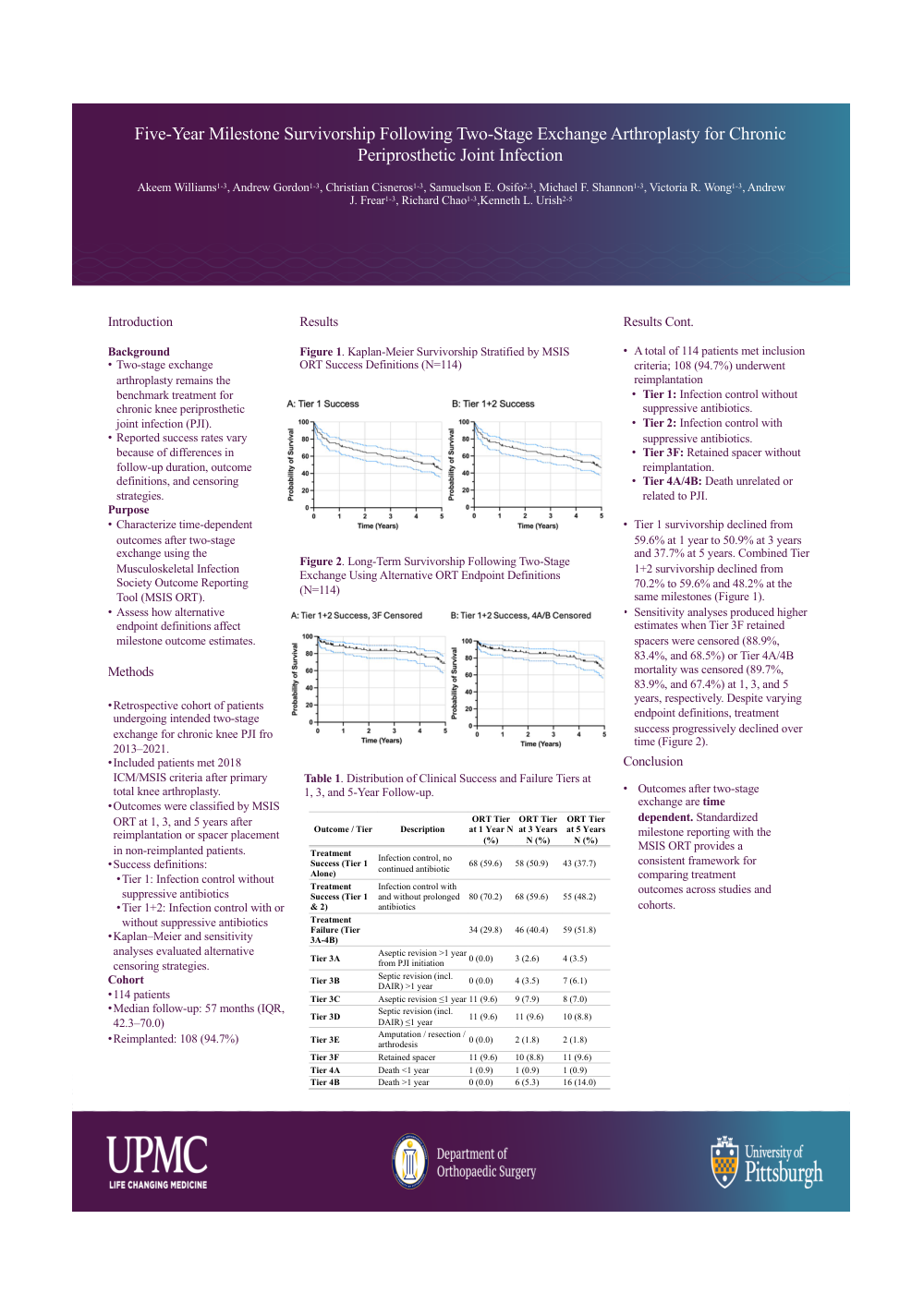
•A total of 114 patients met inclusion criteria; 108 (94.7%) underwent reimplantation
•Tier 1: Infection control without suppressive antibiotics.
•Tier 2: Infection control with suppressive antibiotics.
•Tier 3F: Retained spacer without reimplantation.
•Tier 4A/4B: Death unrelated or related to PJI.
•Tier 1 survivorship declined from 59.6% at 1 year to 50.9% at 3 years and 37.7% at 5 years. Combined Tier 1+2 survivorship declined from 70.2% to 59.6% and 48.2% at the same milestones (Figure 1).
•Sensitivity analyses produced higher estimates when Tier 3F retained spacers were censored (88.9%, 83.4%, and 68.5%) or Tier 4A/4B mortality was censored (89.7%, 83.9%, and 67.4%) at 1, 3, and 5 years, respectively. Despite varying endpoint definitions, treatment success progressively declined over time (Figure 2).
•Outcomes after two-stage exchange are time dependent. Standardized milestone reporting with the MSIS ORT provides a consistent framework for comparing treatment outcomes across studies and cohorts.