477 posters, 14 topics, 2,065 authors, 1,055 institutions
ePostersLive by SciGen Technologies S.A. All rights reserved.
The Joint EBJIS-MSIS 2026 Conference
17 - 19 September, 2026 | Porto, Portugal

EP431
Polymicrobial Periprosthetic Joint Infection Following Multiple Orthopaedic Interventions: A Case Report
Poster Presenter
Part of Topic
Prosthetic Joint Infections
Introduction
Osteoarticular infections following orthopaedic surgery are serious complications, occurring more frequently in patients who have undergone multiple procedures involving osteosynthesis hardware and arthroplasty implants. These cases require a multidisciplinary approach, combining surgical source control with prolonged targeted antibiotic therapy.
Methods
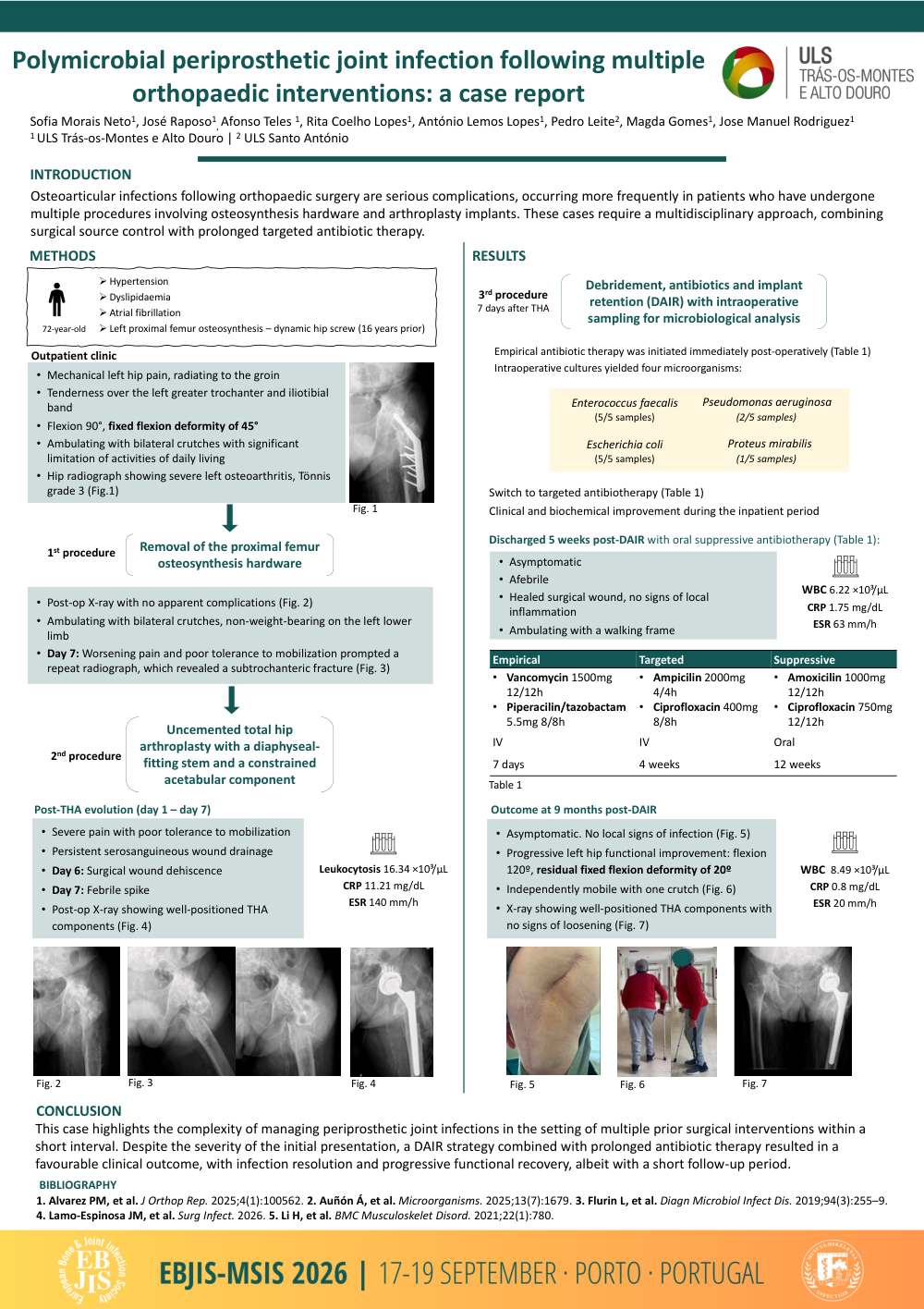
A 72-year-old male with a history of left proximal femur osteosynthesis using a dynamic hip screw for a proximal femur fracture, performed approximately 16 years prior. He was followed in the Orthopaedic outpatient clinic for mechanical hip pain radiating to the groin, ambulating with bilateral crutches. Physical examination revealed tenderness over the left greater trochanter and iliotibial band, with reduced range of motion (flexion 90°, extension deficit of 45°). Imaging showed severe left hip osteoarthritis. He underwent removal of the proximal femur osteosynthesis hardware, with an uneventful intraoperative course and uncomplicated wound healing. A subtrocanteric fracture was identified on plain radiograph at 7 days post-operatively, prompting a new surgical intervention. He subsequently underwent uncemented total hip arthroplasty with a diaphyseal-fitting stem and a constrained acetabular component. The procedure was complicated by intraoperative haemodynamic instability, managed with vasopressor support. The post-operative course was marked by severe pain, poor tolerance to mobilisation, persistent serosanguineous wound drainage and surgical wound dehiscence. On post-operative day 10, a rise in inflammatory markers (CRP 11.21 mg/dL, ESR 140 mm/h, leukocytosis 16.34 ×10³/µL) with an associated febrile spike was noted. Acute periprosthetic joint infection was diagnosed, and the patient underwent debridement, antibiotics and implant retention (DAIR) with intraoperative sampling for microbiological analysis. Empirical therapy with vancomycin and piperacillin/tazobactam was initiated.
Results
Empirical antibiotic therapy was maintained for 7 days. Intraoperative cultures yielded a polymicrobial isolate: Enterococcus faecalis (5/5 samples), Escherichia coli (5/5 samples), Pseudomonas aeruginosa (2/5 samples), and Proteus mirabilis (1/5 samples). Antibiotic therapy was subsequently de-escalated to ampicillin plus ciprofloxacin for 4 weeks. The patient showed clinical and biochemical improvement and was discharged afebrile and asymptomatic, with a healed surgical wound, no signs of local inflammation, and normalising inflammatory markers (CRP 1.75 mg/dL, ESR 63 mm/h, no leukocytosis), ambulating with a walking frame. Oral suppressive therapy with amoxicillin and ciprofloxacin was continued for a further 12 weeks. Serial outpatient assessments demonstrated progressive functional improvement with no signs of infection. At 7 months following DAIR, the patient remains asymptomatic and independently mobile with bilateral crutches, with fully normalised inflammatory markers (CRP 0.8 mg/dL, ESR 20 mm/h, no leukocytosis).
Conclusion
This case highlights the complexity of managing periprosthetic joint infections in the setting of multiple prior surgical interventions within a short interval. The polymicrobial enteric isolate, in the context of two consecutive procedures and surgical wound dehiscence, is consistent with perineal contamination as the likely source of infection. This underscores the importance of systematic intraoperative microbiological sampling and broad-spectrum empirical antibiotic therapy, subsequently tailored to the susceptibility profile. Despite the severity of the initial presentation, a DAIR strategy combined with prolonged antibiotic therapy resulted in a favourable clinical outcome, with infection resolution and progressive functional recovery, albeit with a short follow-up period.