477 posters, 14 topics, 2,065 authors, 1,055 institutions
ePostersLive by SciGen Technologies S.A. All rights reserved.
The Joint EBJIS-MSIS 2026 Conference
17 - 19 September, 2026 | Porto, Portugal

EP430
Single-Stage Revision for Reverse Shoulder Arthroplasty Infection: Report of Three Cases
Poster Presenter
Part of Topic
Prosthetic Joint Infections
Single-Stage Revision for Reverse Shoulder Arthroplasty Infection: Report of Three Cases
Introduction:
Periprosthetic shoulder infection is a severe complication following reverse shoulder arthroplasty (RSA), frequently caused by low-virulence organisms such as Cutibacterium acnes and Staphylococcus epidermidis. Infection is defined by the presence of a sinus tract, intra-articular pus, or two positive cultures with identical organisms, alongside minor criteria. Treatment relies on surgical management and antibiotic therapy. Single-stage revision has become increasingly popular, offering comparable eradication rates while reducing morbidity, hospital costs and joint stiffness associated with multiple surgeries.
Methods:
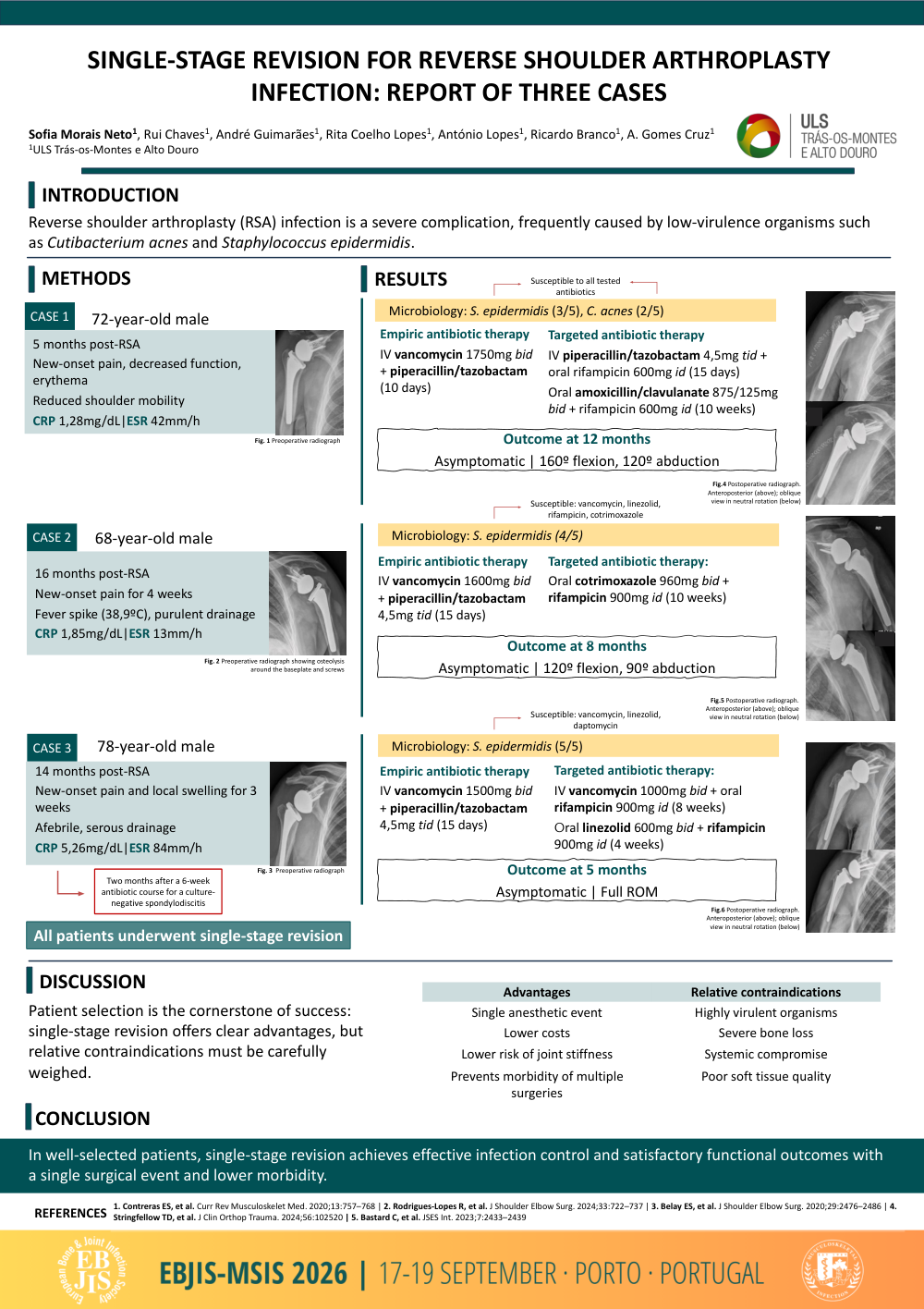
Three males treated with single-stage revision for RSA infection were reviewed.
Case 1 (72 year-old patient) presented five months post-operatively with new-onset pain, decreased function and local erythema (C-reactive protein [CRP] 1.28 mg/dL, erythrocyte sedimentation rate [ESR] 42 mm/h).
Case 2 (68 year-old patient) presented at 16 months with fever, purulent drainage and warmth (CRP 1.85 mg/dL, ESR 13 mm/h).
Case 3 (78 year-old patient) presented at 14 months with serous drainage (CRP 5.26 mg/dL, ESR 84 mm/h), two months after a six-week antibiotic course for a culture-negative spondylodiscitis.
Results:
All patients underwent single-stage revision. Intraoperative cultures isolated S. epidermidis and C. acnes (Case 1), and S. epidermidis alone (Cases 2 and 3).
Case 1 received IV vancomycin/piperacillin/tazobactam (10 days), then IV piperacillin/tazobactam with oral rifampin (15 days), completing 10 weeks of oral amoxicillin/clavulanate/rifampin. At 12 months, he was asymptomatic with 160º flexion, 120º abduction, normal rotations.
Case 2 received IV vancomycin/piperacillin/tazobactam (15 days), then IV cotrimoxazole with oral rifampin (15 days), completing 10 weeks of oral cotrimoxazole/rifampin. At five months, inflammatory signs were absent; active mobility was limited (80º flexion, 70º abduction) with full passive mobility.
Case 3 received IV vancomycin/piperacillin/tazobactam (15 days), then IV vancomycin with oral rifampin (4 weeks), completing 4 weeks of oral linezolide/rifampin. At five months post-revision, he is pain-free with full mobility.
Conclusion:
RSA infections require management by experienced shoulder surgeons. Single-stage revision is indicated under ideal conditions: low-virulence organisms, adequate bone stock and favorable host health. It requires a single anesthetic event, lowers costs and prevents the stiffness and morbidity of multiple surgeries. Conversely, it is relatively contraindicated for highly virulent infections, systemic compromise, or severe bone loss.
In well-selected cases, single-stage revision provides effective infection control and satisfactory functional outcomes, although close follow-up remains essential.