477 posters, 14 topics, 2,065 authors, 1,055 institutions
ePostersLive by SciGen Technologies S.A. All rights reserved.
The Joint EBJIS-MSIS 2026 Conference
17 - 19 September, 2026 | Porto, Portugal

EP424
A descriptive analysis of bacterial isolates from revision surgical samples and the empirical antibiotic coverage, at a specialist orthopaedic hospital
Poster Presenter
Authors
Rishi Raj Banerjee, Felix-Antoine Garneau-Picard, Simon Warren, Natasha Karunaharan, Tariq Azamgarhi, Swee Chin, Katy Crick, Antonia Isabelle Scobie
Affiliations
Royal Free NHS Foundation Trust, United Kingdom, Bone Infection Unit, Royal National Orthopaedic Hospital NHS Trust, United Kingdom; CHU de Quebec, Universite Laval, Canada, Bone Infection Unit, Royal National Orthopaedic Hospital NHS Trust, United Kingdom, Royal Free NHS Foundation Trust
Part of Topic
Prosthetic Joint Infections
Introduction:
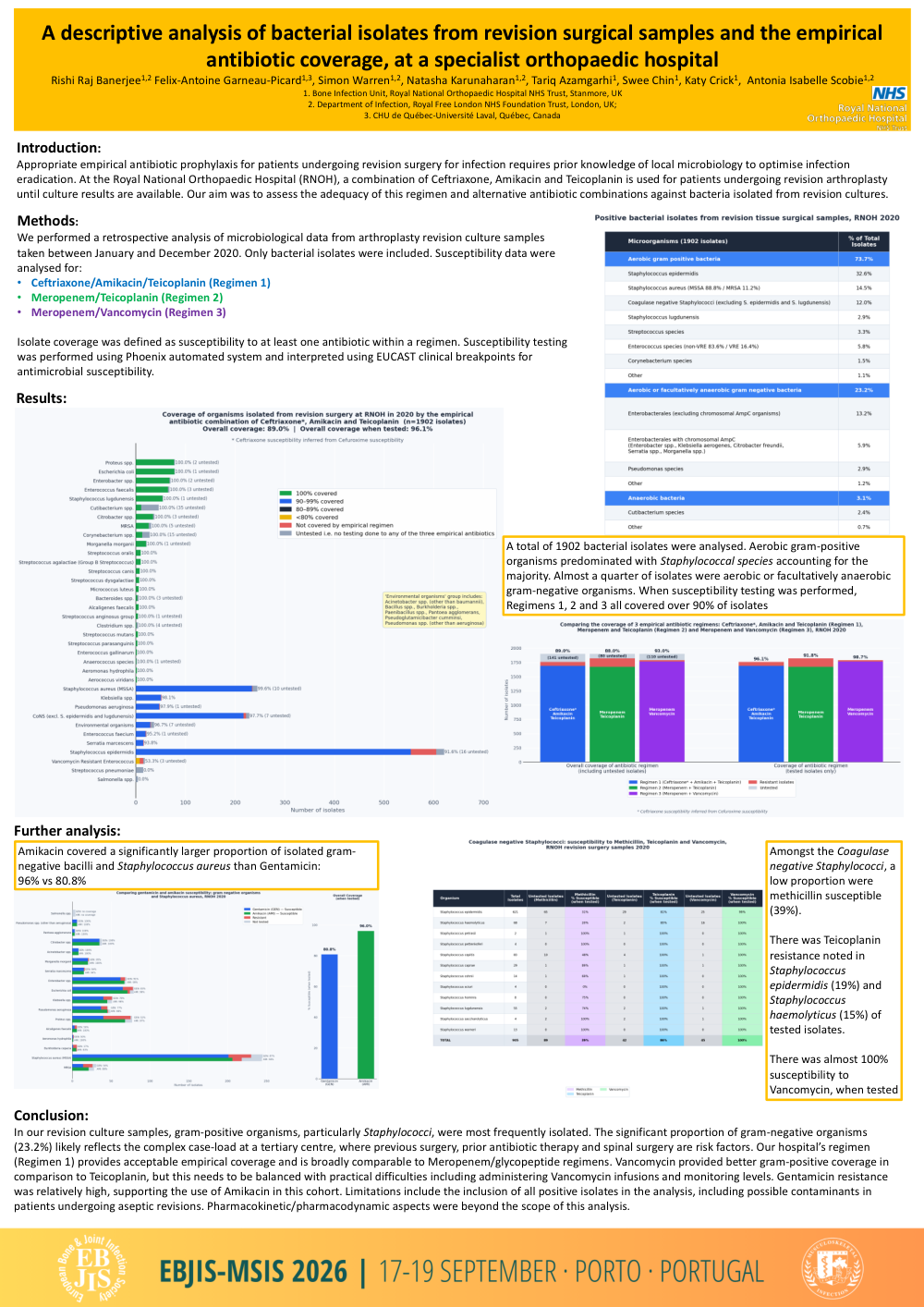
Appropriate empirical antibiotic prophylaxis for patients undergoing revision surgery for infection requires prior knowledge of local microbiology to optimise infection eradication. At the Royal National Orthopaedic Hospital (RNOH), a combination of Ceftriaxone, Amikacin and Teicoplanin is used for patients undergoing revision arthroplasty until culture results are available. Our aim was to assess the adequacy of this regimen and alternative antibiotic combinations against bacteria isolated from revision cultures.
Methods:
We performed a retrospective analysis of microbiological data from arthroplasty revision culture samples taken between January and December 2020. Only bacterial isolates were included. Susceptibility data were analysed for:
Isolate coverage was defined as susceptibility to at least one antibiotic within a regimen. Susceptibility testing was performed using Phoenix automated system and interpreted using EUCAST clinical breakpoints for antimicrobial susceptibility.
A total of 1902 bacterial isolates were analysed. Aerobic gram-positive organisms predominated with Staphylococcal species accounting for the majority. Almost a quarter of isolates were aerobic or facultatively anaerobic gram-negative organisms. When susceptibility testing was performed, Regimens 1, 2 and 3 all covered over 90% of isolates
Further Analysis:
Amikacin covered a significantly larger proportion of isolated gram-negative bacilli and Staphylococcus aureus than Gentamicin: 96% vs 80.8%
Amongst the Coagulase negative Staphylococci, a low proportion were methicillin susceptible (39%). There was Teicoplanin resistance noted in Staphylococcus epidermidis (19%) and Staphylococcus haemolyticus (15%) of tested isolates. There was almost 100% susceptibility to Vancomycin, when tested.
Conclusion:
In our revision culture samples, gram-positive organisms, particularly Staphylococci, were most frequently isolated. The significant proportion of gram-negative organisms (23.2%) likely reflects the complex case-load at a tertiary centre, where previous surgery, prior antibiotic therapy and spinal surgery are risk factors. Our hospital’s regimen (Regimen 1) provides acceptable empirical coverage and is broadly comparable to Meropenem/glycopeptide regimens. Vancomycin provided better gram-positive coverage in comparison to Teicoplanin, but this needs to be balanced with practical difficulties including administering Vancomycin infusions and monitoring levels. Gentamicin resistance was relatively high, supporting the use of Amikacin in this cohort. Limitations include the inclusion of all positive isolates in the analysis, including possible contaminants in patients undergoing aseptic revisions. Pharmacokinetic/pharmacodynamic aspects were beyond the scope of this analysis.