477 posters, 14 topics, 2,065 authors, 1,055 institutions
ePostersLive by SciGen Technologies S.A. All rights reserved.
The Joint EBJIS-MSIS 2026 Conference
17 - 19 September, 2026 | Porto, Portugal

EP422
Joint Decision-Making in Prosthetic Joint Infection: Outcomes of Early Oral Antibiotic Switch Strategies in an MDT Cohort
Poster Presenter
Part of Topic
Prosthetic Joint Infections
Joint Decision-Making in Prosthetic Joint Infection: Outcomes of Early Oral Antibiotic Switch Strategies in an MDT Cohort
Background:
Prosthetic joint infection (PJI) is a complex complication of arthroplasty requiring coordinated surgical and antimicrobial management. Although treatment has traditionally involved prolonged intravenous (IV) antibiotic therapy, evidence from the OVIVA trial supports the use of appropriately selected oral regimens for bone and joint infection. Real-world data on early oral switch strategies in multidisciplinary team (MDT) managed PJI remain valuable.
Aims:
This retrospective study evaluated treatment failure and antimicrobial-related complications among PJI patients managed through a weekly specialist MDT at a tertiary hospital in the South East of Ireland.
Methods:
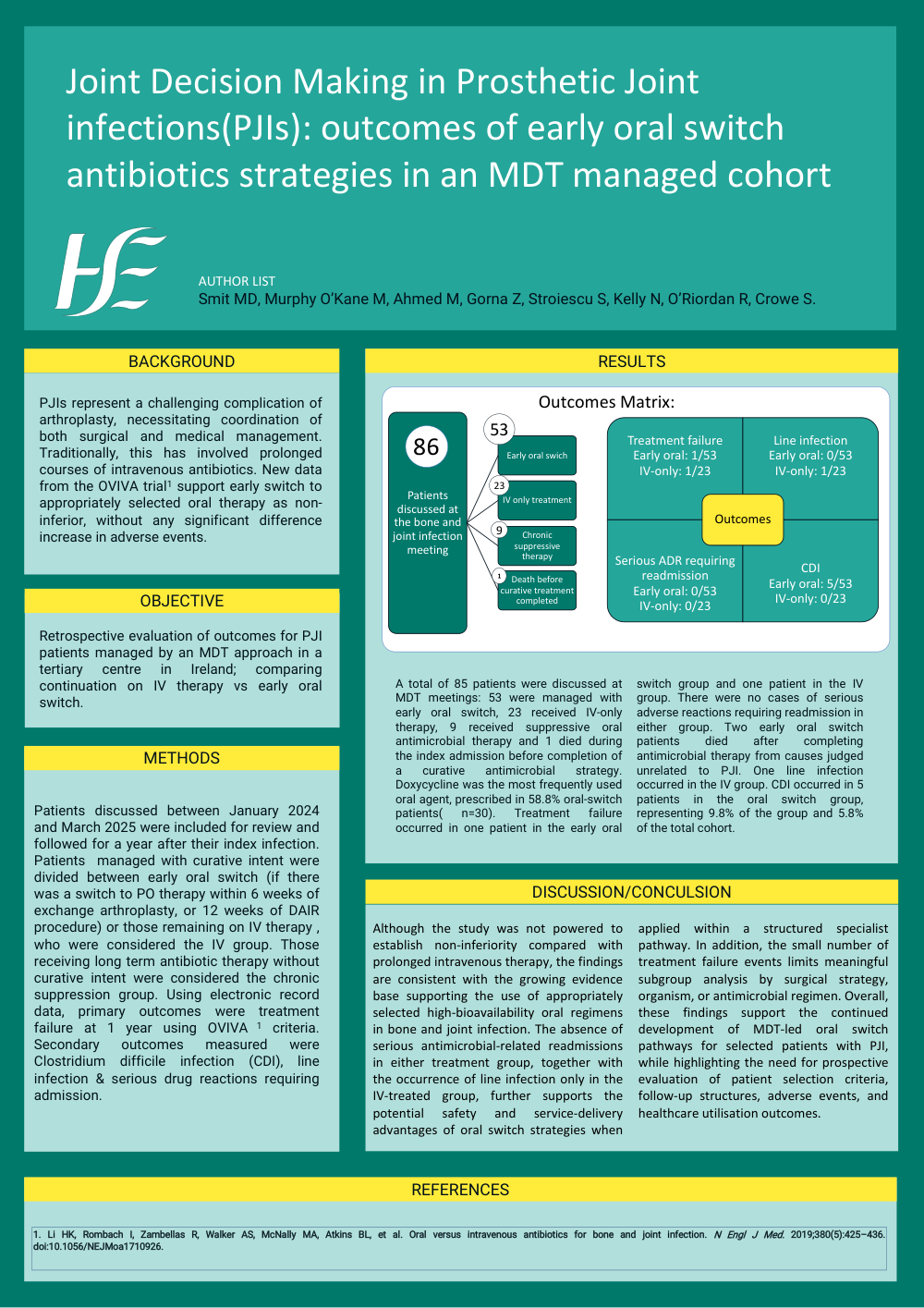
Patients discussed at MDT between January 2024 and March 2025 were followed for 1 year after index infection. Patients managed with curative intent were classified as the early oral switch group if they changed to oral antibiotics within 6 weeks of exchange arthroplasty or within 12 weeks of DAIR. Patients who remained on IV therapy were classified as the IV group. Patients receiving long-term antibiotics without curative surgical intent were classified separately as the chronic suppressive antimicrobial group, and deaths during follow-up were recorded and classified according to timing, treatment group, and whether they were judged related to PJI or antimicrobial therapy. The primary outcome was treatment failure at 1 year, defined using OVIVA clinical, microbiological, and histological criteria. Secondary outcomes included Clostridioides difficile infection (CDI), serious adverse drug reactions requiring readmission, and line infection.
Results:
A total of 85 patients were discussed at MDT meetings: 53 were managed with early oral switch, 23 received IV-only therapy, 9 received suppressive oral antimicrobial therapy and 1 died during the index admission before completion of a curative antimicrobial strategy. Doxycycline was the most frequently used oral agent, prescribed in 58.8% oral-switch patients( n=30). Treatment failure occurred in one patient in the early oral switch group and one patient in the IV group. There were no cases of serious adverse reactions requiring readmission in either group. Two early oral switch patients died after completing antimicrobial therapy from causes judged unrelated to PJI. One line infection occurred in the IV group. CDI occurred in 5 patients in the oral switch group, representing 9.8% of the group and 5.8% of the total cohort.
Discussion:
In this cohort, selected patients managed with early oral switch had low observed treatment failure at 1 year, although the study was not powered to assess non-inferiority. Limitations include the retrospective design, small sample size, and potential selection bias. These findings support the integration switch strategies into routine PJI management pathways, provided that robust MDT oversight and follow-up systems are in place.