477 posters, 14 topics, 2,065 authors, 1,055 institutions
ePostersLive by SciGen Technologies S.A. All rights reserved.
The Joint EBJIS-MSIS 2026 Conference
17 - 19 September, 2026 | Porto, Portugal

EP419
Antibiotic-Associated Adverse Events in the Management of Periprosthetic Joint Infection Following Hip and Knee Arthroplasty: A Systematic Review
Poster Presenter
Authors
Shlok V Patel, Varun Kompala, Matthew Mangel, Khaled A Elmenawi, Spencer Davis, Luke Molitar, Shujaa T Khan, Anabelle Visperas, Bethany Lehman, Nicolas S Piuzzi
Affiliations
Cleveland Clinic Department of Orthopaedic Surgery, Cleveland, United States, Cleveland Clinic, Cleveland Clinic Department of Infectious Diseases, Cleveland, United States
Part of Topic
Prosthetic Joint Infections
Background
- Periprosthetic joint infection (PJI) following hip and knee arthroplasty frequently requires prolonged and often multi-agent antibiotic therapy.
- Although antibiotics are central to both curative and suppressive treatment pathways, most PJI literature emphasizes infection eradication and surgical outcomes, while treatment-related toxicity remains inconsistently characterized.
- This systematic review and meta-analysis aimed to quantify patient-level antibiotic-associated adverse eventsduring PJI management.
Methods
- A PRISMA-guided systematic review and meta-analysis was performed to identify studies reporting antibiotic-associated complications among patients treated for PJI following hip or knee arthroplasty.
- Adverse-event data were extracted at the patient level by complication category, including renal, hepatic, hematologic, gastrointestinal, infectious, and allergic complications.
- Outcomes that were not reported by an individual study were treated as missing rather than assumed to represent zero events, minimizing artificial underestimation of complication rates.
- A study-defined composite of “any adverse drug event” was included in pooled analysis only when explicitly reported by the original investigators.
- Random-effects proportion meta-analysis was performed separately for renal complications and other reported antibiotic-associated adverse events.
- Renal complications were additionally stratified according to exposure to local antibiotic delivery, including antibiotic spacers, antibiotic-loaded cement, intra-articular or topical antibiotics, and antibiotic-containing sponges, versus systemic-only treatment.
- Thirty-nine studies published from 1998–2024, comprising 4,133 patients, met eligibility criteria.
- Antibiotic exposure varied substantially: intravenous treatment ranged from 2–12 weeks and was most commonly 6 weeks; subsequent oral therapy ranged from 4 weeks to 12 months, while suppressive therapy ranged from 3 months to a mean of 5 years.
- Reported follow-up and adverse-event assessment windows ranged from 7 days to 9 years, reflecting substantial variation in treatment and safety surveillance across studies.
Results
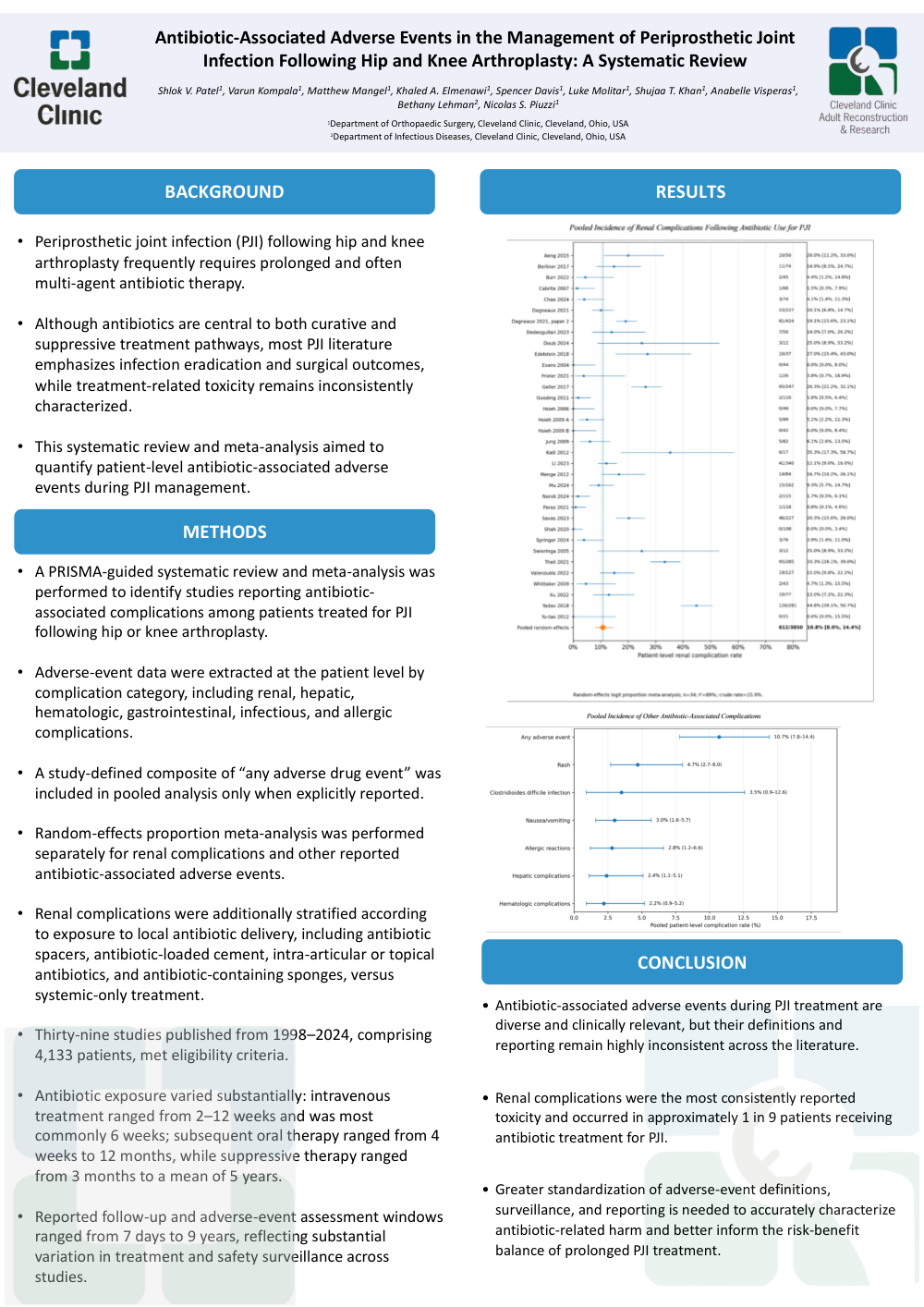
- Renal complications were the most consistently reported adverse events, evaluated across 34 studies and 3,850 patients.
- The pooled renal complication rate was 10.8% (95% CI, 8.0%–14.4%), with substantial between-study heterogeneity (I²=89%).
- In stratified analyses, pooled renal complication rates were:
- 14.1% (95% CI, 10.6%–18.6%) in cohorts receiving local/spacer-based antibiotic delivery
- 7.9% (95% CI, 3.3%–17.8%) in systemic-only cohorts.
These subgroup estimates should be interpreted cautiously given the substantial heterogeneity and overlapping confidence intervals.
- Other pooled patient-level adverse-event rates included:
- Any adverse drug event: 10.7% (95% CI, 7.8%–14.4%)
- Rash: 4.7% (2.7%–8.0%)
- C. difficile infection: 3.5% (0.9%–12.6%)
- Nausea/vomiting: 3.0% (1.6%–5.7%)
- Allergic reactions: 2.8% (1.2%–6.6%)
- Hepatic complications: 2.4% (1.1%–5.1%)
- Hematologic complications: 2.2% (0.9%–5.2%).
Conclusion
- Antibiotic-associated adverse events during PJI treatment are diverse and clinically relevant, but their definitions and reporting remain highly inconsistent across the literature.
- Renal complications were the most consistently reported toxicity and occurred in approximately 1 in 9 patientsreceiving antibiotic treatment for PJI.
- Rates varied across treatment settings, with numerically higher pooled renal complication rates in cohorts incorporating local/spacer-based antibiotic delivery; however, substantial heterogeneity limits direct comparison.
- Greater standardization of adverse-event definitions, surveillance, and reporting is needed to accurately characterize antibiotic-related harm and better inform the risk-benefit balance of prolonged PJI treatment.