477 posters, 14 topics, 2,065 authors, 1,055 institutions
ePostersLive by SciGen Technologies S.A. All rights reserved.
The Joint EBJIS-MSIS 2026 Conference
17 - 19 September, 2026 | Porto, Portugal

EP414
Does Hyperhidrosis Increase Infection-Related Complications Following Primary Total Knee Arthroplasty? A Propensity-Matched Analysis
Poster Presenter
Authors
Shlok V Patel, Vinayak Ganesan, Shujaa T Khan, Khaled A Elmenawi, Anabelle Visperas, Bethany Lehman, Nicolas S Piuzzi
Affiliations
Cleveland Clinic Department of Orthopaedic Surgery, Cleveland, United States, Cleveland Clinic, Cleveland Clinic Department of Infectious Diseases, Cleveland, United States
Part of Topic
Prosthetic Joint Infections
Introduction
•Hyperhidrosis (HH) causes persistent skin moisture, which may promote bacterial colonization and compromise surgical dressings.
•These concerns may be particularly relevant following TKA because of flexion-related shear across the incision and moisture accumulation around the knee.
•However, the association between HH and postoperative infectious and implant-related outcomes after TKA remains poorly defined.
Methods
•A retrospective cohort study was performed using the TriNetXU.S. Collaborative Network, which included approximately 115 million patients from 67 healthcare organizations at the time of analysis.
•Adults ≥18 years undergoing primary TKA (CPT 27447) on or after January 1, 2015 were identified.
•The HH cohort included patients with a preoperative diagnosis of focal hyperhidrosis (ICD-10 L74.5) or generalized hyperhidrosis (R61); patients without either diagnosis comprised the control cohort.
•1:1 propensity-score matching was performed to balance baseline demographics, BMI categories, and major medical comorbidities between HH and non-HH cohorts.
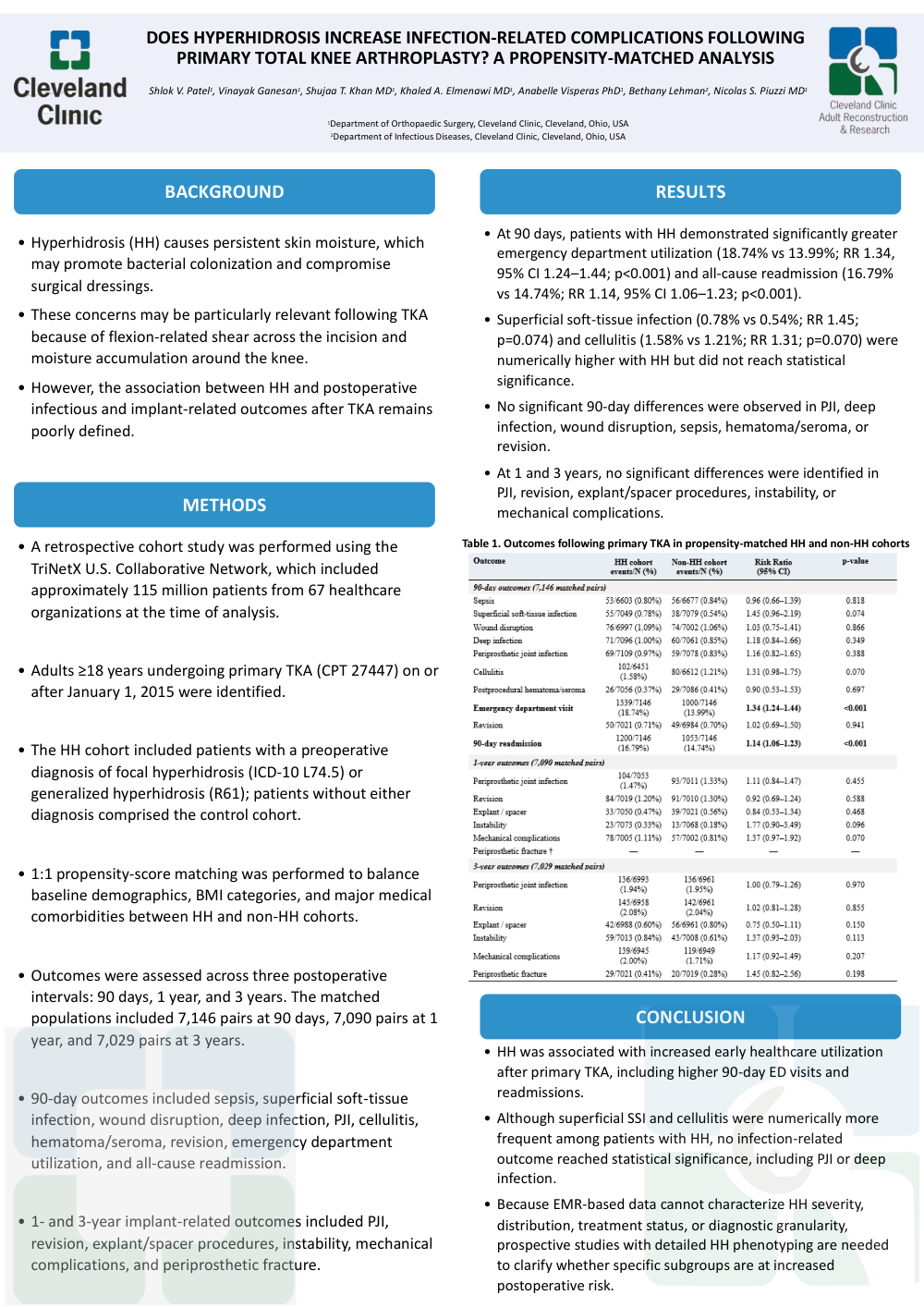
•Outcomes were assessed across three postoperative intervals: 90 days, 1 year, and 3 years. The matched populations included 7,146 pairs at 90 days, 7,090 pairs at 1 year, and 7,029 pairs at 3 years.
•90-day outcomes included sepsis, superficial soft-tissue infection, wound disruption, deep infection, PJI, cellulitis, hematoma/seroma, revision, emergency department utilization, and all-cause readmission.
•1- and 3-year implant-related outcomes included PJI, revision, explant/spacer procedures, instability, mechanical complications, and periprosthetic fracture.
Results
•At 90 days, patients with HH demonstrated significantly greater emergency department utilization (18.74% vs 13.99%; RR 1.34, 95% CI 1.24–1.44; p<0.001) and all-cause readmission (16.79% vs 14.74%; RR 1.14, 95% CI 1.06–1.23; p<0.001).
•Superficial soft-tissue infection (0.78% vs 0.54%; RR 1.45; p=0.074) and cellulitis (1.58% vs 1.21%; RR 1.31; p=0.070) were numerically higher with HH but did not reach statistical significance.
•No significant 90-day differences were observed in PJI, deep infection, wound disruption, sepsis, hematoma/seroma, or revision.
•At 1 and 3 years, no significant differences were identified in PJI, revision, explant/spacer procedures, instability, or mechanical complications.
Conclusion
•HH was associated with increased early healthcare utilization after primary TKA, including higher 90-day ED visits and readmissions.
•Although superficial SSI and cellulitis were numerically more frequent among patients with HH, no infection-related outcome reached statistical significance, including PJI or deep infection.
•Because EMR-based data cannot characterize HH severity, distribution, treatment status, or diagnostic granularity, prospective studies with detailed HH phenotyping are needed to clarify whether specific subgroups are at increased postoperative risk.