477 posters, 14 topics, 2,065 authors, 1,055 institutions
ePostersLive by SciGen Technologies S.A. All rights reserved.
The Joint EBJIS-MSIS 2026 Conference
17 - 19 September, 2026 | Porto, Portugal

EP413
Local vancomycin delivery via hip and knee spacers: a prospective comparison of 1 versus 2 gram vancomycin per batch cement
Poster Presenter
Authors
Floor C.A. Koelewijn, Michelle Mehciz, Jakob van Oldenrijk, P. Koen Bos, Ewout S. Veltman, Birgit C.P. Koch
Affiliations
Department of Orthopedics and Sports Medicine, Erasmus MC, Rotterdam, The Netherlands, Department of Clinical Pharmacy, Erasmus MC, Erasmus University Medical Center, Rotterdam, The Netherlands; Rotterdam Clinical Pharmacometrics Group, Rotterdam, The Netherlands, Department of Orthopedics and Sports Medicine, Erasmus MC
Part of Topic
Prosthetic Joint Infections
Background and Aim
Chronic periprosthetic Joint Infection (PJI) is a serious complication following total joint arthroplasty (TJA). During two-stage revision surgery, antibiotics can be delivered locally using an antibiotic-loaded cement spacer (ALCS). Yet, it is unclear whether sufficient local target tissue concentrations are reached. We quantified intramedullary bone concentrations following vancomycin-loaded spacer implantation and compared these to the individual Minimal Inhibitory Concentration (MIC).
Methods
Stage One - Spacer Implantation
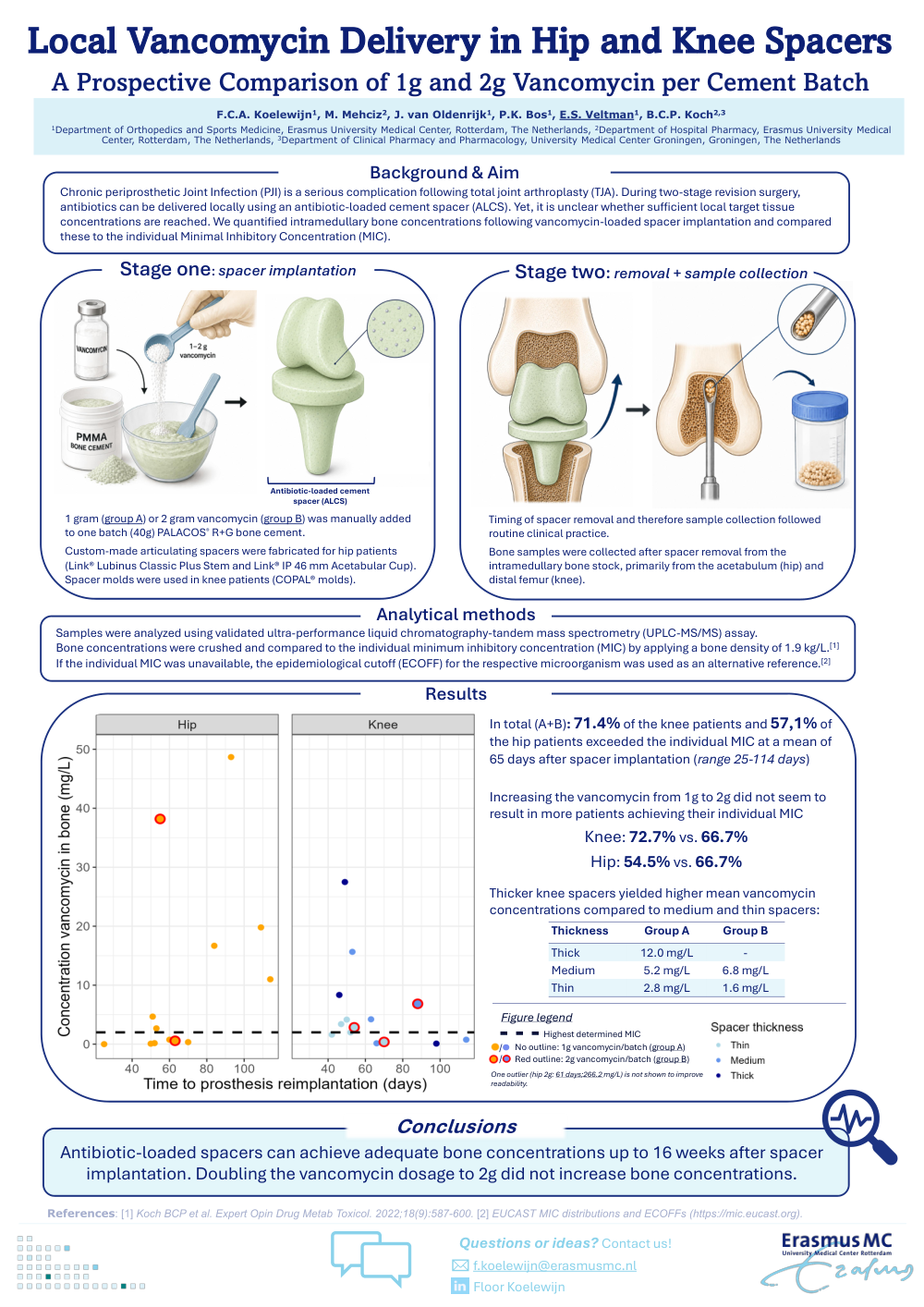
1 gram (group A) or 2 gram vancomycin (group B) was manually added to one batch (40g) PALACOS® R+G bone cement.
Custom-made articulating spacers were fabricated for hip patients (Link® Lubinus Classic Plus Stem and Link® IP 46 mm Acetabular Cup). Spacer molds were used in knee patients (COPAL® molds).
Stage Two - Spacer Removal & Sample collection
Timing of spacer removal and therefore sample collection followed routine clinical practice.
Bone samples were collected after spacer removal from the intramedullary bone stock, primarily from the acetabulum (hip) and distal femur (knee).
Analytical Methods
Samples were analyzed using validated ultra-performance liquid chromatography-tandem mass spectrometry (UPLC-MS/MS) assay.
Bone concentrations were crushed and compared to the individual minimum inhibitory concentration (MIC) by applying a bone density of 1.9 kg/L.[1]
If the individual MIC was unavailable, the epidemiological cutoff (ECOFF) for the respective microorganism was used as an alternative reference.[2]
Results
In total (A+B): 71.4% of the knee patients and 57,1% of the hip patients exceeded the individual MIC at a mean of 65 days after spacer implantation (range 25-114 days)
Increasing the vancomycin from 1g to 2g did not seem to result in more patients achieving their individual MIC
Knee: 72.7% vs. 66.7%. Hip: 54.5% vs. 66.7%
Thicker knee spacers yielded higher mean vancomycin concentrations compared to medium and thin spacers.
Conclusions
Antibiotic-loaded spacers can achieve adequate bone concentrations up to 16 weeks after spacer implantation. Doubling the vancomycin dosage to 2g did not increase bone concentrations.