477 posters, 14 topics, 2,065 authors, 1,055 institutions
ePostersLive by SciGen Technologies S.A. All rights reserved.
The Joint EBJIS-MSIS 2026 Conference
17 - 19 September, 2026 | Porto, Portugal

EP412
Does Hyperhidrosis Increase Infection-Related Complications Following Primary Total Hip Arthroplasty? A Propensity-Matched Analysis
Poster Presenter
Authors
Shlok V Patel, Vinayak Ganesan, Shujaa T Khan, Khaled A Elmenawi, Anabelle Visperas, Bethany Lehman, Nicolas S Piuzzi
Affiliations
Cleveland Clinic Department of Orthopaedic Surgery, Cleveland, United States, Cleveland Clinic, Cleveland Clinic Department of Infectious Diseases, Cleveland, United States
Part of Topic
Prosthetic Joint Infections
Introduction
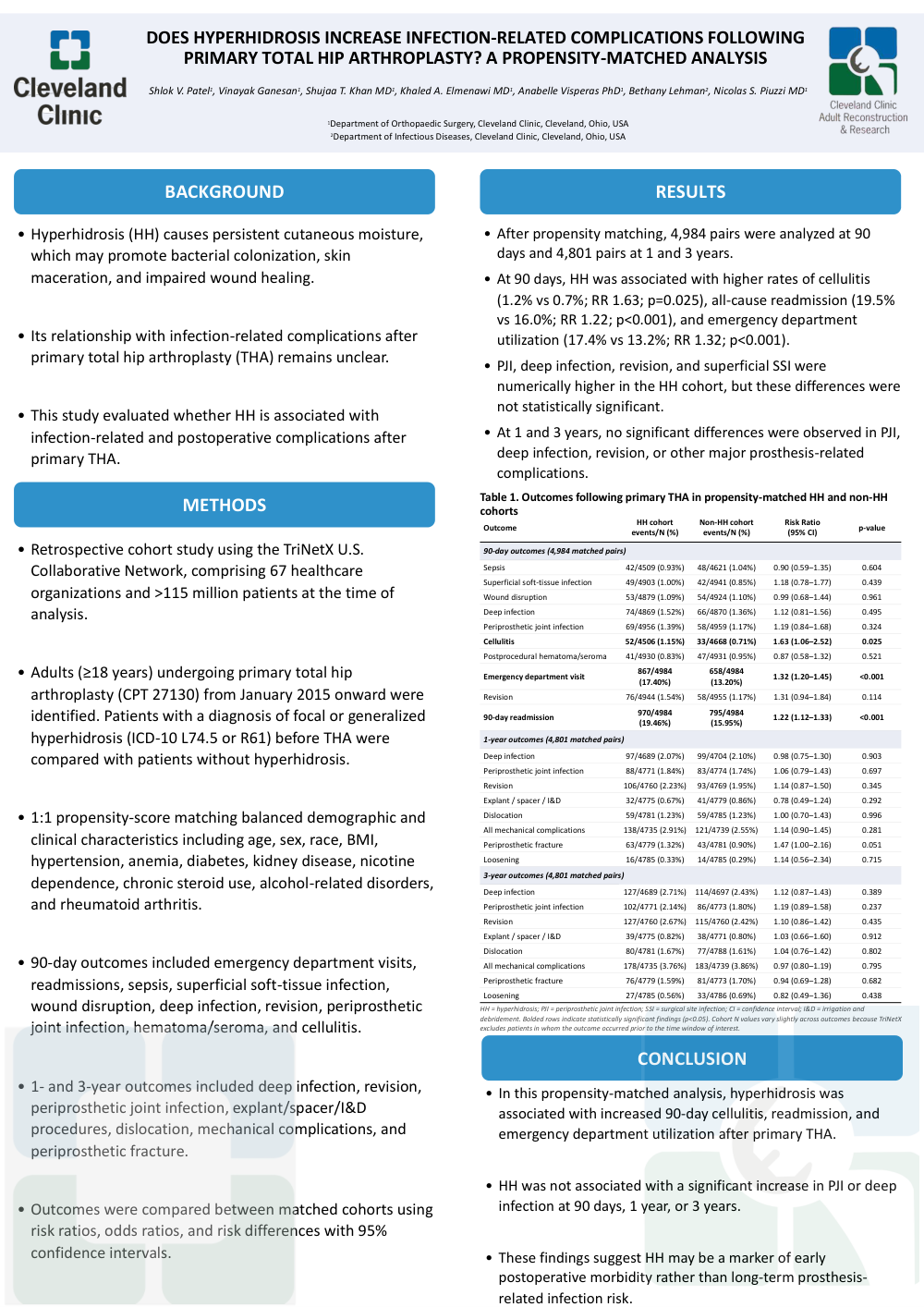
Hyperhidrosis (HH) causes persistent cutaneous moisture, which may promote bacterial colonization, skin maceration, and impaired wound healing. Its relationship with infection-related complications after primary total hip arthroplasty (THA) remains unclear. This study evaluated whether HH is associated with infection-related and postoperative complications after primary THA.
Methods
•Retrospective cohort study using the TriNetX U.S. Collaborative Network, comprising 67 healthcare organizations and >115 million patients at the time of analysis.
•Adults (≥18 years) undergoing primary total hip arthroplasty (CPT 27130) from January 2015 onward were identified. Patients with a diagnosis of focal or generalized hyperhidrosis (ICD-10 L74.5 or R61) before THA were compared with patients without hyperhidrosis.
•1:1 propensity-score matching generated 4,799 patients per cohort, balancing demographic and clinical characteristics including age, sex, race, BMI, hypertension, anemia, diabetes, kidney disease, nicotine dependence, chronic steroid use, alcohol-related disorders, and rheumatoid arthritis.
•90-day outcomes included emergency department visits, readmissions, sepsis, superficial soft-tissue infection, wound disruption, deep infection, revision, periprosthetic joint infection, hematoma/seroma, and cellulitis.
•1- and 3-year outcomes included deep infection, revision, periprosthetic joint infection, explant/spacer/I&D procedures, dislocation, mechanical complications, and periprosthetic fracture.
•Outcomes were compared between matched cohorts using risk ratios, odds ratios, and risk differences with 95% confidence intervals.
Results:
•After propensity matching, 4,984 pairs were analyzed at 90 days and 4,801 pairs at 1 and 3 years.
•At 90 days, HH was associated with higher rates of cellulitis (1.2% vs 0.7%; RR 1.63; p=0.025), all-cause readmission (19.5% vs 16.0%; RR 1.22; p<0.001), and emergency department utilization (17.4% vs 13.2%; RR 1.32; p<0.001).
•PJI, deep infection, revision, and superficial SSI were numerically higher in the HH cohort, but these differences were not statistically significant.
•At 1 and 3 years, no significant differences were observed in PJI, deep infection, revision, or other major prosthesis-related complications.
Conclusion:
•In this propensity-matched analysis, hyperhidrosis was associated with increased 90-day cellulitis, readmission, and emergency department utilization after primary THA.
•HH was not associated with a significant increase in PJI or deep infection at 90 days, 1 year, or 3 years.
•These findings suggest HH may be a marker of early postoperative morbidity rather than long-term prosthesis-related infection risk.