477 posters, 14 topics, 2,052 authors, 1,056 institutions
ePostersLive by SciGen Technologies S.A. All rights reserved.
The Joint EBJIS-MSIS 2026 Conference
17 - 19 September, 2026 | Porto, Portugal

EP405
Does Pooled Intraoperative Sampling Improve the Diagnosis of Periprosthetic Joint Infection? A Paired Diagnostic Accuracy Study
Part of Topic
Prosthetic Joint Infections
Introduction
- Periprosthetic Joint Infection (PJI) represents a severe clinical complication of arthroplasty, and a leading indication for surgical revision.
- A comprehensive tissue sampling regime, collecting from distinct anatomical locations, is key to PJI diagnosis and organism detection —organisations such as EBJIS3 and MSIS4 recommend at least 3 samples be taken.
- It is unclear what role intraoperative prearthrotomy fluid samples play in PJI diagnosis.
- Significant heterogeneity exists in the literature regarding the relative performance of intraoperative fluid culture and tissue culture.
Headline Findings / Conclusions
- Tissue culture uniquely detects more organisms than fluid culture
- Fluid and tissue cultures perform similarly well at diagnosing infection
- Swapping a single tissue sample for a fluid sample only works when very few samples are taken overall
Conclusion: Fluid sampling adds clinically meaningful value when used in addition to comprehensive tissue sampling, especially given the substantial impact of PJI
Research Questions
Question One: What is the incremental value of adding fluid sampling onto an existing comprehensive tissue sampling regime?
Question Two: Can a fluid sample substitute a tissue sample as part of a comprehensive sampling regime without compromising diagnostic yield?
Key Definitions
Microbiological Yield: The proportion of samples which identified a plausibly pathogenic organism.
Diagnostic Yield: The proportion of cases in which the microbiology results increased the EBJIS classification.
Fluid Sample: A sample of synovial fluid drawn intraoperatively prior to arthrotomy
Methodology
- Retrospective observational study.
- Screened all consecutive revision hip and knee arthroplasties (DAIR & implant replacement) conducted at a single specialist orthopaedic centre in the UK between Nov 2024 & Nov 2025.
- 397 cases screened — 165 excluded (53 cancelled, 112 no paired fluid and tissue samples)
- Tissue samples collected according to surgeon discretion (number and location).
- Microbiology processed by a single on-site laboratory; aerobic & anaerobic incubation up to 10 days.
Three levels of analysis:
- Diagnostic & Microbiological yield — overall concordance, single-modality detections, polymicrobial discordance.
- Diagnostic performance (sensitivity, specificity, PPV, and NPV) calculations. EBJIS classification binarised to enable calculation. Paired comparison using McNemar’s test (α = 0.05).
- Resampling of cases with ≥4 tissue samples to enable comparison of tissue-only and tissue+fluid simulated sampling strategies at different overall sample counts. 5% non-inferiority margin used.
Results
One: Diagnostic & Microbiological Yield
- 232 cases included: 68 “infection confirmed”, 6 “infection likely”, 154 “infection unlikely”.
- Among 74 “infection confirmed” & “infection likely”, 47 were monomicrobial (63.5%), 15 (20.3%) polymicrobial, 12 (16.2%) culture-negative.
- Overall diagnostic concordance: 91.9%.
- Five monomicrobial cases were discordant; tissue uniquely identified the plausible pathogen in four cases, and fluid in 1 case.
- All uniquely grown organisms were CoNS.
- Five polymicrobial cases were discordant; tissue identified additional organisms in 4 cases, and fluid in 1 case (Table 2).
Two: Modality Sensitivity, Specificity, PPV, & NPV
- No statistically significant difference was found in diagnostic performance across all 4 performance metrics between both modalities (table 3).
- No difference when reference standard classified PJI-positive as “infection confirmed” + “infection likely” versus “infection confirmed” alone.
- Exclusion of microbiology from reference standard decreased PPV for both modalities (Fluid: -24.2%, Tissue: -21.7%), and decreased fluid specificity (-8.5%), no other statistically significant changes were found.
Three: Resampled Simulated Sampling Strategies
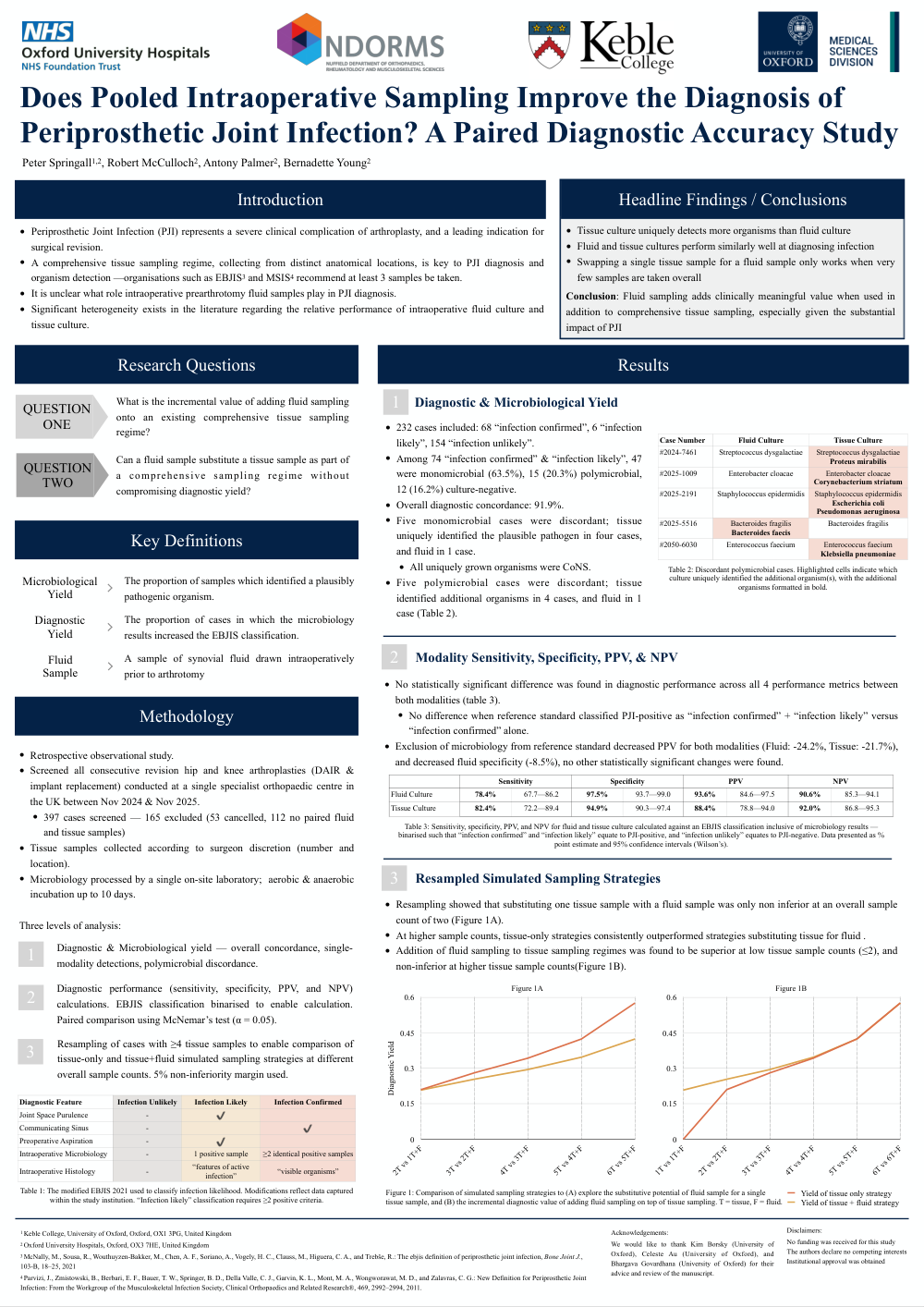
- Resampling showed that substituting one tissue sample with a fluid sample was only non inferior at an overall sample count of two (Figure 1A).
- At higher sample counts, tissue-only strategies consistently outperformed strategies substituting tissue for fluid .
- Addition of fluid sampling to tissue sampling regimes was found to be superior at low tissue sample counts (≤2), and non-inferior at higher tissue sample counts(Figure 1B).