477 posters, 14 topics, 2,065 authors, 1,055 institutions
ePostersLive by SciGen Technologies S.A. All rights reserved.
The Joint EBJIS-MSIS 2026 Conference
17 - 19 September, 2026 | Porto, Portugal

EP402
Outcome of Surgical Strategies for Prosthetic Joint Infection stratified by JS-BACH classification, a multi-national evaluation in 756 patients
Poster Presenter
Authors
Andrew Hotchen, Benjamin Schlossmacher, Ruben Thumbadoo, James Richards, Shawn Tan, Bhavi Patel, Sefa Canbilen, Igor Lazic, Antony Palmer, Martin McNally
Affiliations
University Of Oxford, Oxford University Hospitals, Oxford, United Kingdom; University of Oxford, Oxford, United Kingdom, Oxford University Hospitals, Oxford, United Kingdom, TUM University Hospital Munich, Munich, Germany, Frimley NHS Trust, Slough, United Kingdom, Royal Berkshire Hospital, Reading, United Kingdom, Buckinghamshire Healthcare, Aylesbury, United Kingdom, Milton Keynes University Hospitals, Milton Keynes, United Kingdom, Great Western Hospitals, Swindon, United Kingdom; University of Oxford, Oxford, United Kingdom
Part of Topic
Prosthetic Joint Infections
Aims
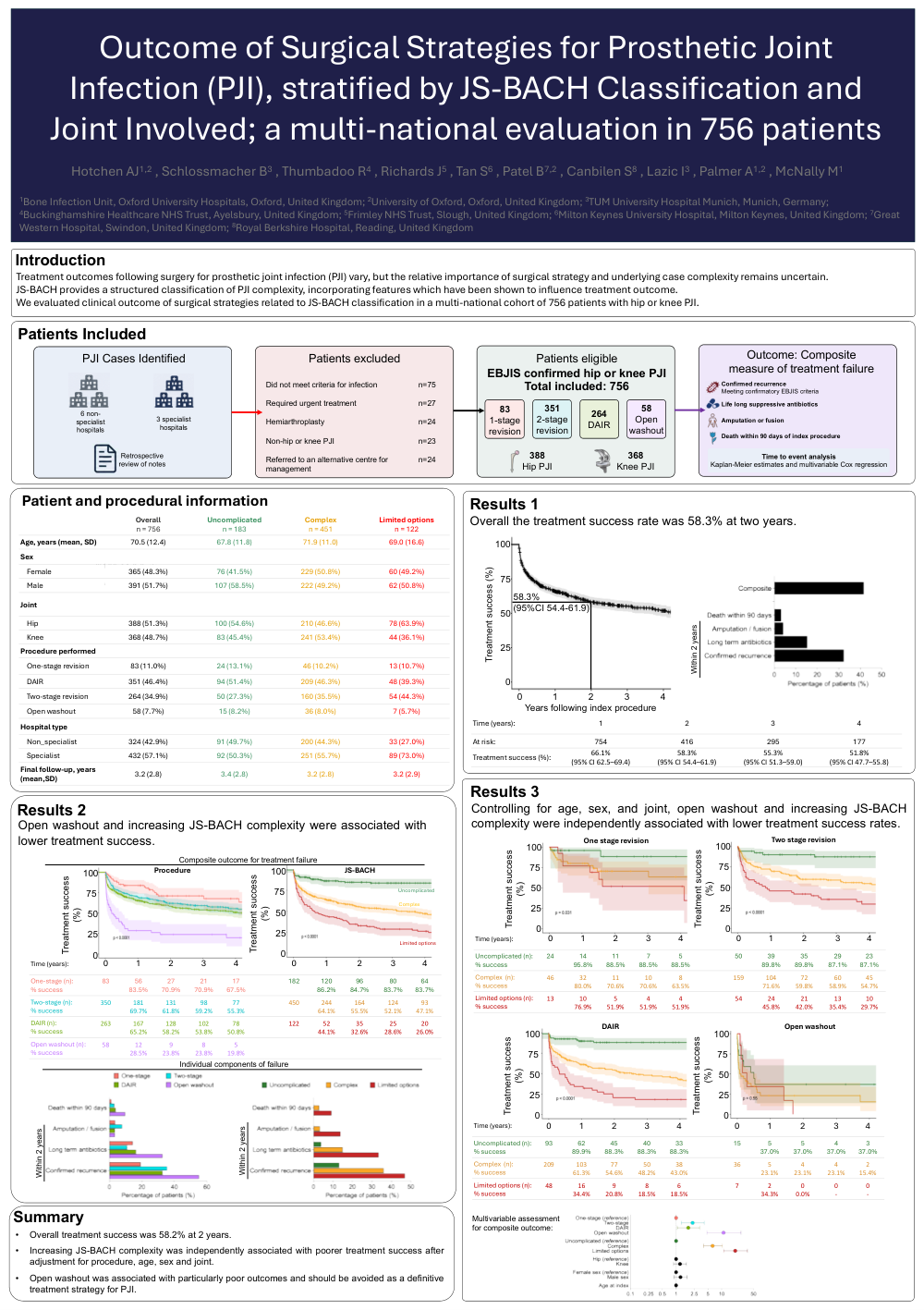
To evaluate how surgical strategy, and JS-BACH complexity are associated with treatment failure in hip and knee prosthetic joint infection (PJI).
Methods
A multi-national, retrospective cohort study of patients undergoing surgery for EBJIS-confirmed PJI was undertaken at 7 non-specialist hospitals and 3 specialist musculoskeletal infection hospitals. Cases were classified by joint involved, centre type, and JS-BACH complexity group (uncomplicated, complex, limited options). Index procedures were one-stage revision, debridement, antibiotics and implant retention (DAIR), open washout, or removal of prosthesis as the first stage of a two-stage strategy. Treatment failure was defined using a predefined composite outcome including recurrence at re-operation according to EBJIS criteria, long-term antibiotic suppression, death within 3 months of surgery, or amputation. In addition, failure to undergo reimplantation was also recorded. Multivariable logistic regression assessed the association between surgical procedure and treatment failure after adjustment for JS-BACH complexity and joint.
Results
756 cases were included, with 388 hip PJIs and 368 knee PJIs. Mean age was 70.5 years (SD 12.4), and mean follow-up 3.2 years (SD 1.5). Overall, 432 cases were managed at specialist centres and 324 at non-specialist hospitals. Treatment strategy differed significantly by centre type (p<0.001), with specialist hospitals favouring two-stage treatment (215/432, 49.8%) and non-specialist hospitals favouring DAIR (177/324, 54.6%). Across the whole cohort, there were 83 one-stage revisions, 351 DAIRs, 58 open washouts, and 264 removals of prosthesis, for 2-stage revision.
Failure was most frequent after open washout (44/58, 75.9%), followed by removal of prosthesis (133/264, 50.4%), DAIR (148/351, 42.2%), and one-stage revision (24/83, 28.9%). Failure increased markedly with JS-BACH complexity. After adjustment, compared with uncomplicated PJI, complex PJI was associated with a higher failure rate (OR 6.28,95% CI 3.93-10.03; p<0.001) and limited-option PJI (OR 19.52, 10.72-35.56; p<0.001). By comparison, procedure had a smaller effect; compared with one-stage revision, DAIR (OR 1.88, 1.07-3.29; p=0.029) and removal of prosthesis (OR 2.29, 1.28-4.09; p=0.005) were associated with more modest increases in failure, whereas open washout had consistently poor outcomes (OR 11.08, 4.71-26.04; p<0.001).
Conclusions
JS-BACH complexity was a stronger predictor of treatment failure than operative strategy in PJI. Open washout consistently performed poorly but, PJI complexity was more associated with outcome than procedure choice. Overall, one-stage revision gave the best results in all groups.