477 posters, 14 topics, 2,065 authors, 1,055 institutions
ePostersLive by SciGen Technologies S.A. All rights reserved.
The Joint EBJIS-MSIS 2026 Conference
17 - 19 September, 2026 | Porto, Portugal

EP401
One-stage Revision for Prosthetic Joint Infection (PJI) Demonstrates Better Medium-Term Outcome when Compared to Matched Patients having Two-stage Revision
Poster Presenter
Authors
Andrew Hotchen, Benjamin Schlossmacher, Ruben Thumbadoo, James Richards, Shwn Tan, Bhavi Patel, Sefa Canbilen, Igor Lazic, Antony Palmer, Martin McNally
Affiliations
University of Oxford, Oxford, United Kingdom, University Of Oxford, Oxford University Hospitals, Oxford, United Kingdom; University of Oxford, Oxford, United Kingdom, TUM University Hospital Munich, Munich, Germany, Buckinghamshire Healthcare NHS Trust, Ayelsbury, United Kingdom, Frimley NHS Trust, Slough, United Kingdom, Milton Keynes University Hospital, Milton Keynes, United Kingdom, Great Western Hospital, Swindon, United Kingdom; University of Oxford, Oxford, United Kingdom, Royal Berkshire Hospital, Reading, United Kingdom
Part of Topic
Prosthetic Joint Infections
Aims
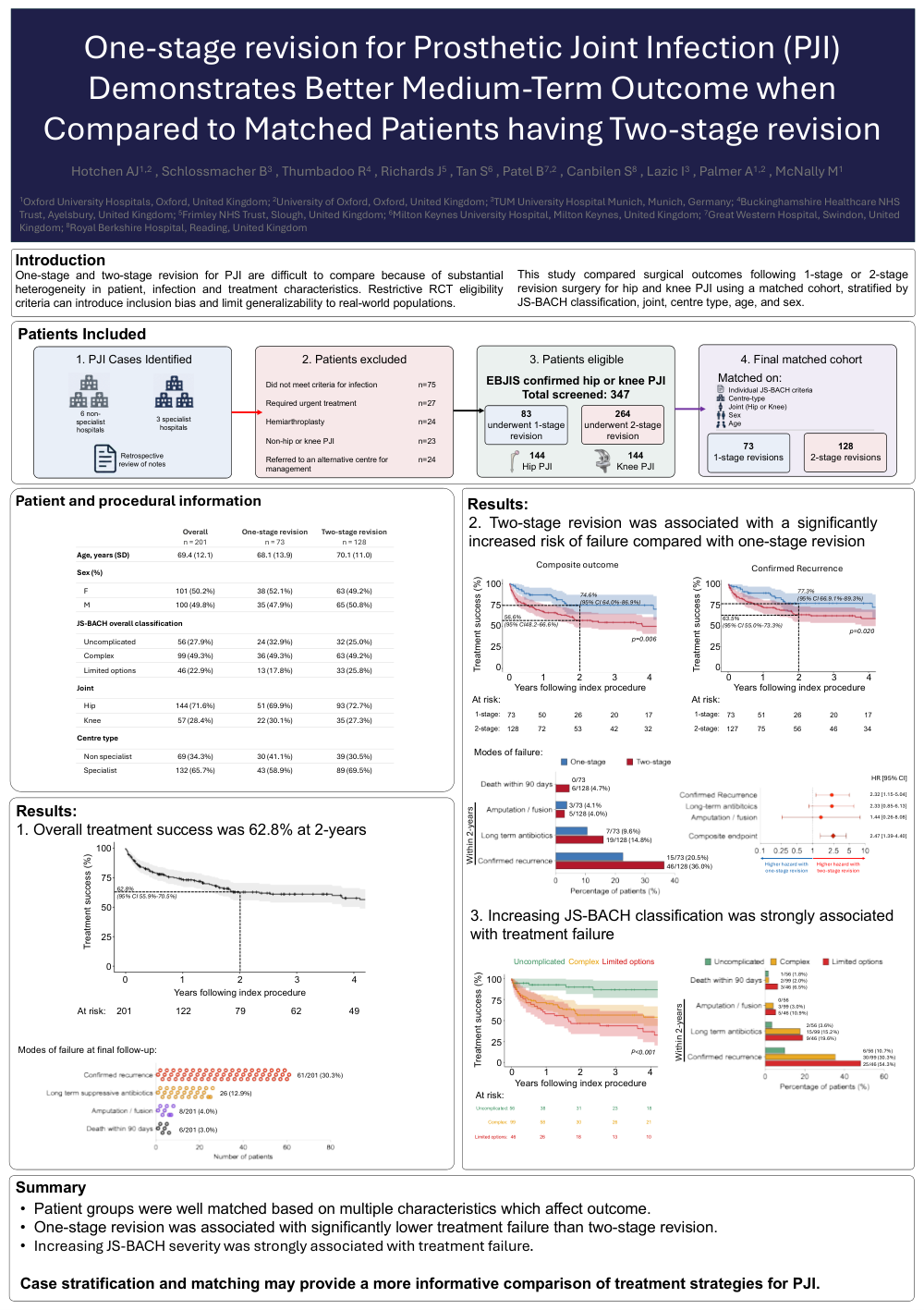
To compare outcome following one-stage revision (1SR) versus removal of prosthesis as part of a planned two-stage revision (2SR) for PJI, using a cohort matched on JS-BACH classification, joint involved, and centre-type.
Methods
A retrospective comparative study of patients undergoing surgery for EBJIS confirmed PJI in 7 non-specialist hospitals and 3 specialist-musculoskeletal infection hospitals. Cases were matched using the four individual components of the JS-BACH classification, the involved joint (hip or knee), and treatment centre-type. Treatment failure was defined as a composite outcome of confirmed recurrence at re-operation according to EBJIS criteria, long-term antibiotic suppression, death within 3 months surgery, and amputation. In addition, failure to undergo reimplantation after 2SR was recorded. Outcomes were compared using time-to-event analysis.
Results
83 patients underwent 1SR and 264 2SR, with 144 hip PJIs and 57 knees. 201 cases were matched (73 1SR and 128 r2SR) with very good covariate balance (mean absolute SMD = 0.0292, maximum absolute SMD = 0.0616). Mean follow-up was 3.4 years (SD 1.7). 69 cases were treated at non-specialist hospitals and 132 at specialist centres.
Treatment failure occurred in 74 patients (36.8%). 2SR was associated with a significantly increased risk of failure (44.5%) compared with 1SR (23.3%) (hazard ratio [HR] 2.43, 95% confidence interval 1.3–4.6;p=0.006). When including failure of reimplantation in the composite end-point, 2SR continued to be associated with treatment failure (HR 3.45,1.81-6.58;p<0.001). Examining individual components of the composite endpoint, confirmed recurrence was more common following 2SR than after 1SR (HR 2.13,1.2-4.0;p=0.020). In contrast, no significant difference was observed between groups for amputation or long-term antibiotic suppression.
There was no evidence of interaction between choice of treatment strategy and JS-BACH classification (p>0.4). However, increasing severity in the Joint-Specific component of JS-BACH was strongly associated with treatment failure (JS2: HR 13.6, 1.08–171.7; JS3: HR 34.8, 2.69–450.1).
Conclusions
Previous studies, including randomised trials, often fail to show any difference between one and two-stage revision for PJI, at least partly due to heterogenicity within groups. The validated JS-BACH classification correlates strongly with outcome after surgery for PJI (1). Stratification with JS-BACH, joint and centre-type allowed an enhanced comparison, minimising heterogenicity, and allowing close case-matching. This analysis showed that 1SR was associated with a substantially lower failure rate across specialist and non-specialist centres. These findings suggest that stratification may allow better evaluation of treatment strategies.
(1) Hotchen AJ, et al., eClinicalMedicine 2022; 42:101192