477 posters, 14 topics, 2,065 authors, 1,055 institutions
ePostersLive by SciGen Technologies S.A. All rights reserved.
The Joint EBJIS-MSIS 2026 Conference
17 - 19 September, 2026 | Porto, Portugal

EP399
Mycobacterium bovis Prosthetic Joint Infection Following Intravesical Therapy
Poster Presenter
Authors
Carolina Monteiro, Diogo Santos, Susana Neto, Francisco Cunha, Manuel Seara, Francisco Serdoura, Francisco Almeida
Affiliations
Servi?o de Doen?as Infeciosas, Hospital De S?o Jo?o, ULS de S?o Jo?o, Porto, Portugal; Faculdade de Medicina da Universidade do Porto, Porto, Portugal, Servi?o de Ortopedia, Hospital de S?o Jo?o, ULS de S?o Jo?o, Porto, Portugal, Servi?o de Ortopedia, Hospital de S?o Jo?o, ULS de S?o Jo?o, Porto, Portugal; Servi?o de Ortopedia, Centro Hospitalar do T?mega e Sousa, ULS do T?mega e Sousa, Penafiel, Portugal, Servi?o de Medicina Interna, Hospital de S?o Jo?o, ULS de S?o Jo?o, Portugal, Faculdade de Medicina da Universidade do Porto, Porto, Portugal; Servi?o de Ortopedia, Hospital de S?o Jo?o, ULS de S?o Jo?o, Porto, Portugal, Faculdade de Medicina da Universidade do Porto, Porto, Portugal; Unidade de Preven??o e Controlo de Infe??o e Resist?ncia aos Antimicrobianos, Hospital de S?o Jo?o, ULS de S?o Jo?o, Portugal; Laborat?rio Para a Investig, Hospital De S?o Jo?o
Part of Topic
Prosthetic Joint Infections
Mycobacterium bovis Prosthetic Joint Infection Following Intravesical Therapy
Introduction
Mycobacterium bovis is a recognized cause of infection after intravesical therapy for bladder cancer. We report a case of late periprosthetic hip infection following intravesical bacillus Calmette-Guérin (BCG) instillation.
Materials and Methods
Retrospective review of medical records, including clinical, laboratory, microbiological, and imaging data.
Results/Discussion
An 89-year-old male with a total right hip arthroplasty performed 12 years earlier due to osteoarthrosis and urothelial carcinoma treated with transurethral resection and intravesical BCG instillations for 3 years (last instillation approximately 6 months prior to presentation), was admitted with a 2-month history of right hip pain, inflammatory signs, and subcutaneous swelling. The patient presented fever, but borderline elevated C-reactive protein (39mg/L) and leukocyte count (10.32x10^9/uL, with 24% monocytes).
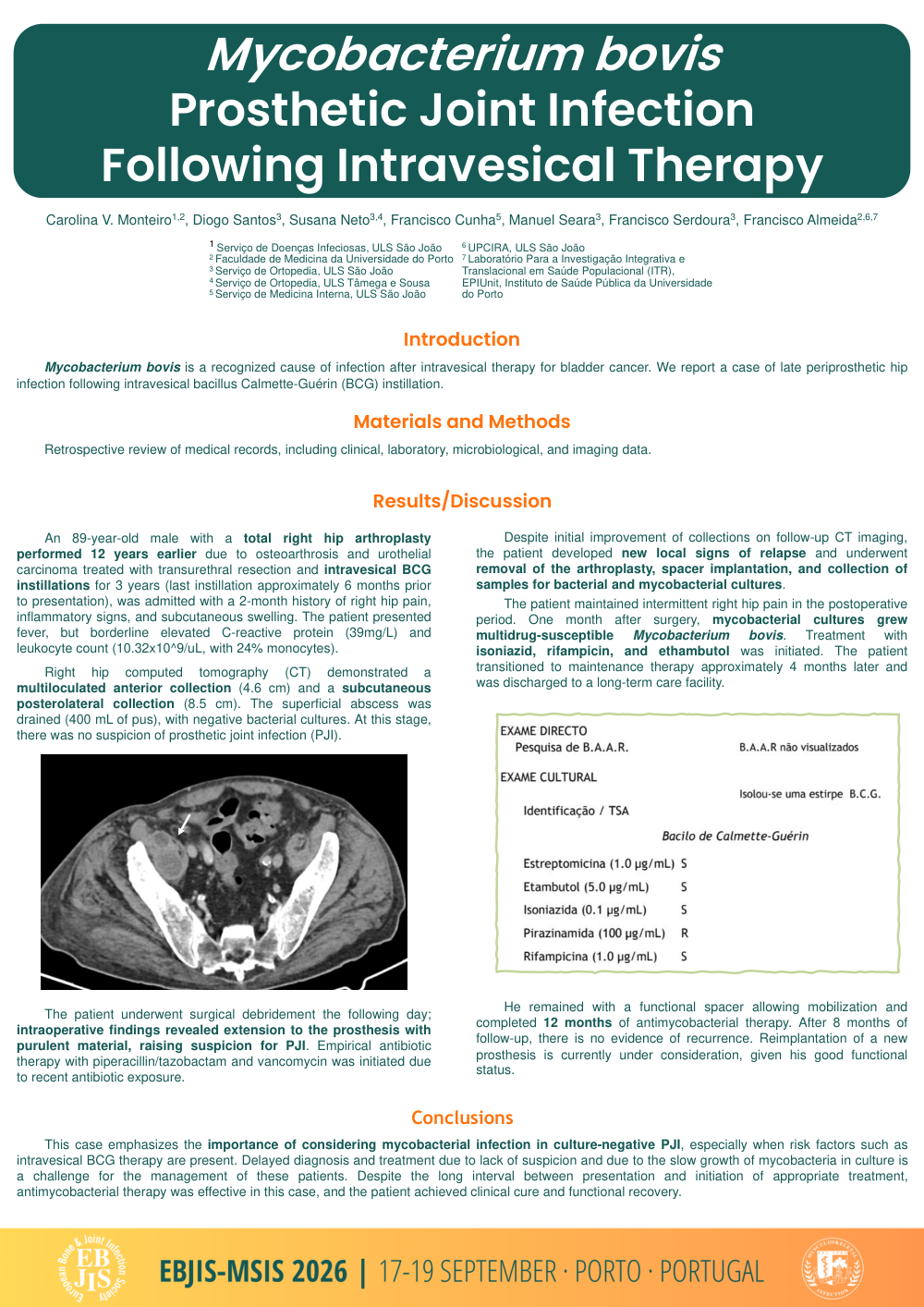
Right hip computed tomography (CT) demonstrated a multiloculated anterior collection (4.6 cm) and a subcutaneous posterolateral collection (8.5 cm). The superficial abscess was drained (400 mL of pus), with negative bacterial cultures. At this stage, there was no suspicion of prosthetic joint infection (PJI).
The patient underwent surgical debridement the following day; intraoperative findings revealed extension to the prosthesis with purulent material, raising suspicion for PJI. Empirical antibiotic therapy with piperacillin/tazobactam and vancomycin was initiated due to recent antibiotic exposure.
Despite initial improvement of collections on follow-up CT imaging, the patient developed new local signs of relapse and underwent removal of the arthroplasty, spacer implantation, and collection of samples for bacterial and mycobacterial cultures.
The patient maintained intermittent right hip pain in the postoperative period. One month after surgery, mycobacterial cultures grew multidrug-susceptible Mycobacterium bovis. Treatment with isoniazid, rifampicin, and ethambutol was initiated. The patient transitioned to maintenance therapy approximately 4 months later and was discharged to a long-term care facility.
He remained with a functional spacer allowing mobilization and completed 12 months of antimycobacterial therapy. After 8 months of follow-up, there is no evidence of recurrence. Reimplantation of a new prosthesis is currently under consideration, given his good functional status.
Conclusions
This case emphasizes the importance of considering mycobacterial infection in culture-negative PJI, especially when risk factors such as intravesical BCG therapy are present. Delayed diagnosis and treatment due to lack of suspicion and due to the slow growth of mycobacteria in culture is a challenge for the management of these patients. Despite the long interval between presentation and initiation of appropriate treatment, antimycobacterial therapy was effective in this case, and the patient achieved clinical cure and functional recovery.