477 posters, 14 topics, 2,065 authors, 1,055 institutions
ePostersLive by SciGen Technologies S.A. All rights reserved.
The Joint EBJIS-MSIS 2026 Conference
17 - 19 September, 2026 | Porto, Portugal

EP396
Unresolved Issues in Candida Prosthetic Joint Infection
Poster Presenter
Part of Topic
Prosthetic Joint Infections
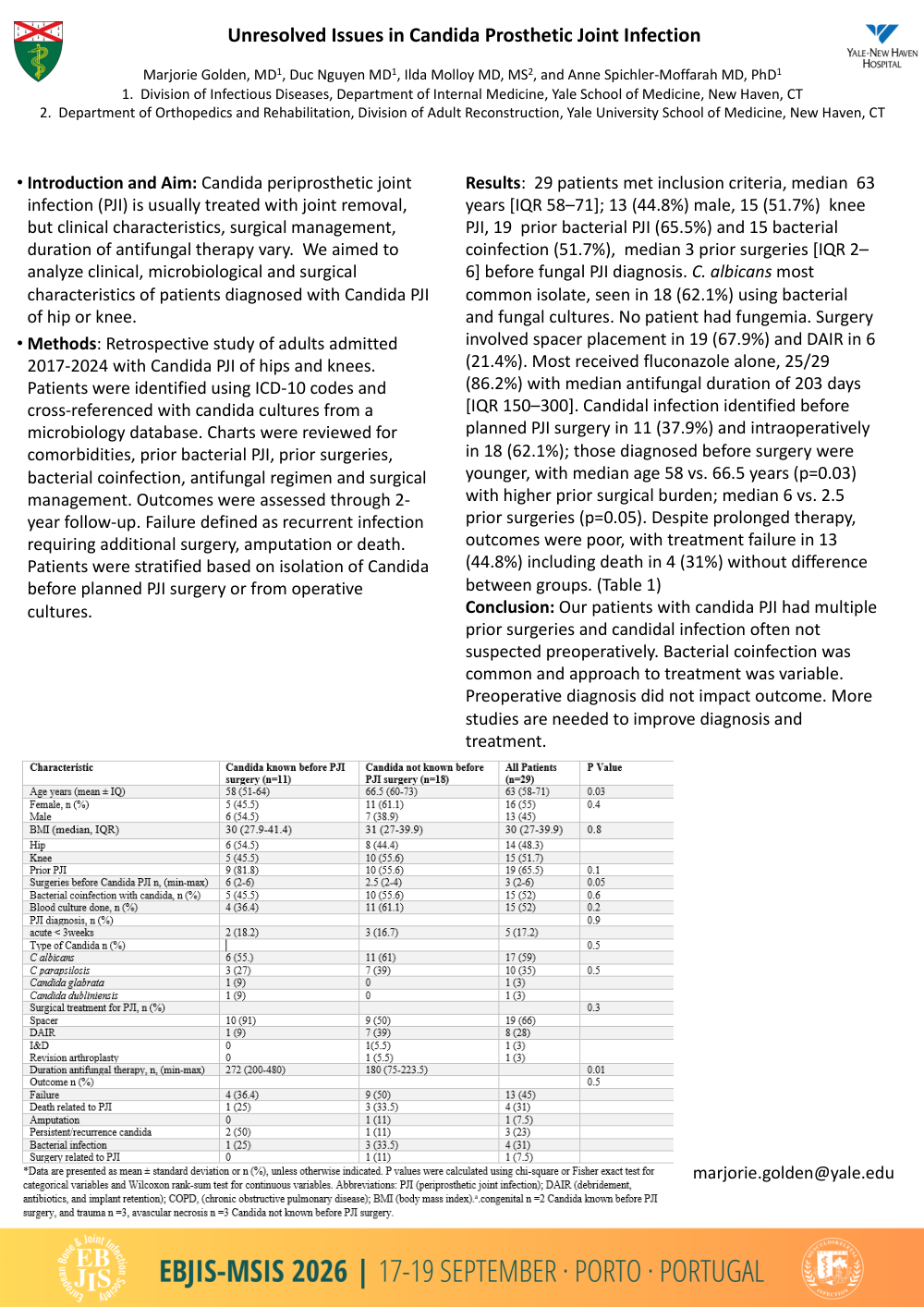
Results: 29 patients met inclusion criteria, median 63 years [IQR 58–71]; 13 (44.8%) male, 15 (51.7%) knee PJI, 19 prior bacterial PJI (65.5%) and 15 bacterial coinfection (51.7%), median 3 prior surgeries [IQR 2–6] before fungal PJI diagnosis. C. albicans most common isolate, seen in 18 (62.1%) using bacterial and fungal cultures. No patient had fungemia. Surgery involved spacer placement in 19 (67.9%) and DAIR in 6 (21.4%). Most received fluconazole alone, 25/29 (86.2%) with median antifungal duration of 203 days [IQR 150–300]. Candidal infection identified before planned PJI surgery in 11 (37.9%) and intraoperatively in 18 (62.1%); those diagnosed before surgery were younger, with median age 58 vs. 66.5 years (p=0.03) with higher prior surgical burden; median 6 vs. 2.5 prior surgeries (p=0.05). Despite prolonged therapy, outcomes were poor, with treatment failure in 13 (44.8%) including death in 4 (31%) without difference between groups. (Table 1)
Conclusion: Our patients with candida PJI had multiple prior surgeries and candidal infection often not suspected preoperatively. Bacterial coinfection was common and approach to treatment was variable. Preoperative diagnosis did not impact outcome. More studies are needed to improve diagnosis and treatment.