477 posters, 14 topics, 2,065 authors, 1,055 institutions
ePostersLive by SciGen Technologies S.A. All rights reserved.
The Joint EBJIS-MSIS 2026 Conference
17 - 19 September, 2026 | Porto, Portugal

EP384
A Machine Learning Approach to Preoperative Diagnosis of Culture-Positive Periprosthetic Joint Infection: External Validation and Comparison with EBJIS Criteria
Poster Presenter
Authors
Martin Wessling, Yannik Hanusrichter, Carsten Gebert, Ruediger von Eisenhart-Rothe, Falitsa Mandraka, Florian Hinterwimmer, Ralf Strobl, Lennart Weber, Sascha Gravius, Igor Lazic
Affiliations
Orthopedic Hospital Volmarstein, Wetter, Germany, Department of Orthopaedics and Sports Orthopaedics, Klinikum rechts der Isar, Technical University of Munich, School of Medicine, Munich, Germany, Department of Clinical Infectious Diseases, Wisplinghoff Laboratory, Cologne, Germany, Lab for AI, Technical University Munich, Munich, Germany, IBE - Institute for Medical Information Processing, Biometry and Epidemiology, Ludwig-Maximilians-Universit?t M?nchen, Munich, Germany, University Medical Centre Mannheim, Mannheim, Germany, Orthopedic Hospital Volmarstein
Part of Topic
Prosthetic Joint Infections
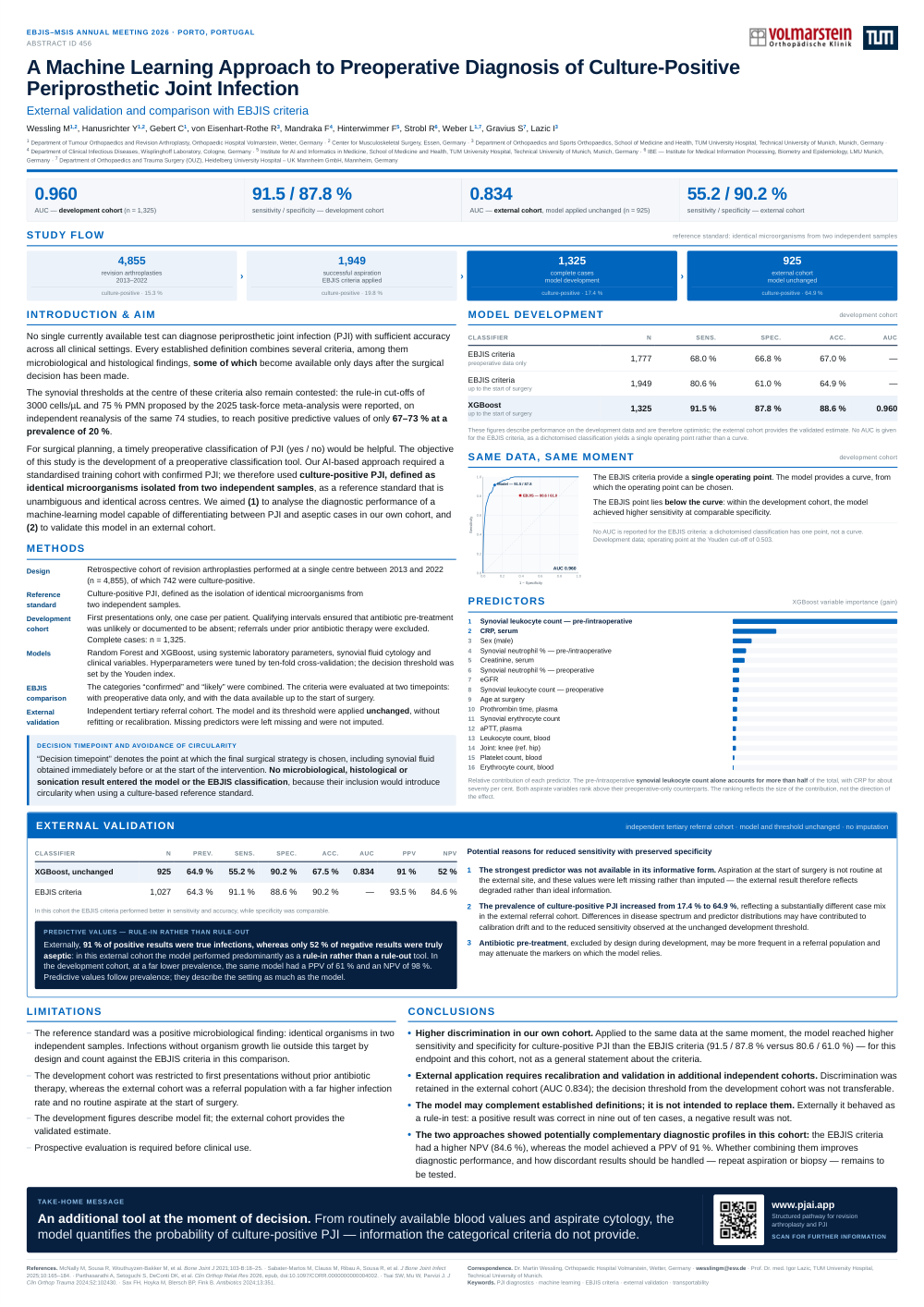
Machine-learning models were developed to identify culture-positive periprosthetic joint infection (PJI) before revision surgery and were compared with the EBJIS criteria applied to the same data at the same moment. In a single-centre cohort of 4,855 revision arthroplasties (1,325 complete cases), XGBoost reached 91.5 % sensitivity, 87.8 % specificity and an AUC of 0.960, compared with 80.6 % sensitivity and 61.0 % specificity for the EBJIS criteria. Applied unchanged to an independent external cohort (n = 925), the model reached 55.2 % sensitivity, 90.2 % specificity and an AUC of 0.834: discrimination was retained, but the decision threshold was not transferable. Externally the model acted as a rule-in test (PPV 91 %, NPV 52 %). It is intended as an addition to the established definitions, not a replacement.
Keywords: periprosthetic joint infection, PJI, machine learning, XGBoost, EBJIS criteria, external validation, synovial fluid leukocyte count, joint aspiration, revision arthroplasty, diagnostic accuracy.