477 posters, 14 topics, 2,065 authors, 1,055 institutions
ePostersLive by SciGen Technologies S.A. All rights reserved.
The Joint EBJIS-MSIS 2026 Conference
17 - 19 September, 2026 | Porto, Portugal

EP367
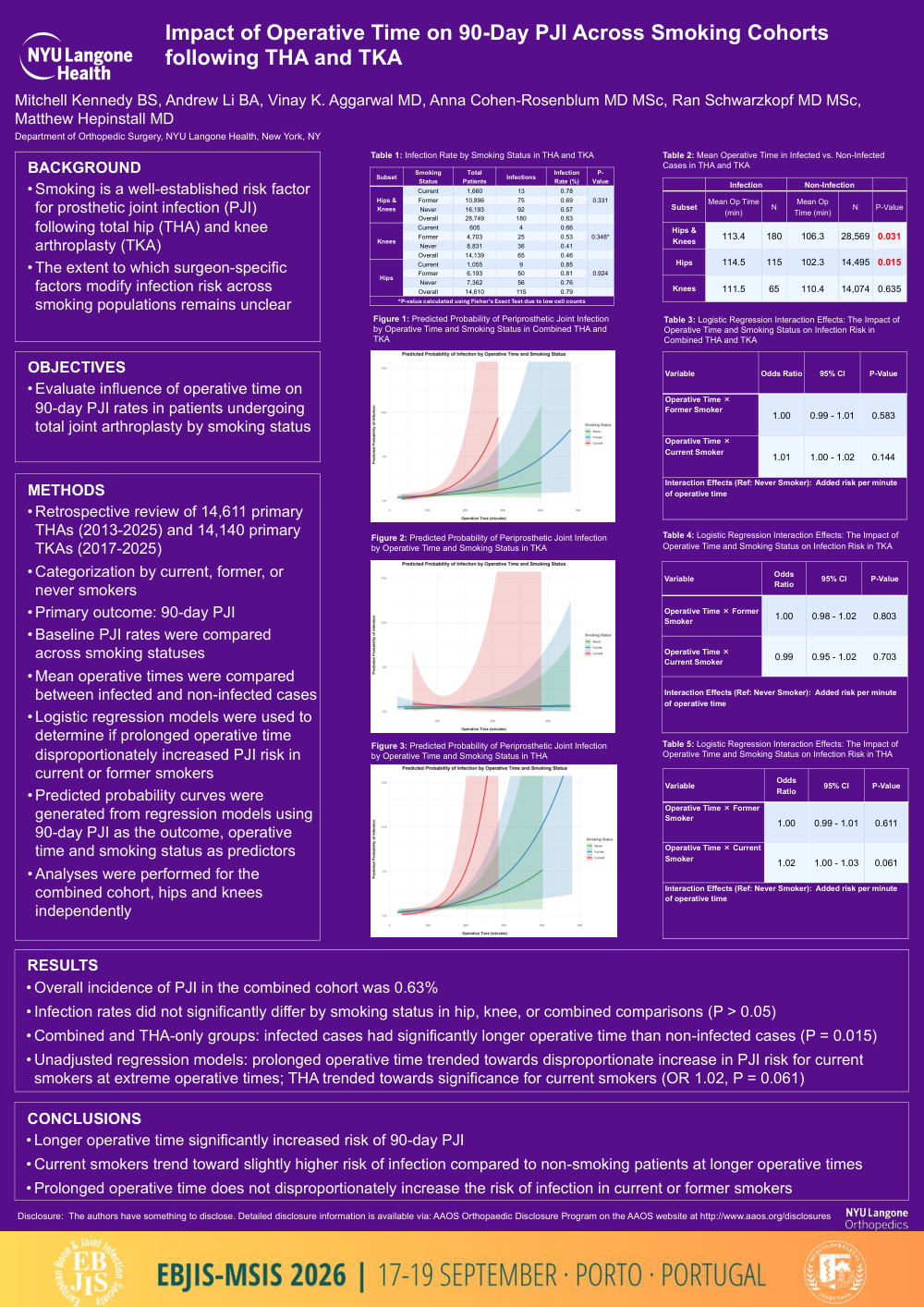
Impact of Operative Time on 90-Day PJI Across Smoking Cohorts following Total Hip and Knee Arthroplasty
Poster Presenter
Part of Topic
Prosthetic Joint Infections
TITLE: Impact of Operative Time on 90-Day PJI Across Smoking Cohorts following THA and TKA
AUTHORS:
Mitchell Kennedy BS, Andrew Li BA, Vinay K. Aggarwal MD, Anna Cohen-Rosenblum MD MSc, Ran Schwarzkopf MD MSc, Matthew Hepinstall MD
Department of Orthopedic Surgery, NYU Langone Health, New York, NY
BACKGROUND
Smoking is a well-established risk factor for prosthetic joint infection (PJI) following total hip (THA) and knee arthroplasty (TKA)
The extent to which surgeon-specific factors modify infection risk across smoking populations remains unclear
OBJECTIVES
Evaluate influence of operative time on 90-day PJI rates in patients undergoing total joint arthroplasty by smoking status
METHODS
Retrospective review of 14,611 primary THAs (2013-2025) and 14,140 primary TKAs (2017-2025)
Categorization by current, former, or never smokers
Primary outcome: 90-day PJI
Baseline PJI rates were compared across smoking statuses
Mean operative times were compared between infected and non-infected cases
Logistic regression models were used to determine if prolonged operative time disproportionately increased PJI risk in current or former smokers
Predicted probability curves were generated from regression models using 90-day PJI as the outcome, operative time and smoking status as predictors
Analyses were performed for the combined cohort, hips and knees independently
RESULTS
Overall incidence of PJI in the combined cohort was 0.63%
Infection rates did not significantly differ by smoking status in hip, knee, or combined comparisons (P > 0.05)
Combined and THA-only groups: infected cases had significantly longer operative time than non-infected cases (P = 0.015)
Unadjusted regression models: prolonged operative time trended towards disproportionate increase in PJI risk for current smokers at extreme operative times; THA trended towards significance for current smokers (OR 1.02, P = 0.061)
CONCLUSIONS
Longer operative time significantly increased risk of 90-day PJI
Current smokers trend toward slightly higher risk of infection compared to non-smoking patients at longer operative times
Prolonged operative time does not disproportionately increase the risk of infection in current or former smokers