477 posters, 14 topics, 2,065 authors, 1,055 institutions
ePostersLive by SciGen Technologies S.A. All rights reserved.
The Joint EBJIS-MSIS 2026 Conference
17 - 19 September, 2026 | Porto, Portugal

EP365
The Challenge of Knee Periprosthetic Joint Infection: A Two-Year Single-Center Experience
Poster Presenter
Part of Topic
Prosthetic Joint Infections
The Challenge of Knee Periprosthetic Joint Infection: A Two-Year Single-Center Experience
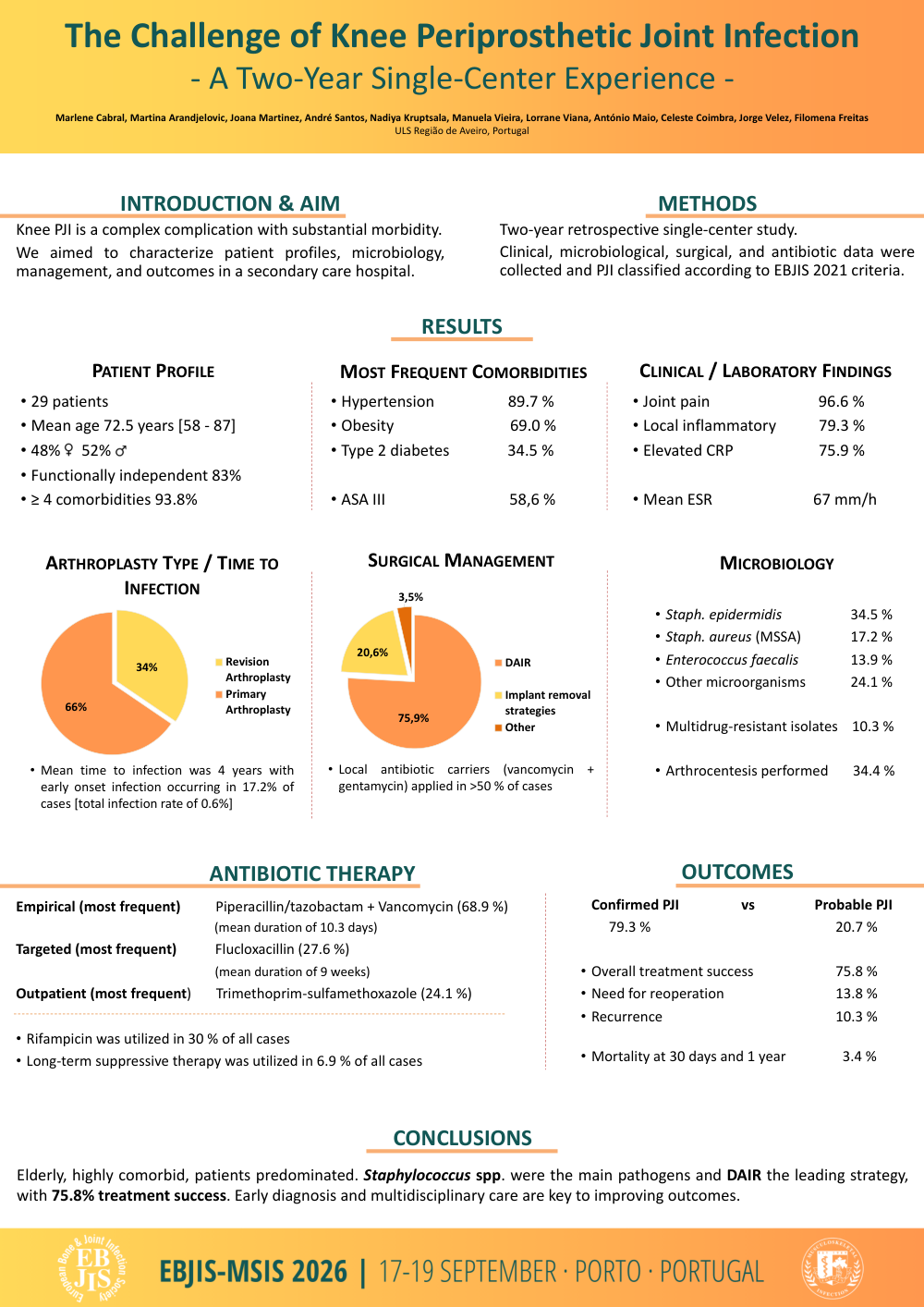
Introduction & Aim: Periprosthetic joint infection (PJI) of the knee remains a challenging complication with complex management and high morbidity. In this study we aimed to characterize patient profile, microbiology, management, and outcomes of knee PJI in a secondary care hospital.
Methods: A retrospective observational study was conducted over a two-year period, and data on demographics, comorbidities, functional status, anesthetic risk (ASA classification), clinical and laboratory findings, microbiological results, surgical strategies, and antibiotic usage was collected. Infections were classified according to the EBJIS 2021 criteria.
Results: The cohort comprised 29 patients with a mean age of 72.5 years (range 58–87), and balanced sex distribution. Most patients were functionally independent (83%), despite multiple comorbidities. About 93.8% presented ≥4 comorbidities, particularly hypertension (89.7%), obesity (69%), and type 2 diabetes (34.5%). The majority were classified as ASA III (58.6%).
Infections followed primary arthroplasty in 65.5% and revision in 34.5%, with a mean time to infection of 4 years. Early onset infections (<3 months) accounting for 17.2% (infection rate 0.6%). Clinically, joint pain (96.6%) and local inflammatory signs (79.3%) predominated. Elevated C-reactive protein occurred in 75.9%, and the mean erythrocyte sedimentation rate was 67 mm/h. Arthrocentesis, performed in 34.4%, frequently showed inflammatory synovial profile.
Surgical management consisted primarily of debridement, antibiotics, and implant retention (DAIR) (75.9%), while implant removal strategies were used in 20.6%. Local antibiotic carriers were applied in over half of cases. Microbiologically, intraoperative samples yielded an average of 1.3 microorganisms per patient, most commonly Staphylococcus epidermidis (34.5%), followed by methicillin-sensitive Staphylococcus aureus (17.2%) and Enterococcus faecalis (13.9%); 10.3% of all isolates were multidrug-resistant.
Empirical antibiotic therapy most frequently included piperacillin/tazobactam plus vancomycin, followed by targeted regimens, commonly flucloxacillin. Outpatient therapy often consisted in sulfamethoxazole-trimethoprim and rifampicin, with a mean duration of 9 weeks. Suppressive therapy was utilized in 6.9%.
According to EBJIS criteria, 79.3% of infections were confirmed and 20.7% were probable. Overall treatment success was achieved in 75.8%, with recurrence in 10.3% and need for reoperation in 13.8%. Mortality was 3.4% at both 30 days and one year.
Conclusions: Knee PJI in this Portuguese cohort predominantly affected elderly patients with a high burden of comorbidities. Staphylococcus species were the leading pathogens, and DAIR was the most frequent strategy utilized - with reasonable success rates. These findings highlight the complexity of PJI and reinforce the need for early diagnosis, individualized management, and coordinated multidisciplinary care to improve outcomes.